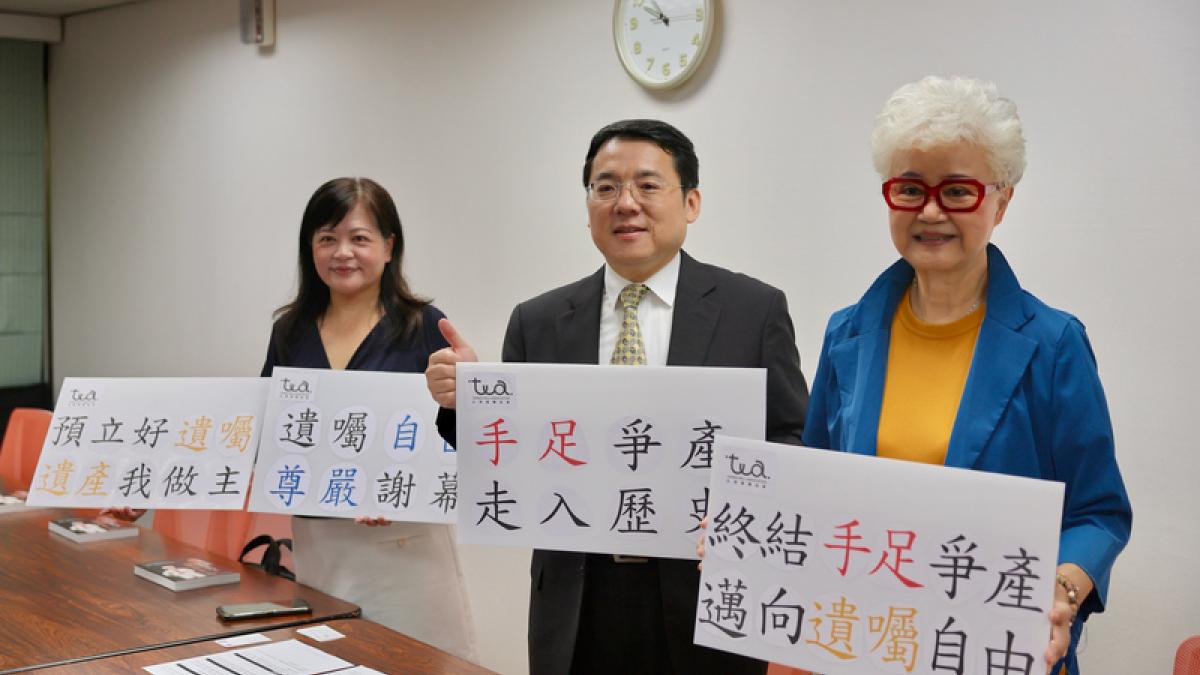
On July 28, Taiwan's Legislative Yuan passed the third reading of amendments to Article 1223 of the Civil Code, deleting the reserved share (forced heirship) for siblings. The new system will take effect six months after promulgation by the President, allowing individuals to use wills to decide whether to leave property to siblings, without being legally required to reserve part of the estate for them.
However, this amendment only removes the 'reserved share'—it does not eliminate siblings' statutory inheritance rights. In other words, if the deceased leaves no valid will, siblings can still inherit legally when there are no higher-priority heirs such as children or parents. Only when a valid will designates assets to a spouse, cohabiting partner, friend, or public welfare organization can siblings no longer claim the legally protected minimum portion. The Ministry of Justice emphasized that siblings' 'statutory inheritance share' remains intact; this amendment merely relaxes restrictions on testamentary freedom.
What is a reserved share? Even if a will states 'not a single cent to siblings,' it may still be invalid.
The 'statutory inheritance share' refers to the legal distribution ratio when there is no will. The 'reserved share' is the legally mandated minimum portion that certain heirs are entitled to, even if a will exists.
Take an unmarried person with no children or surviving parents who leaves behind an estate worth NT$12 million. Under the pre-amendment system, even if the will explicitly states that the entire amount is donated to a public welfare organization, siblings could jointly claim a reserved share equal to one-third of their statutory share—NT$4 million.
After the new law takes effect, as long as the will is valid, the full NT$12 million can be donated, and siblings can no longer demand repayment on grounds of reserved share infringement.
If the deceased has a spouse but no children or parents, under current Taiwanese law, the spouse receives half, and siblings jointly receive the other half. For a NT$12 million estate, siblings' statutory share is NT$6 million, and their reserved share under the old system was one-third of that—NT$2 million. Under the new system, the deceased can use a will to leave the entire estate to the spouse, and siblings can no longer claim this NT$2 million by force.
However, if there is no will, the distribution remains unchanged: the spouse still receives half, and siblings jointly receive the other half.
Japan amended its law in 1980, officially eliminating siblings' legacy portion starting in 1981.
Japan completed a similar reform as early as 1980.
The Japanese Diet passed the Partial Amendment to the Civil Code and the Family Court Act on May 17, 1980, which took effect on January 1, 1981. After the amendment, the Japanese Civil Code explicitly stated that only 'heirs other than siblings' are entitled to a legacy portion, effectively excluding siblings from minimum inheritance protection.
Japan also abolished only the 'legacy portion' for siblings, not their inheritance rights. If the deceased has no children or parents and leaves no will, siblings remain statutory heirs.
The biggest difference between Taiwan and Japan lies in the distribution ratio when the spouse and siblings inherit together. In Taiwan, the spouse receives half and siblings jointly receive half. In Japan, the system clearly favors the spouse: the spouse receives three-quarters, and siblings jointly receive one-quarter.
Suppose a married person in Japan with no children or surviving parents leaves an estate equivalent to NT$12 million and has no will. The spouse would receive NT$9 million, and siblings jointly receive NT$3 million.
But if the deceased leaves a valid will specifying that the entire NT$12 million goes to the spouse, siblings—having no legacy portion—cannot claim the NT$3 million back. Japan's Ministry of Justice's will education materials clearly state that siblings do not have a legacy portion, so as long as a will exists, siblings cannot file a claim for legacy portion infringement.
Why did Japan abolish it? Property is typically accumulated by the couple, not created by siblings.
Japan's 1980 amendment did not solely target siblings but comprehensively reformed the postwar inheritance system, including increasing the spouse's statutory inheritance ratio, limiting the scope of siblings' substitute inheritance, and establishing the 'contribution share' system, allowing heirs who made special contributions to the estate or care of the deceased to receive a larger portion.
The core background of the Diet's deliberations at the time was the shift in family structure from traditional extended families to nuclear families centered on spouses and children.
Testimonies during Diet hearings pointed out that in urban societies, adult siblings increasingly live separately from the deceased and rarely contribute to property formation or maintenance. Especially when the main asset is a house jointly purchased by the couple, legal claims by siblings often conflict with the surviving spouse still living in the home.
The primary purpose of the legacy portion system is to protect spouses, children, or direct ancestors who have close living and economic ties with the deceased, preventing them from losing basic livelihood if the deceased leaves all assets to others via a will. Japan's Ministry of Justice currently defines the legacy portion as the minimum share to protect the livelihood of heirs other than siblings.
In contrast, siblings are typically adults with their own families and financial independence, may not have contributed to the estate, and are not necessarily dependent on the deceased for support—thus, they are considered not to require the same level of mandatory protection as spouses and children.
However, Japan did not go as far as abolishing siblings' statutory inheritance rights. The Diet discussion acknowledged that ancestral property, family common assets, and mutual support among siblings still exist in rural areas, so a compromise was reached: retain statutory inheritance rights for siblings, reduce their share from one-third to one-quarter when inheriting jointly with a spouse, limit substitute inheritance to nieces and nephews (not extending infinitely), and abolish siblings' legacy portion.
Taiwan is 45 years behind, but for nearly identical reasons.
The rationale behind Taiwan's amendment closely mirrors Japan's situation 45 years ago.
The Ministry of Justice stated that modern family lifestyles have changed, and adult sibling relationships are no longer as close as before. Continuing to impose mandatory reserved shares limits the deceased's property arrangements and fails to meet the needs of singles, childless couples, and diverse family structures. Therefore, testamentary freedom should be moderately expanded.
The impact is especially significant for singles and childless couples. In the past, even if a cohabiting partner, friend, or non-blood relative provided long-term care, siblings could still claim a reserved share, preventing full distribution according to the deceased's wishes.
After the new law takes effect, Taiwan's system will closely resemble Japan's: siblings remain statutory heirs but lose the right to claim a minimum guaranteed share against a will. Without a will, siblings can still inherit; with a valid will, the deceased's wishes take precedence.
However,配套 measures originally planned by the Ministry of Justice—including expanding 'discretionary bequests' and introducing a 'special contribution by heirs' system—are still under review by the Executive Yuan and have not been legislated alongside the removal of the reserved share. This is one reason why the new system will only take effect six months after promulgation.
What this amendment truly changes is not whether 'siblings are still family,' but whether the law should allow distant siblings—who have had no contact, provided no care, and contributed nothing to asset accumulation—to overturn a will solely based on blood ties.
Japan chose in 1981 to reserve minimum livelihood protection for spouses and direct relatives; 45 years later, Taiwan has officially moved in the same direction.
*Author holds Japan's National Real Estate Transaction License. Originally published with permission from Tokyo Jutaku.
FACT BOX
- Source: PR Times
- Category: News