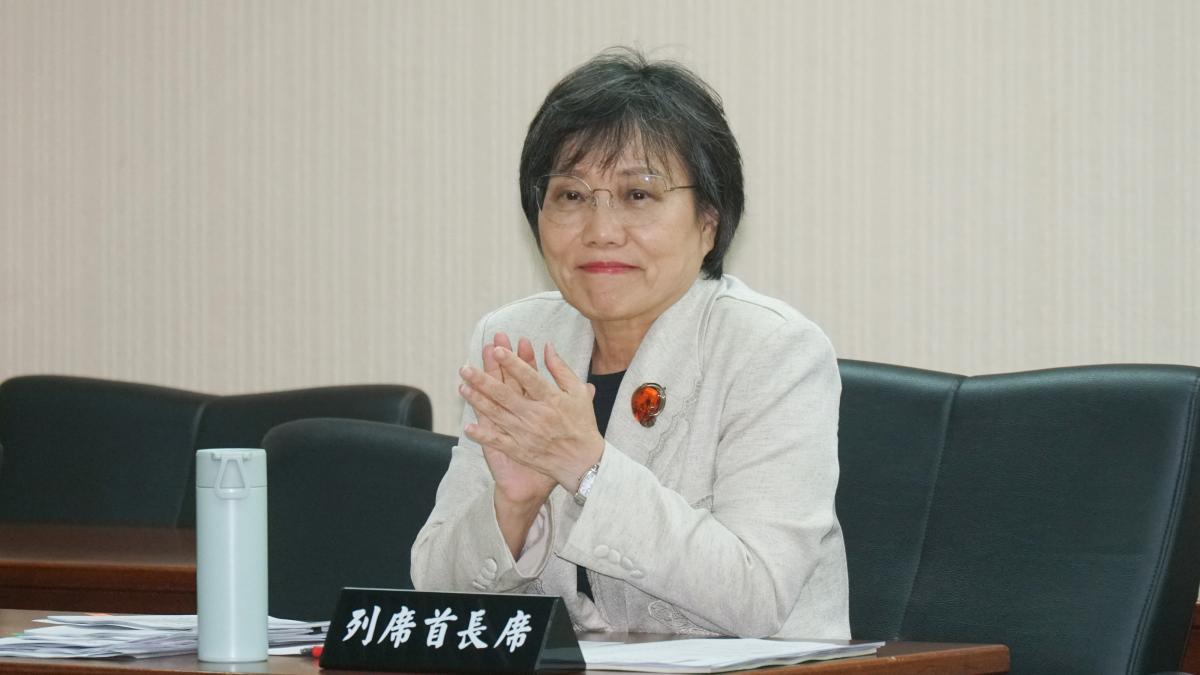
Wei Shun-Yu, who previously created the 'Lai Er Principal' series, recently released a political satire short film titled 'You Can't Have It,' promoting a protest against oil prices on July 25. However, the film is suspected of using AI to generate President Tsai Ing-wen's voice, leading the Criminal Bureau to investigate. KMT legislator Ling Tao questioned whether Interior Minister Liu Si-Fang had instructed the Criminal Bureau to investigate. Liu Si-Fang responded that the Criminal Bureau has reported the case to the Taipei District Prosecutors Office under Articles 230 and 231 of the Code of Criminal Procedure, and that the Interior Ministry fully supports law enforcement agencies in investigating any illegal activities by any political party or individual. The Legislative Yuan's Interior Committee invited the Interior Minister and the Director-General of the National Police Agency to give a special report on 'The Police Raid on the Editor of Lai Er Principal: Reviewing Police Enforcement Standards and Administrative Neutrality' and to answer questions. Before the meeting, Liu Si-Fang stated that Taiwan is a democratic and law-abiding country that guarantees freedom of speech, but forging someone else's voice is unacceptable. Regarding the case, the Criminal Bureau has reported it to the Taipei District Prosecutors Office under Articles 230 and 231 of the Code of Criminal Procedure. As for the investigation process, the principle of non-disclosure of investigations by police and prosecutorial agencies will be respected. The opposition parties also questioned why the case was only reported and no one filed a lawsuit. Liu Si-Fang responded that the Interior Ministry fully supports law enforcement agencies in investigating any illegal activities by any political party or individual. The Interior Ministry stated that the police conducted preliminary investigations based on the report and did not forcibly require the video to be taken down. The Interior Ministry pointed out that generative AI and deepfake technology have become new types of public security issues. When deepfake technology is used for illegal purposes, it can impersonate others, spread false information, and even affect public order or social judgment. Therefore, police agencies still have the legal responsibility to investigate. Therefore, the investigation process also takes into account the two important values of maintaining freedom of speech and clarifying criminal facts in accordance with the law. The Interior Ministry has always adhered to the principles of law-based administration and administrative neutrality. The Interior Ministry explained that the case was initiated by the police after receiving a report on July 25, 2016. After initially reviewing the content of the relevant videos, the police suspected that the president's voice was deeply forged and first reported it to the social platform according to the existing mechanism. The platform reviewed it according to its community rules, and at the same time, it was handed over to the local police agency to help clarify whether the account was impersonated and confirm the source of the video. When the local police went to the scene, the party concerned was not present, and only left contact information for the party concerned, asking the party concerned to contact the police at their convenience, and did not enter the house for a search, did not restrict personal freedom, and did not forcibly require the party concerned to appear. Later, the party concerned actively contacted the police by phone. After the police confirmed that the account and video were made by the party concerned and his team, the preliminary identity confirmation was completed, so the police did not require the party concerned to appear immediately to make a statement. Throughout the process, the police did not take coercive measures, did not forcibly require the video to be taken down, and did not restrict the party concerned from expressing their opinions. The Interior Ministry stated that the police conducted investigations based on the reported content in accordance with the law. According to Articles 230 and 231 of the Code of Criminal Procedure, when judicial police know of a criminal suspect, they have the legal duty to investigate and preserve evidence. Therefore, the police conducted preliminary investigations on the involved accounts and video sources, which have legal basis. On the other hand, if AI technology is used to highly simulate other people's voices or images, depending on the specific case, it may involve violations of Article 210 and Article 216 of the Criminal Code (forgery of private documents), Article 309 and Article 309 of the Criminal Code (defamation), and Article 19 of the Personal Data Protection Act (collection or processing of personal data by non-governmental agencies). Whether a crime is established still needs to be determined by the judicial authorities in accordance with the law. In addition, the police notified the social platform based on the platform's community rules reporting mechanism. Whether to remove the relevant content is still up to the platform to judge according to its own regulations, and the police do not have the power to forcibly remove it. The Interior Ministry also mentioned that the case was analyzed by the Criminal Investigation Bureau of the National Police Agency using deepfake detection tools. The detection results showed that the voiceover in the video had abnormal speech speed, tone, breathing rhythm, and voice characteristics, which were suspected of being AI-generated characteristics. Therefore, it is necessary to further confirm the source of the video and whether it involves illegal activities. The subsequent work still needs to be reviewed by the judicial authorities in accordance with the law. The Interior Ministry will continue to require police agencies to implement the following improvement measures. First, strictly adhere to administrative neutrality, and any case is judged based on criminal facts and legal regulations, and will not have different standards due to the political stance, party attributes, or speech content of the parties concerned. Secondly, strengthen procedural justice. The Interior Ministry will continue to supervise the police's investigation actions in accordance with the Code of Criminal Procedure and other relevant laws and regulations to implement due process. At the same time, strengthen the legal education of front-line officers to avoid causing public misunderstanding. Finally, improve the capacity to handle deepfake audio and video. The National Police Agency will continue to build deepfake audio and video identification equipment, train professional personnel, and promote a unified acceptance, identification, and investigation standard nationwide to improve the professional ability of police agencies to deal with deepfake audio and video crimes.
FACT BOX
- Source: PR Times
- Category: Survey