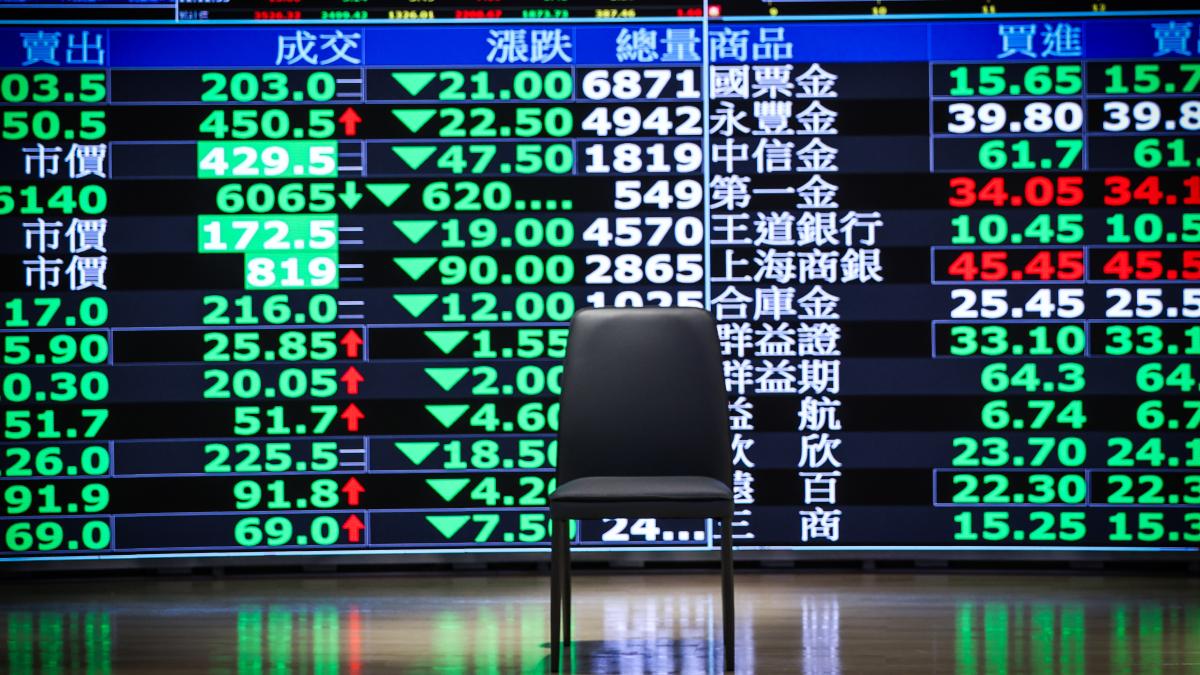
On the 29th, Taiwan's stock market broke below the 40,000-point threshold during trading, closing down 1,564.18 points at 40,039.18—the seventh-largest closing drop in Taiwan's stock market history. TSMC, a major weighted stock, closed down 80 yuan at 2,200 yuan, while United Microelectronics, Walsin Lihwa, Unimicron, Nanya Technology, Nantex, Kinsus, and Macronix all hit their daily trading limits. After two consecutive days of sharp declines, investors are increasingly concerned whether the AI-driven bull market has ended prematurely.
In response, Huang Chin-Yung, founder of DIGITIMES, posted on Facebook stating that during the previous AI frenzy, most people were busy watching stock prices, but few examined the fundamentals. He pointed out that 15 major U.S. tech giants—including AWS, Google, Meta, Microsoft, NVIDIA, and Oracle—are aggressively expanding capital expenditures based on 'over-leveraged profits' to secure monopolistic positions.
Why were AI-related tech stocks slaughtered? With TSMC sharply declining and memory-related stocks like Walsin Lihwa hitting limits, market skepticism toward the AI boom has deepened, intensifying selling pressure on tech stocks. U.S. markets closed mixed, with the Philadelphia Semiconductor Index plunging over 4%. In Asia, Japanese and South Korean markets turned negative after opening positive—Japan fell about 1.75% intraday, while South Korea dropped approximately 6.01%.
Taiwan's market opened lower at 41,491.48 points, briefly turned positive, then continued to fall, hitting an intraday low of 39,384.85 points—a 2,218.51-point drop—breaking below 40,000 points. It closed at 40,039.18 points.
Among key stocks, TSMC closed down 80 yuan at 2,200 yuan (a 3.51% decline), MediaTek and Delta Electronics fell about 5%, and UMC and Walsin Lihwa hit their trading limits. AI bellwethers such as ABF substrate leaders Unimicron, Nantex, and Kinsus were all locked at limits. Memory sector stocks including Nanya Technology, Winbond, and Macronix also hit limits.
Were investors too focused on stock prices to understand fundamentals? Huang Chin-Yung breaks down the 'over-leveraged' strategy of 15 U.S. tech giants.
Huang emphasized the need to understand the root causes of the AI supply chain. Recently, many institutions have revised Taiwan's GDP growth forecasts upward, attributing the surge to the 'AI boom.' Economists cite strong exports as the driver, forecasting monthly orders exceeding $90 billion in the second half.
'Business is so good that everyone is busy watching stock prices, but few are looking at fundamentals,' Huang said. Based on Bloomberg's raw data, he derived several conclusions: the 15 U.S. tech giants led by AWS, Google, Meta, Microsoft, NVIDIA, and Oracle are projected to achieve operating profit growth of 25.1% in 2026 and 18.6% in 2027. Remarkably, these 15 companies will allocate 68% of their 2025 operating profits to capital expenditures, with that figure exceeding 100% in both 2026 and 2027.
Huang also noted that memory procurement as a share of capital expenditure will rise from 14.4% in 2025 to around 37% in 2026 and 2027, indicating that leading firms are investing heavily to secure monopolistic positions. Software is easily replaceable, but hardware manufacturing capacity takes time to expand—thus, dominance must be achieved through hardware. This is precisely why Taiwan and South Korea continue to receive endless orders.
FACT BOX
- Source: PR Times
- Category: News
- Organizations: AWS / Google / Meta