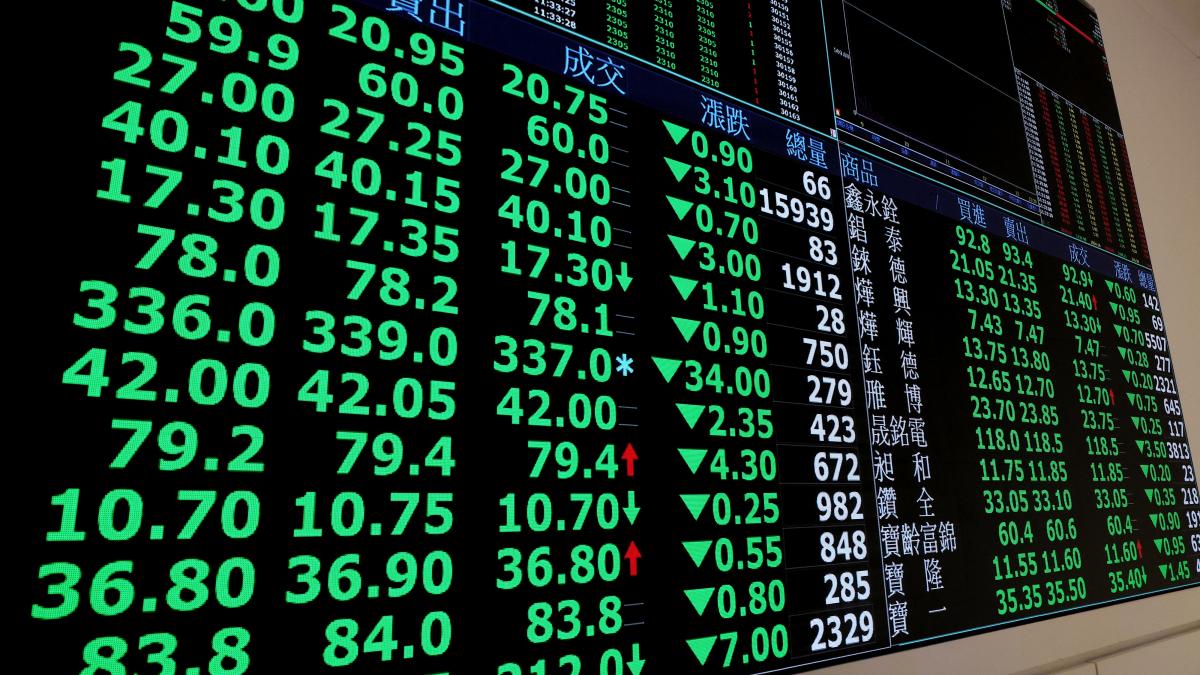
On May 29, Taiwan's stock market briefly fell below the 40,000-point threshold during trading and closed sharply lower by 1,564.18 points at 40,009.18, marking the seventh-largest point drop in its history. Legendary trader Giant Jie posted on Facebook, warning that Taiwan's 'disposition system' is exacerbating liquidity problems. He cautioned that without renewed buying interest, the combination of the disposition mechanism and margin calls could force numerous stocks into daily 'limit-down queues,' resulting in consecutive 'one-line limit-downs' and a cascade of selling.
What is the 'disposition system'? When a stock shows abnormal fluctuations in price, trading volume, or turnover rate, the exchange implements a phased alert and control mechanism to cool the market. Once a stock is designated for disposition, its trading method shifts from continuous matching to batch matching every 5 minutes (first-time disposition) or every 20 minutes (second-time disposition). Additionally, trades above a certain size require pre-deposit of funds or securities, significantly reducing liquidity.
Giant Jie noted that liquidity issues are already apparent in Taiwan's market, and the island's unique 'cute' disposition system will push more stocks into disposition status during downturns, further accelerating liquidity deterioration. Stocks that fall into disposition due to margin calls will be forced into daily limit-down queues with no recovery in sight if buying interest fails to return.
Giant Jie stated that this situation could be worse than the 2025 tariff war, during which many stocks began to rebound before even entering disposition. Taiwan's disposition system is designed to prevent excessive chasing during rallies. But during declines, does the staggered trading prevent panic selling? Not really—margin calls still trigger forced liquidations, making it a 'cute system' in name only.
He warned that without buying support, the combination of disposition rules and margin calls will force many stocks into daily 'one-line limit-downs,' creating a vicious cycle of selling—'multi-killing-multi.' The number of stocks hitting limit-down on May 29 is expected to reach a multi-month high.
What is a 'one-line limit-down'? A term describing a stock's appearance on a candlestick chart. When a stock opens directly at the daily limit-down price and remains there throughout the session, the opening, closing, high, and low prices are all identical. On a chart, this forms a single horizontal line resembling the Chinese character '一' (one).
More exclusive insights from Storm Media: · Taiwan stocks lose 40,000-point support—will July see further declines? Ruan Mu-Hua reveals the 'AI reshuffle script' behind tech stocks: take a deep breath · Is Taiwan's multi-day 1,000-point plunge just the beginning? Shi Jun-Ji warns of two brewing storms: TSMC may become the world's ATM · 350,000 investors face margin calls! Why does Korea's market keep hitting circuit breakers? Hsieh Jin-He reveals the mechanism fueling disaster: like giving hallucinogens to reckless teenagers
FACT BOX
- Source: PR Times
- Category: News