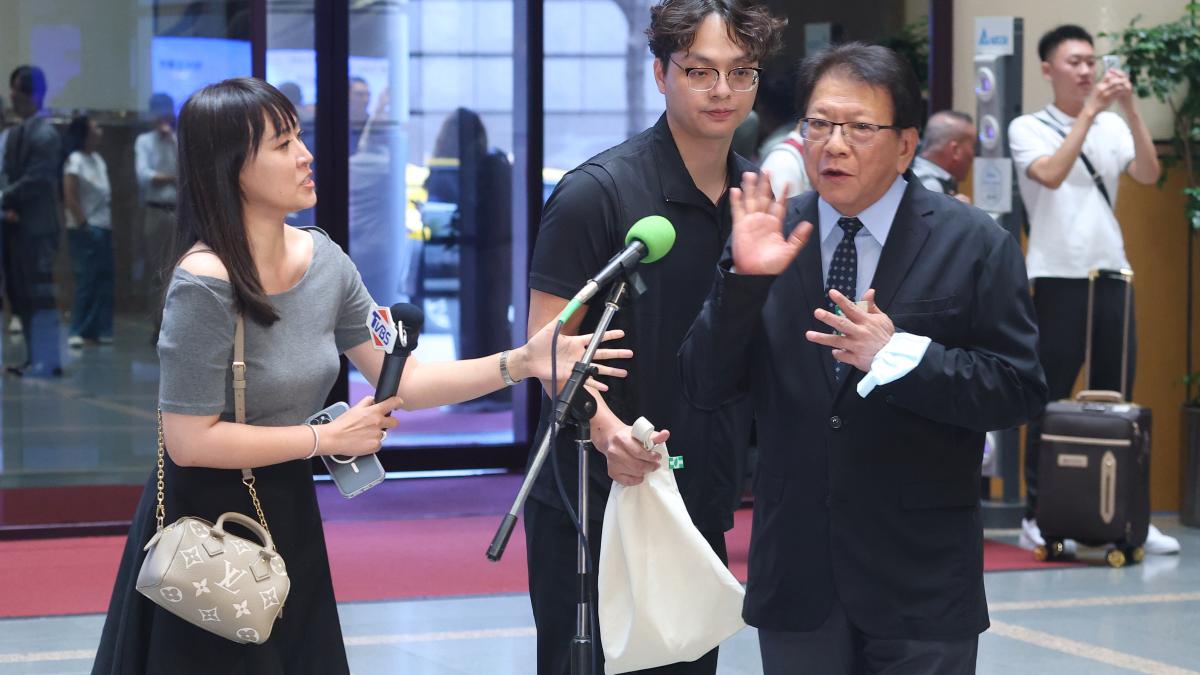
Before the Anti-Toxic Oil Grand March, an incident occurred in which President's Office Secretary-General Pan Men-an struck a pursuing journalist. Whether intentional or accidental, a high-ranking official physically confronting the media is shocking enough. But what's even more surprising is that there are still journalists who 'dare' to question senior officials in the Lai administration. In fact, very few journalists now loudly challenge government officials, let alone ask questions that make them uncomfortable. Unnoticed, Taiwan has become a country where journalists no longer feel safe asking real questions.
Afterward, Pan casually said 'sorry,' yet he remains protected by the thick echo chamber of the Green Camp. This reveals the root of arrogance in a government that won only 40% of the vote. In contrast, reporter Liu Ting-ting, who asked the questions, faced fierce online attacks—her father's nationality questioned, her political stance challenged, and she was sexually slandered simply for being a woman. Aside from a few independent media outlets, almost no mainstream media colleagues came to her defense. This shows that in today's Taiwan, merely doing a journalist's basic job—asking questions—can lead to being demonized by populism, and one must be prepared to stand alone.
Many later debated the 'etiquette' of journalists questioning politicians. However, as the fourth estate, the media's right to question is not just a privilege but also an obligation and duty. As long as journalists ask questions in the public interest, they are entitled to this privilege. Liu Ting-ting did not ask personal questions or ones benefiting her media outlet; she questioned the Lai administration's stance and actions on food safety. She had every right to press for answers—a right granted by the fourth estate. This view is not lofty; in Taiwan, it should be common sense. Yet today, a journalist questioning a high official is treated as if violating a sacred rule. The problem is not with Liu Ting-ting, who fulfilled her journalistic duty. The issue lies in Taiwan's political society and media culture, where normal behavior is now seen as abnormal.
In Taiwan, high-ranking officials in the Presidential Office rarely face the media directly, except for the official spokesperson. A stark contrast is former U.S. President Trump, who, despite clashing with liberal media, frequently engaged with reporters—taking impromptu questions at public events, giving interviews, and answering every question, even from critical outlets like The New York Times. In contrast, President Lai has held only four press conferences since taking office—slightly better than former President Tsai Ing-wen's 700+ days without one, but still extremely rare. Moreover, these events are tightly controlled, with little room for unexpected or uncomfortable questions, especially from domestic media.
The DPP often boasts that Taiwan's press freedom surpasses China's. But judging by how political figures engage with the media, Taiwan's government is clearly closer to China than to the U.S.
The Lai administration can afford to ignore or avoid tough questions from individual media because most outlets have already abandoned asking critical questions about public interest. Reasons are manifold: some media have become part of the ruling team, prioritizing party victory over public welfare; others avoid angering those in power for economic reasons. Thus, when a journalist dares to ask a sharp question in public, it's like a rare echo in an empty valley. Most media have either become cheerleaders or tools of the ruling party, turning their scrutiny toward the opposition. Whether driven by profit or political alignment, a chilling effect has spread across the media landscape. Under such conditions, expecting media to investigate government corruption is pure fantasy—since even basic questioning is now taboo.
The media is the window of democracy. When the media is like this, Taiwan's democratic quality is self-evident. Former President Chen Shui-bian often quoted Thomas Jefferson's famous line: 'I would rather have newspapers than a government.' This reflects an uncompromising stance on press freedom. In contrast, while Lai frequently speaks of freedom of speech and press freedom, he does so in a negative tone—such as saying at a Zheng Nanrong memorial event, '100% freedom of speech does not mean using freedom to destroy freedom.' This statement seems confusing at first, but subtly frames freedom of speech and press as dangerous forces that must be controlled.
When the media is fully instrumentalized, even the right to ask real questions is confiscated. Taiwan is now sliding toward that reality.
FACT BOX
- Source: PR Times
- Category: News