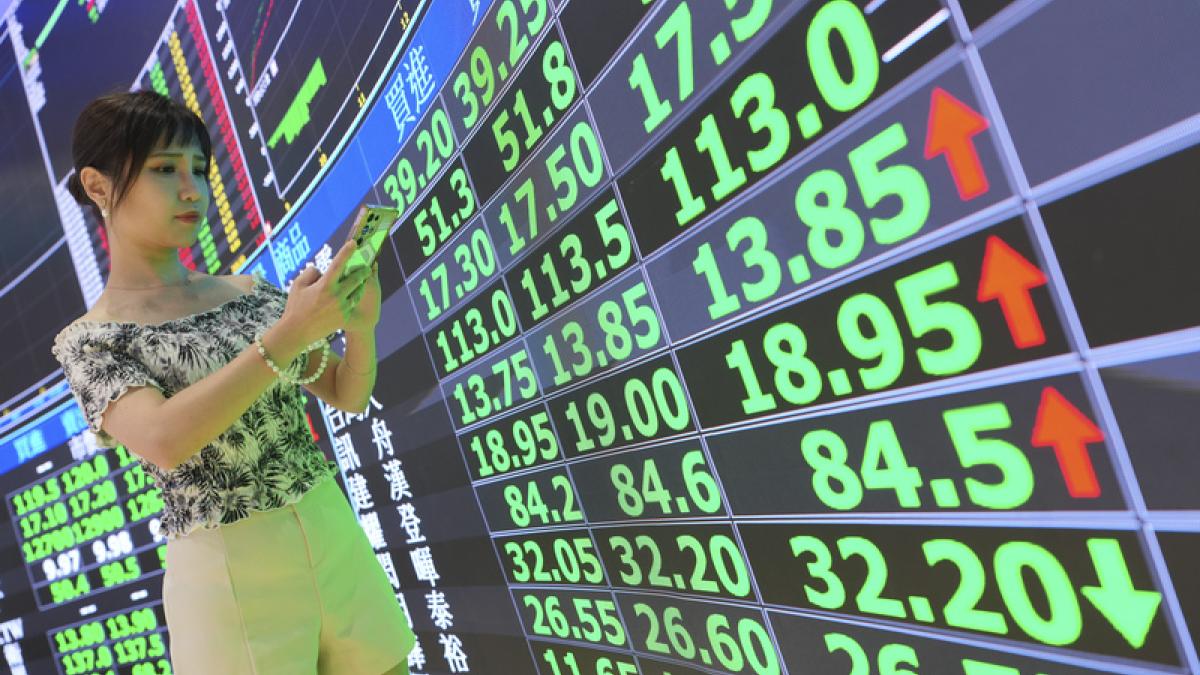
Behind the so-called 'four loans in harmony' and 'six loans in harmony' lies a hidden high-risk warning. Selecting stocks based on technical analysis, investor positioning, and price-to-earnings (P/E) ratios can likely help navigate through turbulent times. Following price hikes in memory, ABF substrates, and AI supply chains, along with the upcoming launch of new Apple devices, pullbacks may present attractive buying opportunities.
By Fang Ya-Shen
The recent movement of the Taiwan stock market resembles the situation during the early March U.S.-Iran conflict. Despite positive catalysts, stocks fail to rise; conversely, negative news triggers immediate declines—a troubling scenario. International oil prices have surged, equity markets have corrected, and corporate earnings reports have mostly delivered positive results, yet stock prices have sharply declined.
Another long-standing fear lurking in the market is that major high-market-cap U.S. tech companies are investing excessively in AI infrastructure. These firms, once known for generating massive free cash flow, are now shifting toward cash outflows. Moreover, China, similar to its emergence of DeepSeek, may now achieve or approach the capabilities of U.S. giants like OpenAI and Anthropic through low-cost development, further fueling investor skepticism.
While the Dow Jones Industrial Average remains above its quarterly moving average, supported by strong performance in financial and energy stocks, the S&P 500, Nasdaq, and the Philadelphia Semiconductor Index (SOX) have all fallen below their quarterly lines. The same applies to Asian markets—Japan, South Korea, and Taiwan. Global equity markets are either experiencing high-level volatility or undergoing corrections.
Looking back at the series of negative factors since Trump took office—such as the sudden yen appreciation, tariff hikes, and the early March U.S.-Iran war that pushed oil prices sharply higher—U.S. equities have remained resilient despite these headwinds, continuing to set new highs. The bullish trend in the U.S. market has remained intact under Trump’s administration, aligning with South Korea, Japan, and Taiwan as some of the world’s strongest-performing markets. Whenever the U.S. indices face negative news and pull back, they quickly rebound and reach new highs.
The primary reasons include Trump’s incentives and pressures encouraging foreign manufacturers to invest and build factories in the U.S., and overseas military operations or arms supplies (e.g., to Ukraine) stimulating the U.S. manufacturing, technology, and financial sectors. Combined with the U.S. being the world’s largest oil producer, the economy and stock market continue to thrive. Although the market’s base level has risen, raising concerns, the U.S. financial market has historically been highly efficient at reflecting doubts and fundamentals. As long as the trend remains unchanged, sharp declines are typically followed by rapid rebounds.
One of the two major recent tech market topics is Google raising its capital expenditure for this year to $204.5 billion. Notably, Google was previously a free cash flow-generating company, but with combined spending exceeding $300 billion over the past two years on AI infrastructure, its balance sheet has shifted from cash inflow to outflow. To fund this, the company has issued bonds to raise capital from the market. Despite reporting cloud business annual growth of 82%—significantly exceeding the 64% market expectation—its stock price gapped down sharply.
Additionally, Intel’s earnings report revealed revenue of $16.13 billion, a 25.4% year-over-year increase, far surpassing the expected $14.42 billion. This marks the company’s strongest quarterly revenue growth in over 15 years. Adjusted EPS reached $0.42, nearly double the market expectation. Gross margin stood at 41.8%, outperforming the expected 38.8%. Notably, the Data Center and Artificial Intelligence (DCAI) division generated $6.3 billion in revenue, up 59% year-over-year, indicating that AI computing demand has materially translated into Intel’s revenue growth.
Despite strong earnings, the stock declined—highlighting that AI-related capital expenditure has become the biggest variable. For the third quarter outlook, Intel’s revenue forecast significantly exceeds market expectations. To meet growing demand for data center CPUs, Intel has raised its annual capital expenditure forecast from $18 billion to $20 billion, with expectations of further significant increases next year. The earnings report was nearly flawless, yet the stock dropped 7.9% the following day.
Prior to this, ASML, Texas Instruments, and even TSMC reported solid earnings but saw their stock prices fall. Upcoming earnings reports from AI heavyweights like Apple, Microsoft, Amazon, and Meta will draw intense market scrutiny, particularly regarding their capital spending plans. The market now awaits a phase where stocks no longer fall on bad news and surge strongly on good news.
Secondly, memory stocks—historically among the most profitable—have recently shown neutral-to-weak momentum, especially South Korea’s SK Hynix and Samsung. After Samsung released its preliminary earnings, its stock price plummeted below 300,000 Korean won. Hynix’s U.S.-listed ADR also fell below its offering price after issuance. The 2x or 3x leveraged ETFs based on these two dominant memory firms have recently been highly volatile, with increasing circuit breaker triggers as share prices fall. Since these two companies account for over half of South Korea’s total market capitalization, their volatility indirectly causes frequent circuit breakers in the broader Korean market, affecting Micron and Kioxia as well. While fundamentals remain unchanged, the key question is when investor positioning will stabilize.
If the Korean Composite Stock Price Index (KOSPI) peaked at 9,385 points, the neckline support at 7,394 points has already been broken, with a measured move target at 5,403 points. In other words, a break below 5,800 points could technically favor a bottoming process.
FACT BOX
- Source: PR Times
- Category: News
- Organizations: Google / Intel / Apple