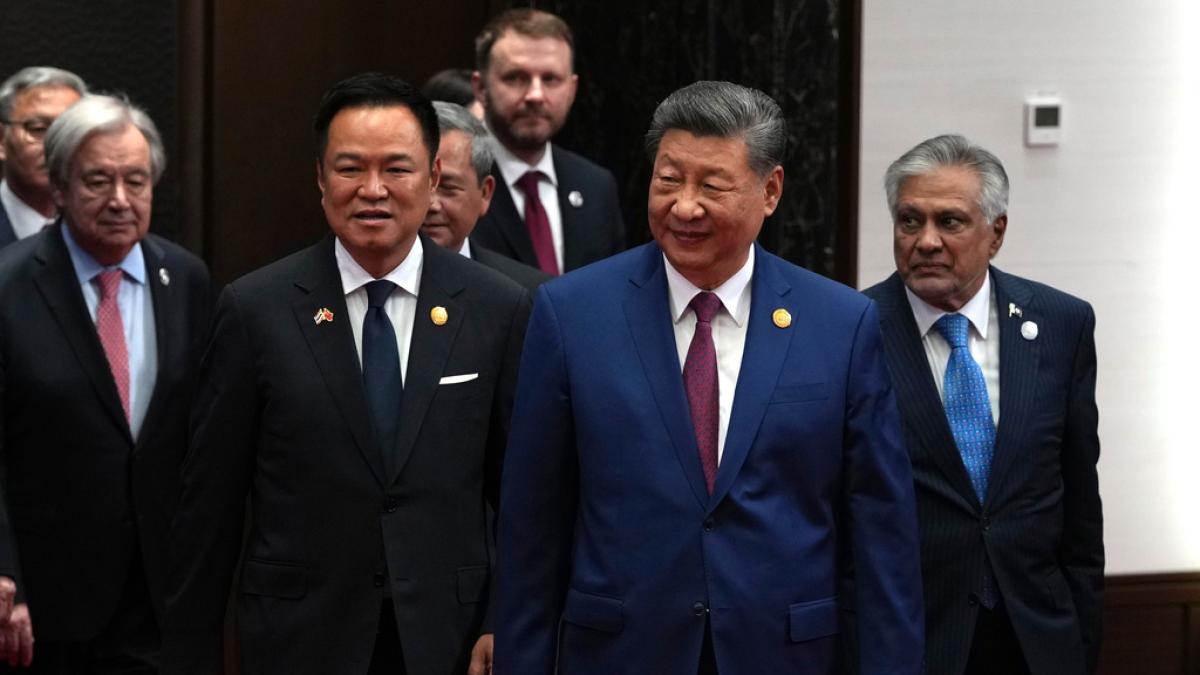
"China and Thailand are as close as family"—Chinese President Xi Jinping reiterated this phrase on July 17 during a meeting with Thai Prime Minister Anutin Charnvirakul (Chen Xiyao) at the 2026 World Artificial Intelligence Conference held in China. Due to the current close relationship between the two countries across multiple levels, human rights organizations are deeply concerned that Thailand may agree to repatriate Chinese dissidents detained in Thai immigration detention centers back to China.
Just days before Anutin's visit to China, Human Rights Watch (HRW) urged the Thai government not to deport at least four Chinese dissidents and media workers, stating that "the Chinese government has intensified pressure on Thai officials ahead of Prime Minister Anutin's visit to China from July 16 to 20."
The four individuals are: Bai Zhaodong, a 59-year-old former renowned investigative journalist with Caixin; Tan Yixiang, a 49-year-old human rights activist for Tibet and Uyghur causes; Zhang Xinyan, a 56-year-old self-proclaimed member of the 'Hong Kong Parliament' and Falun Gong practitioner; and Zhou Junyi, a 54-year-old member of the China Democracy Party who previously organized commemorations for the June 4 Tiananmen Square incident.
Recently, Sunai Phasuk, Senior Thailand Researcher at Human Rights Watch, revealed to BBC News Thai during the Thai Prime Minister's visit to China that Tan Yixiang had already been repatriated to China in June of this year. "No one knew—not even Mr. Tan's own lawyer," he said.
Prior to the Thai leader's scheduled visit to China, over 50 international human rights and media organizations issued a joint statement urgently calling on the Thai government not to deport or expel Bai Zhaodong to China.
The joint statement warned: "If repatriated to China, Bai Zhaodong will face severe risks." Subsequently, on July 17, Lin Jian, spokesperson for China's Foreign Ministry, told the media that, based on available information, Bai Zhaodong is suspected in China of extortion and bribery involving non-state personnel.
In response, the human rights organizations behind the joint statement dismissed these allegations as "fabricated false charges." Lin Jian stated: "China has formally requested Thailand's extradition, and we hope Thailand will hand him over as soon as possible."
On July 16, the Bangkok South Criminal Court held a hearing on an application submitted by Zhang Xinyan's lawyer. The application requested the court to investigate, under Thailand's 2023 Prevention and Suppression of Torture and Enforced Disappearance Act, whether the immigration authorities' refusal to allow Zhang to travel to Canada was lawful. The lawyer argued that since a third country had agreed to accept her, the authority to detain should have ceased; additionally, the immigration office's denial of legal visits from July 13 to 15 may constitute a violation of laws against enforced disappearance.
According to Prachatai, the judge ultimately rejected the application filed by Zhang Xinyan's legal representative. However, during the hearing, Colonel Watcharapol Kanjanakun, head of the third division of the immigration investigation unit, revealed that Zhang Xinyan was detained by immigration authorities on May 7, 2026, for overstaying her visa. Furthermore, Chinese authorities sent a letter to Thailand on July 7 requesting a delay to the planned transfer of Zhang to Canada on July 8.
Since the country of origin opposed her transfer to a third country, Prime Minister Anutin, as chair of the National Security Council, had to decide where she should be sent. The National Security Council determined that the case involved international relations, and thus she remains detained in the immigration detention center.
Looking back at events over the past decades, it is understandable why human rights groups are deeply concerned about Thailand potentially repatriating Chinese journalists and dissidents.
According to a Human Rights Watch report, in 2015, Thai authorities repatriated Chinese human rights activists Dong Guangping and Jiang Yefei to China, despite both having been recognized as refugees by the UN High Commissioner for Refugees (UNHCR). Dong Guangping later escaped China again in 2026 and was resettled in Canada.
Last year, the Thai government repatriated 40 Uyghurs to China, and no one has been able to verify their current conditions. A similar incident occurred in 2015, when Thai authorities allowed China to dispatch a plane from Bangkok to take over 100 Uyghurs back to China.
At the end of 2025, Thailand handed over She Zhijiang, the founder of Shwe Kokko in Myawaddy, Karen State, Myanmar—a site accused of being one of Myanmar's largest fraud centers—to China. Thailand transferred She under its extradition law, although his legal team questioned the process as "abnormal."
Moreover, since last year, Thai authorities have assisted the Chinese government in arranging flights to land at Mae Sot International Airport in Tak Province to repatriate Chinese citizens involved in online crime and fraud cases from Shwe Kokko, totaling over 1,000 people. According to Thai PBS, the most recent operation on July 9 saw Chinese authorities dispatch three flights to take back over 300 Chinese citizens.
All of this raises a critical question: Is Thailand becoming an extension of China's transnational law enforcement system?
How does Thailand weigh China's demands?
Sunai Phasuk, Senior Thailand Advisor at Human Rights Watch, believes Thailand is pursuing a policy with "tributary state" characteristics—prioritizing appeasement of China to gain calculated benefits, whether economic or in deepening state and leadership-level relations. He questions whether Thailand is truly receiving what it needs, or merely "what China is willing to give."
"China often uses phrases like 'as close as brothers, not outsiders' in speeches and statements, but in reality, this is not an equal relationship, but one where China has long taken advantage of Southeast Asian small states," he said.
He argues that Thailand has calculated that pleasing China is more convenient and easier than adhering to international norms or the principle of non-refoulement, which prohibits returning individuals to countries where they may face persecution. From the recent cases of Tan Yixiang and Zhang Xinyan, it is evident that Thailand is willing to cooperate with China's demands to block refugees and activists opposed to Beijing's stance.
"Judging from Anutin's attitude during his recent visit to China, I see no hope that Thailand will resist China's use of power to exert influence and oppression. The status of a tributary state is becoming increasingly clear, and China will be increasingly able to issue orders," Sunai said.
Simon Menet, researcher at the French Foundation for Strategic Research (FRS), told BBC Thai that Thailand is not incapable of refusing to repatriate Chinese dissidents, but rather, after weighing the costs, often chooses to comply because doing so usually does not significantly harm Thai interests.
He believes pressure from NGOs has limited impact on the Thai government; even the United States, under President Donald Trump, does not prioritize human rights as a top policy issue.
"If so, why wouldn't they do it?" Menet said, adding that the practice of sending dissidents and cross-border criminal suspects to China reflects Thailand's different cost-benefit calculations in different cases.
"For example, the case of She Zhijiang took a considerable time before he was sent back to China. To some extent, he had higher strategic value, and keeping him in Thailand was an advantage for Thailand. In the case of Chinese political dissidents, Thailand must carefully weigh the costs and benefits. I don't believe the current cost to Thailand is high enough to justify refusing repatriation," he explained.
Dr. Mark Cogan, peace and conflict studies expert at Kansai University of Foreign Studies in Japan, explained that China's influence on Thailand's law enforcement and judicial systems operates through two main channels. The first is the visible formal route, such as the 1993 Sino-Thai Extradition Treaty and public cooperation mechanisms like the enforcement of Interpol Red Notices through Thai courts.
However, in cases involving Chinese national security, the pursuit of Chinese refugees or dissidents, Thailand faces informal external pressure—the so-called 'invisible hand.'
"Many human rights organizations refer to this phenomenon as the 'swap mart of transnational repression,' and it's not exclusive to China," said the Japanese scholar.
Cogan pointed out that in recent years, Thailand has frequently repatriated Chinese dissidents during or around bilateral leader meetings—a pattern that remains a 'mystery' without a clear explanation.
He noted that last year's repatriation of 40 Uyghurs occurred about three weeks after then-Prime Minister Paetongtarn Shinawatra's visit to China. Although that visit was a bilateral meeting, it was not directly related to the issue. More recently, ahead of Anutin's planned trip to Shanghai for the 2026 World AI Conference, renewed requests from Chinese authorities emerged.
FACT BOX
- Source: PR Times
- Category: News
- Organizations: Human Rights Watch / BBC News / Prachatai