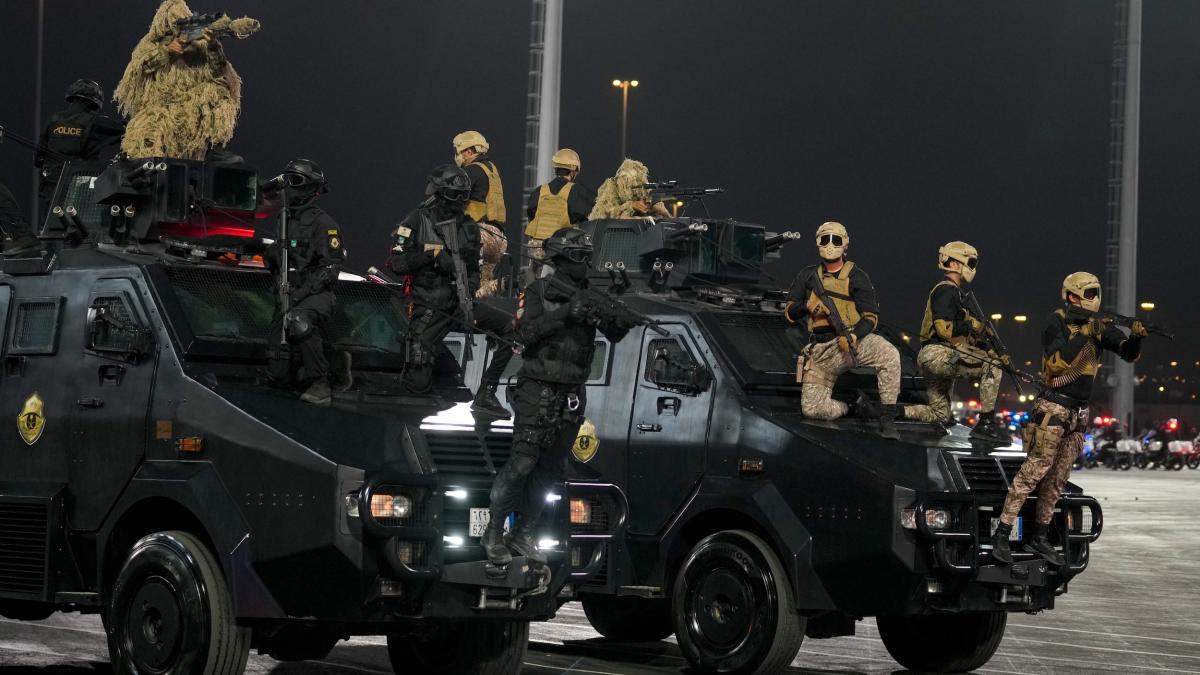
Saudi Arabia's Ministry of Defense announced on July 27, 2025, that it had successfully intercepted multiple drones targeting oil facilities in the country's eastern region. These drones were launched from within Iraqi territory by Iran-backed Shiite militia groups.
The Saudi Defense Ministry stated in a press release: 'These terrorist attempts were launched from Iraqi territory and executed by terrorist militias affiliated with Iran.' The statement did not specify the exact number of drones launched or whether any ground damage occurred during the interception.
On the same day, Saudi Arabia's Ministry of Foreign Affairs issued a statement strongly condemning the 'condemnable drone attacks' carried out by Iran-backed militias operating in Iraq. The ministry urged the Iraqi government to 'take all necessary measures to prevent its territory from being used as a launchpad for acts of aggression.'
Iraqi Prime Minister Ali Al-Zaidi announced late on July 27 that security forces had been ordered to investigate the drone attack. Iraqi military spokesperson Sabah al-Numan stated: 'The Iraqi government reaffirms its constitutional and firm commitment to the principle of good neighborliness and preventing Iraqi territory from being used as a route or launch point for attacks against brotherly or friendly nations.'
Al-Numan added that Iraq is reviewing 'existing evidence and information' and is prepared to take 'legal action' against any party proven to be involved. He emphasized: 'The government also reaffirms that its relationship with the Kingdom of Saudi Arabia is deeply rooted and fraternal, based on mutual respect, shared interests, and the principle of good neighborliness.'
The Islamic Resistance in Iraq (IRI), an umbrella organization of Iran-backed Shiite militias operating in this Sunni-majority country, denied launching drones at Saudi Arabia on July 27 and threatened that any Saudi retaliation would 'deeply regret it.'
The group mocked: 'These fabrications are merely attempts to justify the inability to respond to painful strikes from Yemen targeting their core infrastructure, due to fear of the nature of the upcoming Yemeni response.' This refers to another Iranian proxy—the Houthi rebels in Yemen—who have been attacking Saudi-linked shipping in the Red Sea.
IRI warned: 'Any foolish Saudi action will be met with a severe response, leaving them biting their fingers in regret.'
Regional analysts told The New York Times on Monday that Iran and its Houthi 'protégés' are exploiting Saudi Arabia's vulnerable position, as the Strait of Hormuz is currently under de facto blockade, significantly reducing oil exports.
Analysts suggest Saudi Arabia reportedly no longer wishes to remain involved in Yemeni affairs. The country has been engaged in the Yemen conflict since 2015, with limited success and facing heavy international criticism for the suffering of Yemeni civilians. The Houthis, meanwhile, are reportedly frustrated by their inability to conquer more Yemeni territory after a 2022 ceasefire with Saudi Arabia. The Hormuz crisis presents the Houthis with an opportunity to break the stalemate, and Iran may be using its Iraqi militia proxies to increase pressure on Saudi Arabia.
Farea al-Muslimi, a researcher at Chatham House, lamented: 'The Houthis have only one solution for every problem—war. Saudi Arabia tries to solve every problem by throwing money at it. The Houthis fight with guns; Saudi Arabia fights with cash.'
FACT BOX
- Source: PR Times
- Category: News