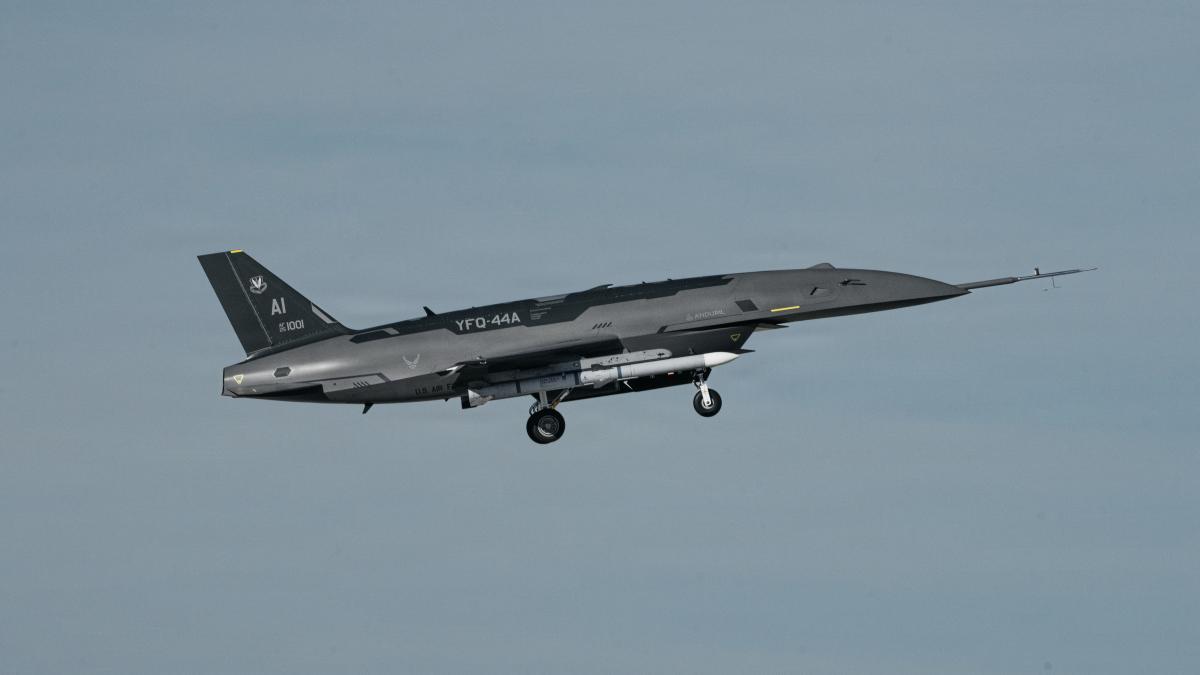
Anduril, a U.S. defense technology unicorn, announced that the first mass-produced semi-autonomous unmanned combat aircraft, the 'YFQ-44A,' has been officially completed at its 'Arsenal-1' manufacturing facility in Ohio. From the launch of the production program to the delivery of the first aircraft, the entire process took only four months. This semi-autonomous fighter was specifically developed and produced for the U.S. Air Force (USAF) and will serve as a vital aerial wingman, assisting manned fighters in executing a variety of missions, including strike operations. Anduril will begin full-scale mass production starting July 2026. The aforementioned manufacturing facility, with a total investment of $1 billion (approximately NT$32.5 billion) and covering 5 million square feet, has created around 4,000 local jobs in Ohio. The U.S. Air Force's next-generation semi-autonomous unmanned wingman, the YFQ-44A, is being mass-produced by drone startup Anduril. (Source: DVIDS system)
In addition to Anduril producing the YFQ-44A, another company, General Atomics, is responsible for the YFQ-42A model. In the first phase, the U.S. Air Force plans to procure between 100 and 150 loyal wingman drones, with a long-term goal of deploying at least 1,000 units.
General Ken Wilsbach, Chief of Staff of the U.S. Air Force, stated that achieving air superiority in today's high-risk competitive environment requires the rapid deployment of a significant combat force. The U.S. military will integrate unmanned systems with pilots to effectively expand operational range and enhance strike effectiveness.
Publicly available data shows that the YFQ-44A unmanned fighter has a total length of 6.2 meters, a maximum takeoff weight of 2,268 kilograms, and can carry two AIM-120 Advanced Medium-Range Air-to-Air Missiles (AMRAAM). Its maximum flight speed reaches up to 0.95 Mach.
The U.S. Air Force's next-generation semi-autonomous unmanned wingman, the YFQ-44A, is being mass-produced by drone startup Anduril. (Source: DVIDS system)
Although the YFQ-44A possesses unmanned and semi-autonomous flight capabilities, U.S. Air Force officials have emphasized that the final decision on whether to launch weapons during missions will remain in the hands of human operators, not delegated to the system for autonomous judgment. The U.S. military's next step is to first establish trust between human operators and autonomous systems, then gradually bring this wingman aircraft into operational service through computerized man-in-the-loop simulations and live exercises.
FACT BOX
- Source: PR Times
- Category: New Product
- Organizations: General Atomics