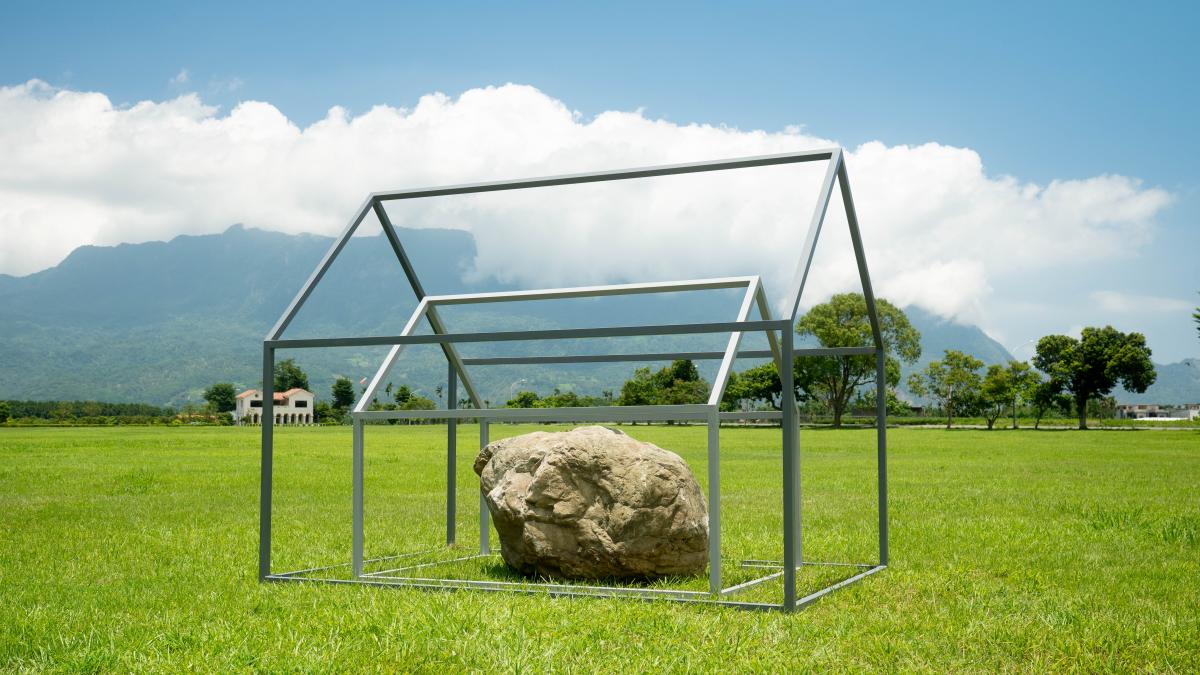
As the car window moves forward along Highway 9, the Central Mountain Range and Coastal Mountain Range face each other across the landscape. Rice fields ripple with varying shades of green in the wind, occasionally interrupted by a white egret soaring overhead, adding a light, blank stroke to the vast longitudinal valley. The 2026 'Piaoniao 197 – Vertical Valley Art Festival' will scatter artworks among the grasslands, wetlands, rice fields, and old houses of Luye, Guanshan, and Chishang. There are no white walls of a museum, nor prescribed viewing directions—sunlight, wind sounds, cloud shadows, and distant mountains are all part of the exhibition. As you follow rural paths in search, art does not suddenly appear, but slowly emerges from the land itself. Layers of Roofs Holding Wandering Souls – Luye’s Long Winds Shape the Outline of Home Arriving at the Luye Longtian Landing Field, grasslands stretch toward distant mountains, where Turkish artist Mehmet Ali Uysal’s 'Home' quietly resides. The layered, enveloping space feels like a home still containing another home within, or like a door in the depths of memory that hasn’t fully closed. This work is not about a house, but about the sense of belonging everyone spends their life seeking. Home might be a person, a family, a city, or even a culture that allows one to let down their guard and simply be themselves. Standing in the open field, the boundaries of home become expansive. No longer confined by walls, it stretches with the wind toward the softest place in each person’s heart. Nearby, British-Egyptian artist Sam Shendi’s 'Between Us' rises upward in vivid colors and geometric volumes. (Photo/Provided by Taitung Branch and Hualien Branch of the Rural Water Conservation Agency) Not far away, British-Egyptian artist Sam Shendi’s 'Between Us' stacks upward in vivid colors and geometric forms. The piece appears to sway, yet maintains balance through mutual support—like human encounters that seem accidental but ultimately become the strength that keeps us standing. Alien Sprouts Land in the Wetlands – Growing Toward Light Despite Scars In Luye’s Xinliang Wetland, American artist Danielle Leigh Ranck’s 'The Stranger in the Field' resembles a plant that drifted from a distant planet, stretching its body between green grass, moisture, and sky light. The entwined stems deliberately leave gaps, symbolizing the incompleteness, setbacks, and scars experienced during growth. The outer layer of the plant appears like a slowly shedding old shell, while new life emerges from within. At the top of the work, an eye gazes skyward. It seems to tell everyone who has ever felt out of place: even with gaps in your being, as long as you are nourished by the land and community, you can still grow into a unique and singular form. Dragonflies Turn Through Guanshan’s Rice Waves – Feng Shui Brings the Message of Rain Moving north along the road, Guanshan De’ao’s rice fields shimmer with soft, bright green under the sun. Malaysian artist Chu Wei-lung’s 'Dragonflies in the Rice Know the Rain' slowly rotates among the rice waves. Wind pushes the straw components to sway back and forth, while water drives the dragonflies to spin and dance in the air. Wind and water pass the baton within the artwork, transforming rural observations of weather into a light, graceful field performance. Dragonflies have long been seen as a sign that rain is coming. As they fly over the rice fields, they seem to foretell a rain that will nourish the land, reminding us of the intricate, ancient connections between climate, agriculture, and life. Malaysian artist Chu Wei-lung’s 'Dragonflies in the Rice Know the Rain' uses wind and hydraulic mechanisms to make dragonflies spin and dance over Guanshan’s rice fields. (Photo/Provided by Taitung Branch and Hualien Branch of the Rural Water Conservation Agency) Unknown Signals Dock at an Old House – Flying Cats Preserve Childlike Wonder in Chishang Leaving the rice fields and entering a tin-roofed building in Guanshan, Li Wei-mu’s 'The Place of Landing – They Were Here' cloaks the abandoned structure in a mysterious aura. Floating bodies, towers, ant-people, and mirrors refract the sky, fields, and human figures into a cluster of unknown signals, as if some form of life briefly paused here before quietly departing. Li Wei-mu’s 'The Place of Landing – They Were Here' cloaks the abandoned building in mystery, as if some life briefly paused and then quietly left. (Photo/Provided by Taitung Branch and Hualien Branch of the Rural Water Conservation Agency) Entering Chishang, A-Lieh Hsin-hung’s 'Flying Cat' rests playfully among the fields. Hailing from the imagined 'Feifei Planet,' it runs on sunlight, converting it into 'meow-energy resonance.' The work uses no complex language, instead transmitting a soft, calming force through vibration, frequency, and imagination. In a world that is too fast and too serious, the Flying Cat feels like a small note sent to travelers, reminding us that we don’t always need to rush—we can also leave space in life for breathing, daydreaming, and dreaming. A-Lieh Hsin-hung’s 'Flying Cat' rests in Chishang’s fields, using sunlight, vibration, and imagined 'meow-energy resonance' to add whimsy to the journey through the valley. (Photo/Provided by Taitung Branch and Hualien Branch of the Rural Water Conservation Agency) From Luye to Chishang, art does not steal the land’s beauty, but grows slowly alongside the existing landscape. Home, rain, scars, the unknown, and childlike wonder become different glimmers of light along the way, accompanying people as they continue their journey through the valley.
FACT BOX
- Source: PR Times
- Category: Event