Leaving Chishang and continuing north, the mountains draw closer, and farmland, forests, and villages blur past the car window. Arriving in Fuli and Ruishui, art does not rush to catch the eye—it hides quietly among the trees beside Dapi Pond, in the grasslands of Liushishan, and deep within betel nut groves, waiting for people to step into the wind and slowly encounter it.
This journey calls for a slower pace. Wind passes through bamboo slats, sunlight falls into holes, and reddish-orange netting gently ripples between trees. Art is not merely an object before the eyes, but a landscape to be felt with the body, ears, and breath.
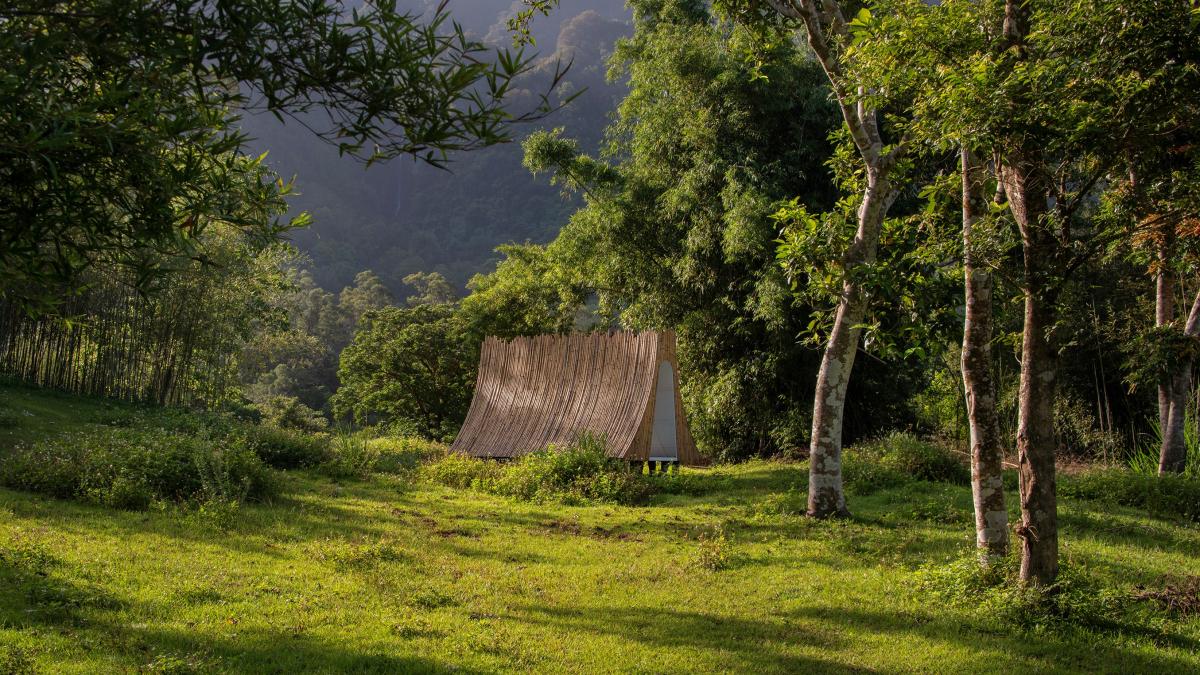
Near Luoshan’s Dapi Pond in Fuli, YuYu Art Studio’s 'Fluid Dwelling' resembles a lightweight bamboo structure delicately suspended in the forest. Layered bamboo strips form the roof, while the lower structure evokes animal footprints or the slow, meandering traces of mountains and rivers shifting over eons. Though the work appears light, it speaks of the earth’s ceaseless transformation.
As wind flows through the bamboo frame, wind chimes emit soft, delicate sounds, giving direction to otherwise invisible air currents. The fleeting presence of cats and dogs moving through the space transforms geological evolution from a distant natural phenomenon into a gentle, everyday change.
'Dwelling' has never meant permanence. Mountains rise, rivers bend, creatures leave and find new places to rest. What people perceive as stable daily life may simply be a brief, precious encounter within nature’s long river.
Lin Jingge’s 'Memory of Strata,' located in the grasslands of Fuli’s Liushishan, uses cuts, holes, and layered textures to reveal the patterns left by the sedimentation of time. (Photo/Provided by Taitung and Hualien Branches of the Rural Water Conservation Agency)
Cutting Open Volumes to Reveal Strata—Holes That Hold Echoes of Time
Ascending the mountain path toward Liushishan, meadows, valleys, and the horizon unfold in layers. Lin Jingge’s 'Memory of Strata' consists of a quiet, structured volume made of regularly arranged tubes, resembling a time slice extracted from deep within the land.
From afar, the surface appears straight and orderly; up close, the once-smooth exterior is sliced open, revealing holes, indentations, and textures of varying depth. These cross-sections resemble rock layers eroded by wind and rain, or the marks time leaves within living beings.
Strata do not form overnight, nor does human memory. One experience overlays another; joy, loss, and scars interweave, eventually settling into the self we are today.
Standing before the work, the gaze naturally shifts between the smooth exterior and the internal voids. It seems to whisper softly: beneath every seemingly whole life lies a texture carved by time and echoes long held within.
German-Polish artist Danuta Karsten uses approximately 200 pieces of reddish-orange netting to create 'Breath of Wind,' making invisible air currents visible within Ruishui’s betel nut groves. (Photo/Provided by Taitung and Hualien Branches of the Rural Water Conservation Agency)
Red-Orange Nets Connect the Trees—Wind and Light Take Shape
Entering the betel nut groves of Ruishui, Danuta Karsten’s 'Breath of Wind' gives visible form to the invisible wind. Around 200 pieces of reddish-orange netting hang between the betel nut trees, standing out vividly against the sea of green. A light breeze causes the nets to sway gently; stronger gusts turn the entire grove into a flowing wave of red-orange.
Originally planted in neat rows for agricultural purposes, the betel nut grove has developed irregular gaps as some trees disappeared over time. Rather than filling these gaps, the artist worked with the existing trees and spacing, allowing the voids created by time to become part of the artwork.
Walking along the path into the grove, the nets overlap and separate, revealing tea plantations, orchards, sky, and mountain shadows through their gaps. With each step forward, the landscape rearranges itself.
When the wind blows, the artwork breathes with it. Being inside it, one does not merely observe art but enters a space woven from wind, light, and trees.
Artworks along the Fuli–Ruishui route are nestled among forests, slopes, and farms, allowing people to sense the earth’s changes through wind sounds, shifting light, and the breath of the valley. (Photo/Provided by Taitung and Hualien Branches of the Rural Water Conservation Agency)
From Fuli to Ruishui, the Land Art Festival embeds time in bamboo strips, engraves memory into strata, and captures wind in flowing nets. These works do not compete with nature for attention—they gently lean into the land, helping people once again hear the sounds the valley has always held.
FACT BOX
- Source: PR Times
- Category: Event
- Dates in source: 2026