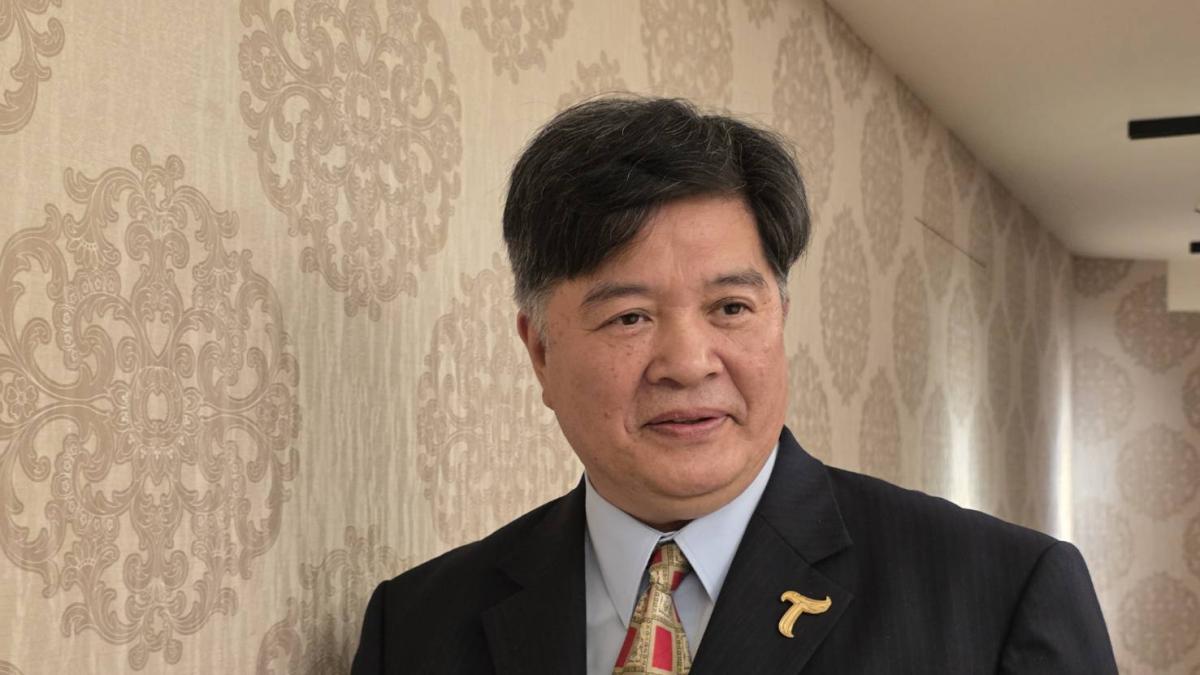
The demand for high-speed optical transmission driven by AI data centers has also highlighted the structural risk of Taiwan's optical fiber supply chain's long-term reliance on imports. Lian Guang Tong (4903) held a media lunch on the 30th, where Chairman Lin Yu-Chang announced that the company is evaluating the establishment of an optical fiber drawing factory in Taiwan. Initially, they will purchase optical rods from partners and then draw them domestically. At the same time, they are accelerating the deployment of MPO multi-core optical fiber connectors and FAU optical fiber array units. The new MPO production line is expected to complete equipment procurement by the third quarter and may start production by the end of the year. The FAU technology cooperation is also nearing the prototype stage, and the cooperation partner and details are expected to be announced soon.
Lian Guang Tong's revenue for the first half of this year was 816.63 million NT dollars, an increase of 38.8% year-on-year, outperforming the company's expectations. Based on the current operating situation, the engineering business accounts for about 60% of the revenue, the energy business is expected to exceed 20% this year, and the traditional optical fiber business accounts for about 15% to 20%. With the engineering business providing more stable revenue and cash flow, Lian Guang Tong is shifting its resources to AI optical communication, smart grids, and energy infrastructure, attempting to move from a traditional optical cable manufacturer further up the supply chain.
Traditional Optical Fiber Market Faces Double Pressure Lin Yu-Chang: Not Just Chasing AI Topics Lin Yu-Chang pointed out that Taiwan's traditional optical fiber market has faced two major pressures in recent years. First, the large-scale optical fiber laying of domestic telecommunications networks has driven huge demand, but as the main backbone is gradually completed, subsequent demand mainly comes from replacement and new community construction. The bid volume released by Chunghwa Telecom and other telecommunications operators has been decreasing year by year.
On the other hand, Taiwan's production costs are higher, and optical fiber and optical cable products have long faced low-price competition from Chinese manufacturers, squeezing the survival space of domestic manufacturers and causing some upstream production capacity to gradually withdraw from the market. Now, Taiwan's optical fiber filaments and related raw materials are to a considerable extent dependent on overseas suppliers from China, Japan, and other countries. Once geopolitical conflicts, export controls, or raw material shortages occur, domestic optical cable factories may face supply disruptions.
"Taiwan cannot be self-sufficient. How can we talk about optical communication?" Lin Yu-Chang said that Lian Guang Tong's re-layout of the optical fiber upstream is not just because of the heating of the AI topic, but hopes to make up for Taiwan's gradually lost basic material supply capacity. He cited the mask shortage during the epidemic as an example, pointing out that if an industry is completely moved overseas due to price competition, it may not be able to resume production in time when a crisis occurs. "We see the development of optical fiber not so short-sighted. It's not just because of the current heating of AI demand that we are doing this, but we are returning to the path we should have taken."
First Buy Optical Rods, Draw in Taiwan Not Challenging the Highest Technical Barrier at Once The upstream process of optical fiber can be mainly divided into stages such as optical rods and drawing. Among them, the optical rod, also known as the optical fiber preform, is a key raw material for producing optical fiber filaments, and its manufacturing involves high technical barriers and huge capital expenditure. Currently, the relevant technology and production capacity are mainly in the hands of Japanese, Chinese, and American companies.
Lian Guang Tong stated that considering the scale of investment and the difficulty of technology acquisition, the company will not step into optical rod manufacturing at this stage, but plans to first purchase optical rods from partners and then build drawing production capacity in Taiwan, thereby gradually restoring the self-supply capacity of domestic optical fiber filaments.
The company pointed out that Taiwan currently has almost no optical fiber drawing production capacity. In the past, there were optical cable factories that evaluated investment, but due to the insufficient domestic market scale, it was difficult to support large-scale production lines. Now, with the demand growth driven by AI data centers, and the US-China technological competition prompting European and American customers to re-examine the sources of the supply chain, Taiwanese companies have the opportunity to cut into the non-red supply chain.
Therefore, the optical fiber drawing factory planned by Lian Guang Tong will not only rely on the Taiwanese market. In the future, the products will not only supply domestic optical cable manufacturing but also aim at the European and American markets. However, the company has not yet announced the location of the factory, the amount of investment, the planned production capacity, and the mass production schedule, and is still in the evaluation stage.
Over 40 Years of Cooperation with Fujikura Hsinchu Factory Can Produce Over 900-Core Optical Cables Lian Guang Tong is not starting from scratch to enter optical fiber manufacturing. Lin Yu-Chang stated that the company has had a cooperative relationship with the Japanese optical fiber giant Fujikura (Fujikura) for over 40 years. When Lian Guang Tong first built its factory, Fujikura dispatched technical personnel to assist in setting up the production line. The existing equipment and manufacturing technology are also based on the Japanese system.
In 2024, Lian Guang Tong obtained Fujikura's project technology license and completed the construction of production technology and equipment that meet the needs of Chunghwa Telecom for 600-core optical cables. The company pointed out at the lunch meeting that the Hsinchu factory is technically capable of producing optical cables with over 900 cores, demonstrating that the existing production line still has the ability to produce high-core-count products.
However, the next transformation focus of Lian Guang Tong is not to continue staying in the traditional land cable market, but to further extend from optical fiber filaments and cables to high-value-added products such as MPO and FAU used in data centers, reducing dependence on domestic telecommunications tenders.
MPO New Production Line May Start Production by the End of the Year Targeting 800G to 1.6T Demand AI data centers have brought optical transmission needs from outdoor telecommunications backbones into machine rooms, also making the MPO technology that has existed for many years receive market attention again. Lian Guang Tong's operating general manager Lai Hao-min stated that traditional outdoor telecommunications backbones use 10G and 100G transmission, which can already meet existing needs. However, after the rapid expansion of AI servers and GPU clusters, the data throughput inside the machine room has significantly increased, and the transmission specifications are being upgraded from 100G and 400G to 800G and 1.6T, driving the demand for multi-core optical fiber connectors.
Lian Guang Tong used to produce optical fiber jumpers, but due to fierce price competition for standard products, the related production line was once reduced. Now the company has decided to re-establish MPO mass production capacity, and it is expected to complete equipment procurement by the third quarter. Since the production line does not require large-scale machine room renovation, it can be put into operation as early as the end of this year to meet the demand for 800G to 1.6T high-speed optical modules.
The company explained at the lunch meeting that MPO was originally mainly 8-core specifications. With the increase in high-speed transmission demand, the market is gradually developing towards 24-core and 32-core. Higher-end products even adopt dual-row or multi-row stacked designs. Lian Guang Tong will initially focus on 24-core and 32-core products and adjust according to customer architectures in the future.
Regarding customers and orders, Lian Guang Tong emphasized that it has not yet announced specific cooperation partners. The establishment of the production line is not customized for a single customer or a specific international AI giant. The future business model will be mainly OEM, ODM, and customized production, developing products according to different customer specifications, rather than just producing standard products waiting for buyers.
"We are not making products just for the sake of making products," the company explained. Facing the rapid evolution of AI data center architectures, the more important thing at this stage is to first establish design, manufacturing, and mass production capabilities, so that we can enter the supply chain when customer needs arise.
MPO and FAU Dual-Track Layout Technology Cooperation Nears Prototype Stage In addition to MPO, Lian Guang Tong also regards FAU as an important layout for entering the CPO and silicon photonics supply chain. MPO is a relatively standardized multi-core optical fiber connector, mainly used for optical fiber wiring inside data centers. FAU needs to precisely arrange multi-core optical fibers and couple them with silicon photonics chips or optical components, which is a key component for the CPO architecture to guide optical signals into and out of the chip.
Compared with MPO, FAU must be adapted to different customers' chip sizes, optical designs, packaging architectures, and coupling methods. Currently, there is not yet a completely unified market specification, and the technical and customization thresholds are relatively high.
Lai Hao-min frankly admitted that a traditional optical cable manufacturer cannot establish a complete FAU technology on its own in a short period of time. Therefore, Lian Guang Tong chose to cooperate with domestic research institutions and professional technical teams with international capabilities, shorten the early research and development time through technology transfer and joint development.
"A traditional optical cable manufacturer cannot enter a higher-level industry in one step," the company revealed at the lunch meeting that the FAU cooperation plan has been progressing for some time and is now close to the first piece or initial prototype stage. Subsequent product verification, process adjustment, and mass production introduction are still required. The cooperation partner and plan content are expected to be officially announced soon.
This also means that Lian Guang Tong will adopt a dual-track strategy of MPO and FAU: MPO will first establish the ability to mass-produce standardized products, and FAU will enter the CPO supply chain with a higher degree of customization through external technology cooperation.
Moving from Downstream Cables to Midstream Components YouthX May Play the Role of Overseas Channel Lian Guang Tong has mainly engaged in the downstream manufacturing of bundling optical fiber filaments into optical cables in the past, but in the future, it hopes to extend along the supply chain to optical fiber drawing, MPO, and FAU. From the perspective of the CPO supply chain, the related links include optical fibers, MPO, optical modules, FAU, and wafers. Among them, Lian Guang Tong will focus on optical fibers, MPO, and FAU, while optical modules can form a division of labor with other related companies in the China Steel Group.
In terms of product sales, Lian Guang Tong also plans to cooperate with YouthX (2332). The company revealed at the lunch meeting that the two parties may hold a joint press conference as early as November or December this year. In the future, YouthX is expected to play the role of brand, channel, and overseas sales platform, while Lian Guang Tong will be responsible for product development and OEM/ODM manufacturing.
Lin Yu-Chang pointed out that YouthX has already established a channel foundation in overseas markets such as India. In the future, Lian Guang Tong's special optical fibers, MPO, or other optical communication products may have the opportunity to expand into overseas markets through YouthX. However, the cooperation products, business models, and press conference content of both parties are still in planning and have not been formally decided.
Engineering Accounts for About 60% of Revenue Providing the Confidence Needed for Optical Communication Transformation Lian Guang Tong proposed the layout of three major businesses: optical communication, smart grids, and infrastructure. However, the largest source of revenue at this stage is still the engineering business. According to the company's estimate, the engineering business currently accounts for about 60% of the revenue, the energy business is expected to exceed 20% this year, and the traditional optical fiber business accounts for approximately
FACT BOX
- Source: PR Times
- Category: 科技