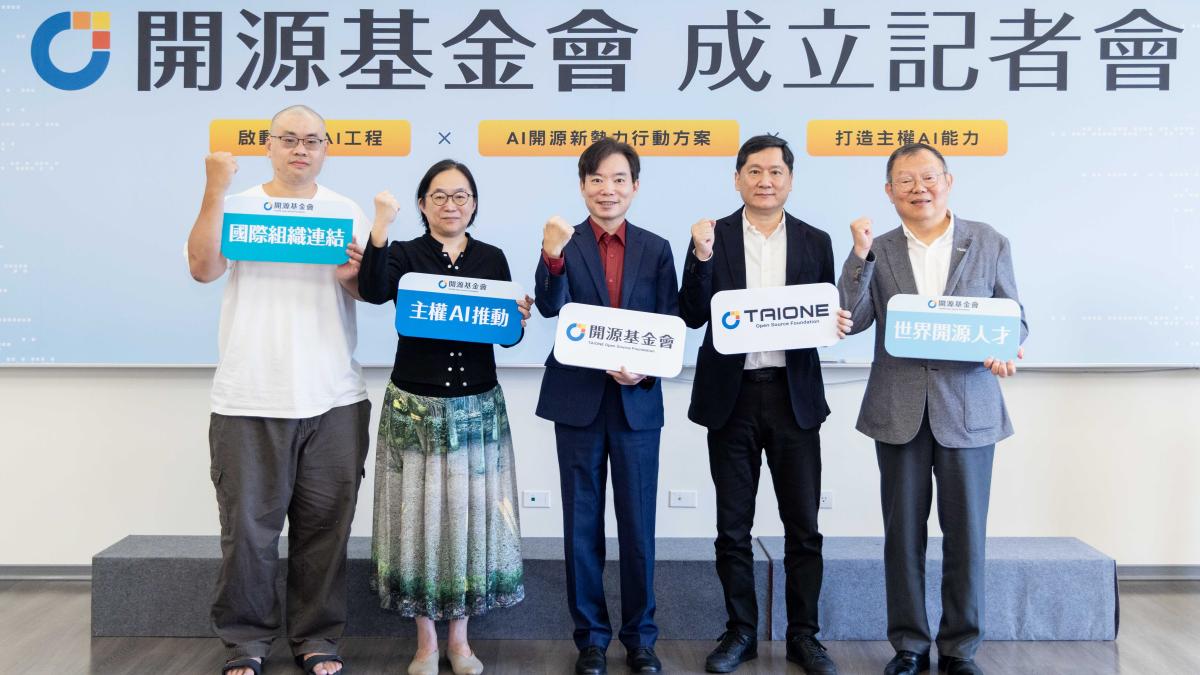
Taiwan has a global advantage in the semiconductor and AI server hardware supply chain, but the next AI competition has expanded to models, toolchains, data, software ecosystems, and technical standards. The Taiwan Open Source Foundation (TAIONE Open Source Foundation) was officially established today (30th) and announced that it will invest 300 million NT dollars in private industry resources over the next three years, focusing on 10-15 internationally important open-source projects such as vLLM, Kubernetes, Ray, and Apache Airflow. In collaboration with Wistron (3231), National Yang Ming Chiao Tung University, and the open-source technology community, the foundation aims to build a thousand-person local open-source community in Taiwan for each of these key projects.
Tsai Chi-yen, chairman of the Open Source Foundation, pointed out that Taiwan is in a golden period for AI hardware industry, but to extend this prosperity for 10 or 20 years, it must not only stay in the role of manufacturing and OEM, but must also enter the fields of models, software, development tools, and international technology governance. He emphasized, "Open source is not a choice for an industry, it is a matter of national destiny for Taiwan."
Tsai Chi-yen observed that the capabilities of open-source AI models, especially large language models, are rapidly catching up with closed-source models, which means that the main battlefield of global AI competition will further shift to the open-source world. Future competition is not only about who launches a larger model, but also includes toolchains, data, standards, governance, and developer ecosystems, which will jointly determine the success of the technology path.
He pointed out that Taiwan's AI manufacturing and OEM industry is at an unprecedented good time, but "the world will increasingly be defined by software, and value will be defined by software." To transform Taiwan's hardware advantages into the next decade's national competitiveness, it must evolve from past open-source technology users to contributors, maintainers, and participants in technical specifications and community governance.
Open source is no longer just a technical interest for a few engineers. According to the data quoted in the foundation's briefing, 97% of audited commercial code libraries contain open-source components, 70% of scanned code comes from open source, and each application contains an average of 911 open-source components.
Another piece of data from Sonatype shows that the download volume of the four major software package libraries, Maven Central, PyPI, npm, and NuGet, will reach 9.8 trillion times in 2025. This also means that when enterprises use open source, they must not only consider development efficiency but also face governance issues such as licenses, software vulnerabilities, software bills of materials (SBOM), supply chain security, and long-term operations.
Cheng Chi-yao, CTO of Wistron and a director of the Open Source Foundation, pointed out that Taiwan has built a globally leading hardware supply chain from upstream semiconductors to midstream components and downstream AI servers and system manufacturing, but still has a way to go in terms of software applications and AI implementation capabilities.
Cheng Chi-yao pointed out that Wistron has been continuously promoting the donation of computing power in the past one or two years, providing the company's built GPU clusters to schools and start-up teams, hoping to promote more AI application scenarios. Facing open source, Taiwanese enterprises used to be "desperate to use and secretly use," but now they should "open the door and take the main road," encouraging engineers to participate in international open-source communities and regard code contributions as part of their work.
"You should not deduct their salary or think their performance is poor just because employees engage in open source, because it is also part of their work," Cheng Chi-yao said. He pointed out that overseas large enterprises have long regarded open-source contributions as a norm, and Taiwanese enterprises should gradually establish the same mindset, allowing engineers not only to use open-source tools but also to participate in technology development and governance.
Cheng Chi-yao also revealed that Wistron recently became the first hardware manufacturer in Taiwan to obtain the ISO/IEC 42001 artificial intelligence management system certification, demonstrating that even in the hardware manufacturing industry, it is necessary to establish a management mechanism for responsible AI. He said that he hopes to link software, community, and industrial resources through the Open Source Foundation to bring Taiwan's hardware competitiveness to another milestone.
Lin Chi-hung, president of National Yang Ming Chiao Tung University and a director of the Open Source Foundation, pointed out that openness (Openness) and flexibility (Flexibility) are irreplaceable core values of higher education. Generative AI is rapidly changing the way students learn, and universities should not only cultivate talents who can use AI, but also allow students to participate in the co-development of world-class technology through open-source implementation and international cooperation.
Lin Chi-hung pointed out that the past learning model based on knowledge transmission needs to add more practical, exploratory, and open-source cooperation fields in the future, so that students can have the opportunity to contribute to the international open-source community during their studies. National Yang Ming Chiao Tung University has long been closely connected with the industry, and in the future, it also hopes to bring campus talents to a larger international technology stage through the foundation platform.
The foundation will first promote the "AI Open Source New Force Action Plan" (TAIONE Fellowship Program), concentrating resources on 10-15 core projects with international influence and industrial value, rather than spreading them thinly across many open-source projects.
The first wave of focus areas includes AI inference, cloud-native and low-level computing, big data workflows, distributed computing, and high-performance data engines, including projects such as vLLM, Kubernetes, Apache YuniKorn, Ray, KubeRay, Flyte, Apache Airflow, Apache Kafka, Apache Ozone, Apache Comet, and Apache DataFusion.
These projects are closely related to GPU memory usage efficiency, AI cluster scheduling, data pipelines, and high-performance computing, and directly drive the development of Taiwan's AI servers, computing power leasing, cloud services, and information services industries. Tsai Chi-yen said that if Taiwanese engineers can enter the core of these projects, they can not only grasp the direction of next-generation technology but also have the opportunity to make open-source software more efficiently adapt to the hardware produced by Taiwan's supply chain.
The foundation plans to build a three-tier talent structure for each project. The most core Track Lead will be undertaken by Taiwanese engineers who have already taken on roles such as Committer, Maintainer, or members of the Project Management Committee (PMC) in international projects; the second layer Fellow will be selected from students, researchers, and corporate engineers, receiving technical guidance and continuously contributing code; the third layer will be open to general developers, students, corporate engineers, and open-source enthusiasts.
Tsai Chi-yen said that the foundation hopes that each key project can gradually form a local community of thousands of people in Taiwan. This does not mean that thousands of people are all full-time engineers, but is composed of core contributors, talent cultivation, and general community participants, building a talent network that can inherit technology and experience in the long term.
To lower the economic threshold for students and young engineers to engage in open source for the long term, the foundation will provide Fellows with a monthly reward of 20,000 NT dollars. Tsai Chi-yen further explained at the scene that the relevant support starts at 240,000 NT dollars per year, combined with other bonuses, the annual support amount may be between 240,000 and 700,000 NT dollars, hoping that university students, graduate students, or young engineers do not need to take on other part-time jobs and can concentrate on international open-source projects.
Tsai Chia-ping, a director of the Open Source Foundation and Apache Local Community Taipei, pointed out that Taiwan is not lacking in world-class technical talents. There are already dozens of engineers who have taken on core roles such as Committer, Maintainer, or PMC in international projects, possessing technical speaking rights and decision-making power; but many of them later moved abroad or entered foreign companies, reflecting that Taiwan still lacks the system and industrial environment to support open-source talents to invest in the long term.
Tsai Chia-ping said that he hopes to integrate funds, computing power, mentors, and international community resources through the foundation to expand the current dozens of international core talents to hundreds of people, and then have the core talents drive a broader thousand-person participation community.
In addition to talent cultivation, the foundation will also promote sovereign AI. Tsai Chi-yen pointed out that sovereign AI should not be measured by whether it has a domestically produced large model or the percentage of domestically produced components.
"Sovereign AI does not necessarily need to emphasize the percentage of domestically produced components, but the dominance of value and rules," Tsai Chi-yen pointed out. On the one hand, the foundation will support the accumulation of language data, data sets, small and large models, pre-training, fine-tuning, benchmarks, toolchains, and deployment specifications by Taiwan's open-source community; on the other hand, it also hopes to transform the principles that Taiwan values, such as freedom, democracy, human rights, rule of law, privacy, diversity, and accountability, into executable and verifiable AI norms.
These results will be fed back to international open-source AI projects through upstream contributions in the future, so that Taiwan can not only use global technology but also bring its own technological achievements and value norms into the international ecosystem.
FACT BOX
- Source: PR Times
- Category: Event