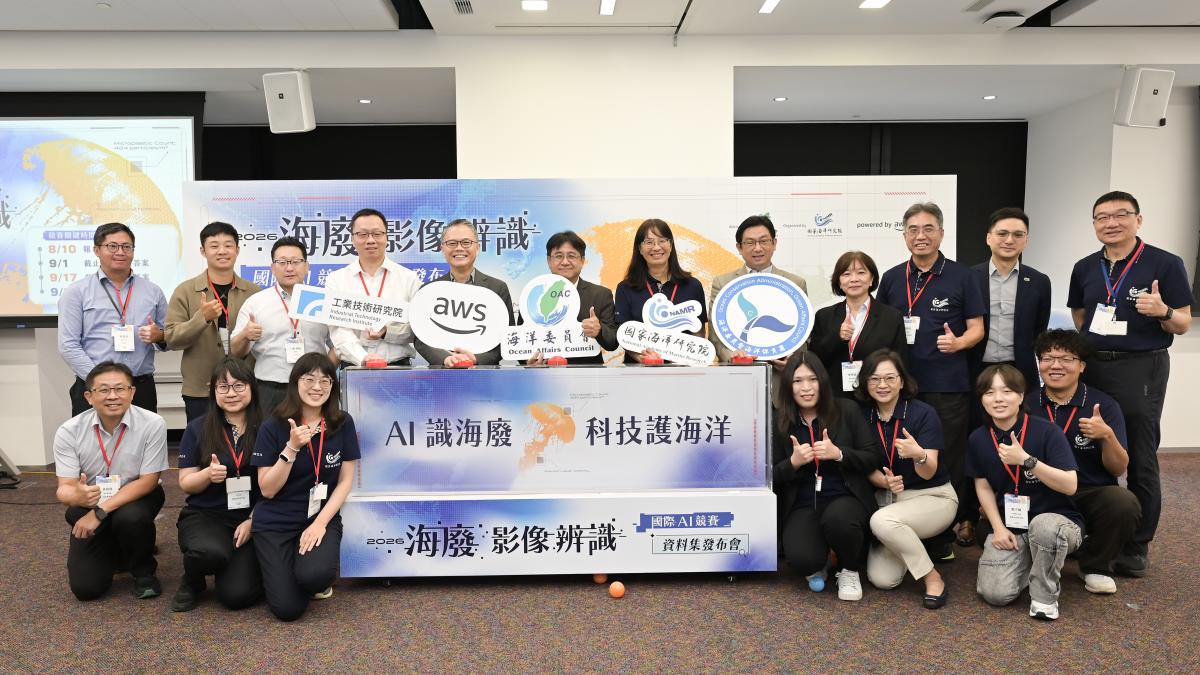
To accelerate the digital transformation of marine governance and improve the efficiency of marine debris monitoring, the National Academy of Marine Research (NAMR) under the Ocean Affairs Council officially released Taiwan’s first AI-ready "MDImageNet Marine Debris Image Dataset" today (30th), and simultaneously launched the "2026 International AI Competition for Marine Debris Image Recognition." This initiative is guided by the Ocean Affairs Council, with Amazon Web Services (AWS) providing cloud and AI technology support, and the Industrial Technology Research Institute’s (ITRI) AIdea platform managing competition execution. By combining high-quality open data with an international AI competition, the project aims to build a digital public infrastructure for marine governance and promote AI applications in ocean conservation.
NAMR stated that marine debris drifts across borders via ocean currents, and Taiwan’s coastlines have long faced the accumulation of both domestic and foreign marine waste. Traditional methods relying on manual patrols, classification, and documentation are time-consuming, labor-intensive, and lack consistent interpretation standards. To address this, NAMR has spent years developing the MDImageNet dataset, which now includes over 20,000 real coastal images and 42,000 labeled marine debris objects, forming a high-quality dataset suitable for AI model training.
The dataset is based on the International Coastal Cleanup (ICC) classification system and further adopts a three-tier NAMR classification framework (NAMR), balancing international alignment with domestic survey needs. It is openly licensed under CC BY 4.0, enabling academic institutions, research bodies, and industries to jointly develop AI-driven innovations.
Wu Hsin-hsiu, Vice Chairperson of the Ocean Affairs Council, stated that marine governance is entering a new phase of AI application. NAMR has already integrated a national marine data platform with over 30 billion marine data records. The council will continue advancing data standardization, structuring, and governance to transform this vast data into a foundation for AI training, marine research, and policy decision-making.
Chen Chang-ling, President of NAMR, emphasized that high-quality, shareable data is the cornerstone of AI development. The release of the MDImageNet dataset not only digitizes years of coastal survey work but also aims to foster collaboration among research institutions, academia, and industry in AI model training and technological development through open sharing.
Wang Ting-kai, Managing Director of AWS Taiwan, noted that Taiwan’s coastline exceeds 1,500 kilometers, making manual patrols costly and inefficient. Integrating drones, AI, automation, and cloud technologies will significantly enhance coastal monitoring. AWS aims to collaborate with government, enterprises, and startups to advance smart ocean initiatives and elevate Taiwan’s technological achievements on the global stage.
Ogura Tsuneyoshi, Director of Xpark, highlighted that businesses have long engaged in beach cleanups and marine conservation. The release of the marine debris image dataset demonstrates new possibilities in combining technology with environmental protection, benefiting not only Taiwan’s marine monitoring but also serving as a foundation for global marine scientific research, education, and international exchange.
Alongside the dataset release, NAMR launched the "2026 International AI Competition for Marine Debris Image Recognition," also unveiling the research team’s baseline model to serve as a benchmark for participants. The competition evaluates models based on mean Average Precision (mAP) and model lightweight efficiency, open to teams of high school, vocational, university students, and professionals. Registration closes on August 10, with a total prize pool of 300,000 NTD. A special "Best Lightweight Optimization Award" encourages models that balance high accuracy with deployment efficiency.
NAMR hopes the open dataset and international competition will gather cross-disciplinary talent in AI, computer vision, data science, and marine science, enabling technological innovation to be applied in marine environmental monitoring, pollution control, and sustainable management, advancing Taiwan toward a smart and sustainable ocean future.
FACT BOX
- Source: PR Times
- Category: Event
- Organizations: Amazon Web Services / Xpark