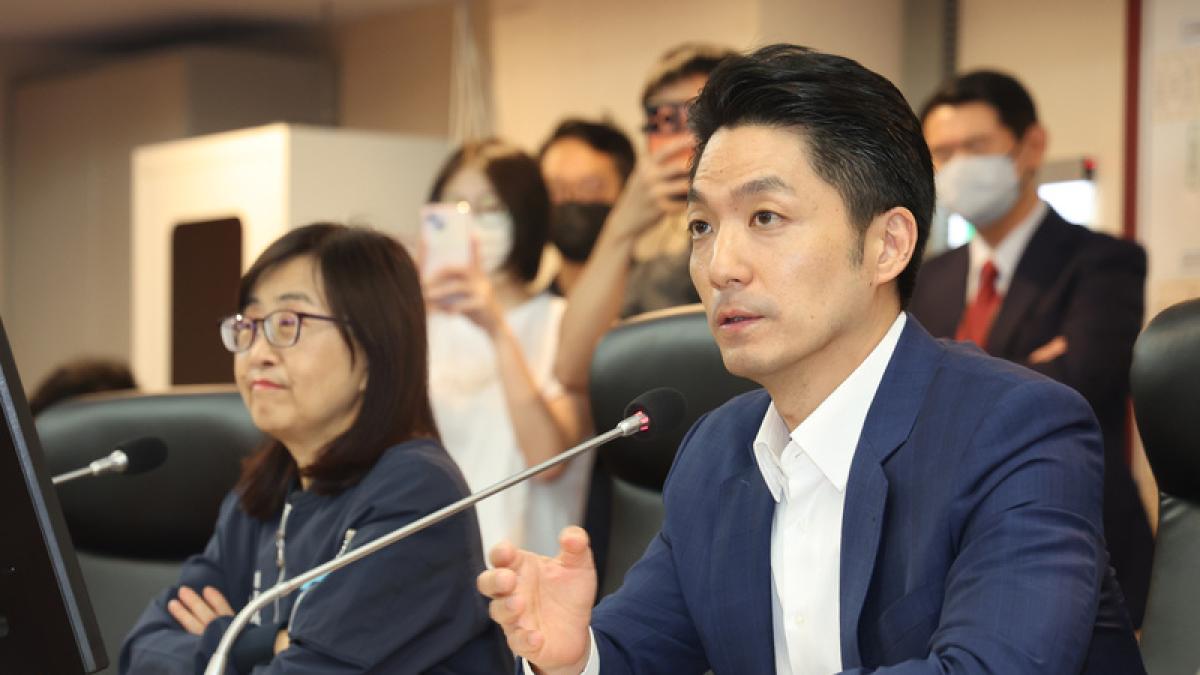
Shortly after calling for the 'July 25 Anti-Toxic Oil' movement, Taipei Mayor Chiang Wan-an has once again promoted a vote of no confidence (a motion to oust the Premier), but this time the Blue-White coalition did not rally behind him. The Taiwan People's Party countered sharply, insisting that 'toppling Lai' should be the priority. Most KMT legislators could only respond with bitter smiles: 'There is no consensus.' This is not the first time Chiang has proposed a no-confidence motion amid political turmoil. Last year, during the height of the mass recall campaign, he made a similar proposal, which was eventually dropped after discussion. Now, a year later, Chiang has pulled this sour, long-forgotten issue back out of the freezer.
Cho Jung-tai stands alone, effectively sidelining the Legislative Yuan. Chiang's persistent advocacy for a no-confidence vote is understandable. Under constitutional design, a no-confidence motion against the Premier is the Legislative Yuan's ultimate tool of oversight over the Executive Yuan. Cho's cabinet has served for over two years and 800 days, yet has known no peace. The 'mass recall' campaign lasted a full year, and the Executive Yuan has initiated 'review petitions' against eight bills and budgets passed by the Legislative Yuan—all of which failed. According to constitutional procedure, Premier Cho had only two options: accept the bills or resign. Instead, Cho created a 'constitutional first'—neither accepting nor resigning. Most absurdly, while the Executive Yuan (including the Presidential Office and other branches) filed cases with the Constitutional Court, Cho refused to countersign, preventing the President from promulgating laws and ministries from enforcing them. In short, Lai Qingde relies on Cho Jung-tai to single-handedly 'sideline' the Legislative Yuan.
In the past 800 days, Cho should have resigned at least nine times—eight failed review petitions and the disastrous mass recall campaign were all clear moments for resignation. Cho is not someone clinging to power, but his loyalty to preserving the DPP regime outweighs his sense of constitutional duty. After the mass recall failure, Cho did express resignation intentions multiple times. President Lai, citing unresolved tariff negotiations and unpassed budgets, persuaded him to stay and announced a 'four-part cabinet adjustment': (1) reorganize to make governance more tangible—though the month-long carcinogenic oil scandal showed no real improvement; (2) prioritize economic livelihood and youth welfare in policy sequencing, reflected in budgets and special allocations—yet youth housing 3.0 failed to gain traction, and special budgets focused only on weapons and drones; (3) improve executive-legislative interaction—empty promises, as Cho continued refusing to countersign, the Presidential Office withheld promulgation of passed bills, and independent agency appointments—from Grand Justices to NCC commissioners and PTS board members—were made without prior consultation with opposition parties, except for the CEC; (4) adjust national fiscal structure—yet the total budget exceeded NT$3 trillion, with defense and drone special budgets surpassing NT$1 trillion, making deficits worse, while also blocking legislative budget freezes.
Elections every two years—judicial threats loom, who among Blue-White legislators would risk their careers? A Premier with resignation intentions and zero willingness to coordinate with the legislature is the core problem. Whenever controversy arises, he sees only political maneuvering, losing the ability to perceive or solve issues. The carcinogenic oil scandal raged for a month, yet no one clarified whether the issue lay in raw materials or production processes. No government agency took responsibility. In short, from top to bottom, the DPP government refuses to 'admit fault.' For such a cabinet, what alternative is there to a no-confidence motion to force reorganization?
Politically, dissolving the legislature via a no-confidence vote could instantly heat up the otherwise cold local elections, creating a favorable atmosphere for the Blue-White camp—much like the 2018 local elections energized by the 'Han Wave' and eight referendums. Today's 'nine-in-one' elections need a similar 'political whirlwind' to rally supporters across districts. Though there are referendum proposals in the legislature, they lack grassroots petitioning, generating far less public enthusiasm than eight years ago. A legislative reshuffle triggered by a no-confidence vote, even without being a whirlwind, would still be a major disruption for the ruling party. More importantly, if legislators are re-elected, the presidential election 18 months later would be decoupled from legislative results, leaving Lai Qingde to run alone for re-election—an advantage for the KMT, whose leadership remains unclear.
Paradoxically, political calculations that seem beneficial from one angle may backfire. What appears advantageous for the KMT could also be a major liability. First, KMT legislators who just survived the mass recall would face re-election again—effectively three elections in two years—who could endure that? Their 'fighting spirit' falls far short of constitutional logic. Second, while the DPP government shows fatigue, it is far from weak. When cornered, its combativeness and ruthlessness surpass that of a demoralized KMT. During the recall campaign, the KMT loudly called for 'recalling the Green,' but all efforts failed under prosecutorial pressure. Dissolving the legislature sounds easy, but who can guarantee how many legislators will face judicial intervention mid-process?
Lee Teng-hui's 'constitutional monster' has become a shield protecting the Lai administration's dysfunction. With only four months until year-end elections, Cho's departure is 99% certain—the only question is whether he resigns over defeat or after completing a phase. Under constitutional procedure, a no-confidence motion requires the Premier to resign within ten days and request the President to dissolve the legislature. The President may consult the legislature and announce dissolution within ten days, with re-election within 60 days. To align with the nine-in-one elections, the legislature must pass the motion at least two months in advance. But is it worth risking a full re-election just to make Cho look bad—the first Premier ever ousted by such a motion?
Most critically, post-amendment institutional design overwhelmingly favors executive power. The legislature lost its approval power over the Premier and, despite having the right to propose no-confidence motions, cannot decide on a successor. Even if a motion passes, the President may or may not dissolve the legislature and can reappoint a Premier who still ignores Blue-White legislators' preferences. That's why Chiang Wan-an named Kaohsiung Mayor Chen Chi-mai as a suitable candidate—not necessarily to exploit DPP factionalism, but because he assumes Lai will appoint a party insider. Chen, a former Vice Premier with strong local support, fits the profile. But Chen has no reason to accept. Even if he becomes Premier, his term ends in four months—why rush to Taipei two months early? If he does, he'd have to shoulder not just Kaohsiung but nationwide election responsibilities. If a full legislative reshuffle results in another 'small ruling party, large opposition' scenario, would Chen have to resign again? Or follow Cho's example and claim elections are irrelevant?
Taiwan's democracy is full of miracles. On the 30th anniversary of direct presidential elections, after seven constitutional amendments, we witness the 'tremendous achievement'—our 'system' is fundamentally flawed and dysfunctional, essentially unwork able. If the ROC Constitution is a patchwork car, the constitutional amendments are a Frankenstein of secondhand parts—an awkward hybrid that frequently breaks down. Beyond regular elections, changing drivers depends solely on conscience. Former DPP Chair Hsu Hsin-liang called Lee Teng-hui, the architect of these amendments, a 'DPP member serving as KMT chairman.' Only after ten years of continuous DPP rule has it become clear that this design renders opposition oversight completely ineffective—a true 'masterpiece.' Yet, if Lee were alive today, he might struggle to tolerate how dysfunctional DPP governance has become!
FACT BOX
- Source: PR Times
- Category: News