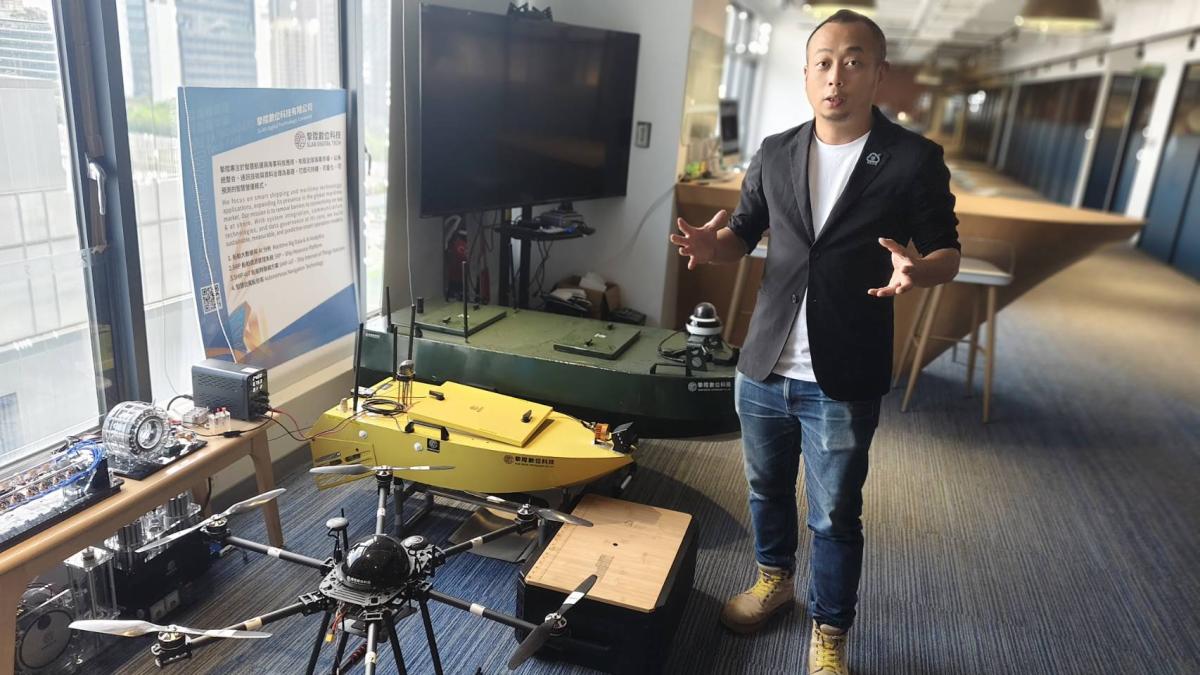
A new face has emerged among the Democratic Progressive Party's candidates for the Cianjhen and Xiaogang district city council elections! Wu Yu-Feng, a tech entrepreneur honored with the Ministry of Economic Affairs' highest 'New Venture Award' and ranked among the top 20 in Digital Times for two consecutive years, has officially announced his entry into politics this year. As an atypical political newcomer, he states he will leverage his hands-on experience in the tech industry to chart a path of transformation for Cianjhen and Xiaogang—areas dominated by traditional manufacturing—toward 'value amplification and labor-capital win-win' outcomes, with a strong focus on developing the unmanned vessel industry.
Kaohsiung is a convergence hub for industry, government, academia, and research, with nearly half of its key players concentrated in Cianjhen and Xiaogang.
Regarding Kaohsiung’s advantages in developing an unmanned vessel industry, Wu Yu-Feng cites analysis by Dr. Hu Hui-Wen, a professor at National Pingtung University of Science and Technology: 'From the industrial sector and government agencies to academic and research institutions, all the key forces required to build unmanned vessels are gathered in Kaohsiung, with nearly half located in Cianjhen and Xiaogang. This provides the most complete conditions for developing an unmanned vessel industry.'
Wu further outlines Kaohsiung’s local strengths:
Heavy Industry and Energy Giants: - China Steel provides critical high-strength steel and wind power structures. - CPC Taiwan refines lightweight composite materials, anti-fouling coatings, and anode battery materials. - CSBC Corporation handles platform design, system integration, and military/commercial-grade construction.
Policy Agencies and Top-Tier Academic Research: - The Ocean Affairs Council has formulated a three-phase 'Unmanned Vehicle Technology Capacity Development Plan'. - National Sun Yat-sen University specializes in underwater technology and has successfully developed a domestically produced manned research submersible capable of carrying two people and diving to 500 meters. - National Kaohsiung University of Science and Technology focuses on intelligent vessels and green energy propulsion.
National-Level Research Institutes: - The Metal Industries Research & Development Centre has established an 'Unmanned Vehicle Laboratory' at Hsingta Harbor. - The National Academy for Marine Research achieves high-precision integrated above-water and underwater depth measurement. - The National Research Institute of Oceanography uses towed sonar systems for deep-sea exploration.
'Unmanned vessels are not distant futuristic technology, but a new market that traditional manufacturers in Cianjhen and Xiaogang can enter using their existing equipment!' This view from Dr. Wang Chao-Chang, former Director of the Ocean Affairs Council, precisely aligns with Wu Yu-Feng’s policy core.
Wu Yu-Feng consults with Dr. Wang Chao-Chang, former Director of the Ocean Affairs Council and board member of CSBC, to build an unmanned vessel supply chain that injects a revitalizing force into traditional industries in Cianjhen and Xiaogang, establishing Kaohsiung’s true marine technology brand. (Photo: Provided by Wu Yu-Feng's Office)
Breaking Free from the 'Prototype' Trap! Transforming Traditional Factories in Zhen-Gang to Capture the 80 Billion NTD Defense and Non-Red Supply Chain
Wu Yu-Feng candidly admits that many traditional black-industry factories have long complained, 'We only produce one or two prototypes, so we can't make any profit.' But the global situation has drastically changed. Under the backdrop of AIT Director Brent Christensen emphasizing that 'drones/unmanned vehicles enhance defense capabilities and bring economic opportunities,' Taiwan’s defense autonomy and cross-industry integration have become essential demands.
'In the central government’s estimated 250 billion NTD budget for defense autonomy and emerging vehicles, the output value of unmanned vessels is conservatively estimated at 80 billion NTD!' Wu Yu-Feng sharply points out. If Kaohsiung can channel these orders to local factories, placing orders for tens of thousands of units at once, it could drive mold engineering and mass production. Metal processing, plastic injection, motor manufacturing, power supplies, and AI information services could all share in the profits.
More crucially, there’s a 'labor-capital win-win' mechanism. Wu Yu-Feng likens it: 'A light bulb on land sells for 100 NTD, but an underwater-capable bulb is worth 10,000 NTD, with profits several times higher than basic products.' Business owners enter high-value 'non-red supply chains' and system solutions, diversifying orders; workers gain skill upgrades through training in AI driving and sensors, leading to overall wage increases.
Proposing the Establishment of a 'Greater Southern Unmanned Vessel Industrial Park'! Value Spillover to Energize Local Economies
To ensure policy implementation, Wu Yu-Feng advocates designating the Dalinpu Circular Materials Park as the site for a 'Greater Southern Unmanned Vessel Industrial Park.' This location can integrate traditional industries from both Kaohsiung and Pingtung, jointly creating Taiwan’s unique unmanned vessel demonstration and production base. Zheng Xi-Kun, Chairman of Ming Ann Group, also affirms the industry’s potential: 'Human flow is cash flow. The unmanned vessel industry not only brings white-collar and blue-collar mobility but also stimulates surrounding economies through business exchanges.'
Wu Yu-Feng emphasizes that once high-salary, high-value tech industries are established, the resulting 'spillover effect' will directly benefit local livelihood economies:
Food and Daily Consumption: - Influx of talent directly boosts local restaurant revenues.
Real Estate and Hospitality: - Long-term employment population stimulates the housing market; business travel energizes local accommodations.
Transportation and Daily Services: - Increased MRT and taxi ridership drives demand for daily clothing and entertainment.
Education Investment: - Higher incomes enable families to invest more in self-improvement and children’s education.
Speaking about his motivation for running for city council, Wu Yu-Feng frankly states he does not intend to follow the traditional political path of building support bases, consolidating votes, and organizing services. Instead, he hopes to leverage the innovative thinking, flexible marketing strategies, and broader industrial vision of a corporate CEO to upgrade traditional industries in Cianjhen and Xiaogang and integrate them into the global unmanned vessel supply chain, fundamentally improving the local economic structure and realizing a vision of shared prosperity and universal wealth for Zhen-Gang residents.
Wu Yu-Feng concludes that unmanned vessels are the key to value amplification—not only enabling Taiwan to move from domestic defense to the global blue ocean of non-red markets but also injecting a revitalizing force into traditional industries in Cianjhen and Xiaogang, establishing Kaohsiung’s true marine technology brand. He hopes to leverage the innovative thinking, flexible marketing strategies, and broader industrial vision of a corporate CEO to upgrade traditional industries in Cianjhen and Xiaogang, fundamentally improving the local economic structure and realizing shared prosperity for residents. (Photo: Provided by Wu Yu-Feng's Office)
FACT BOX
- Source: PR Times
- Category: News