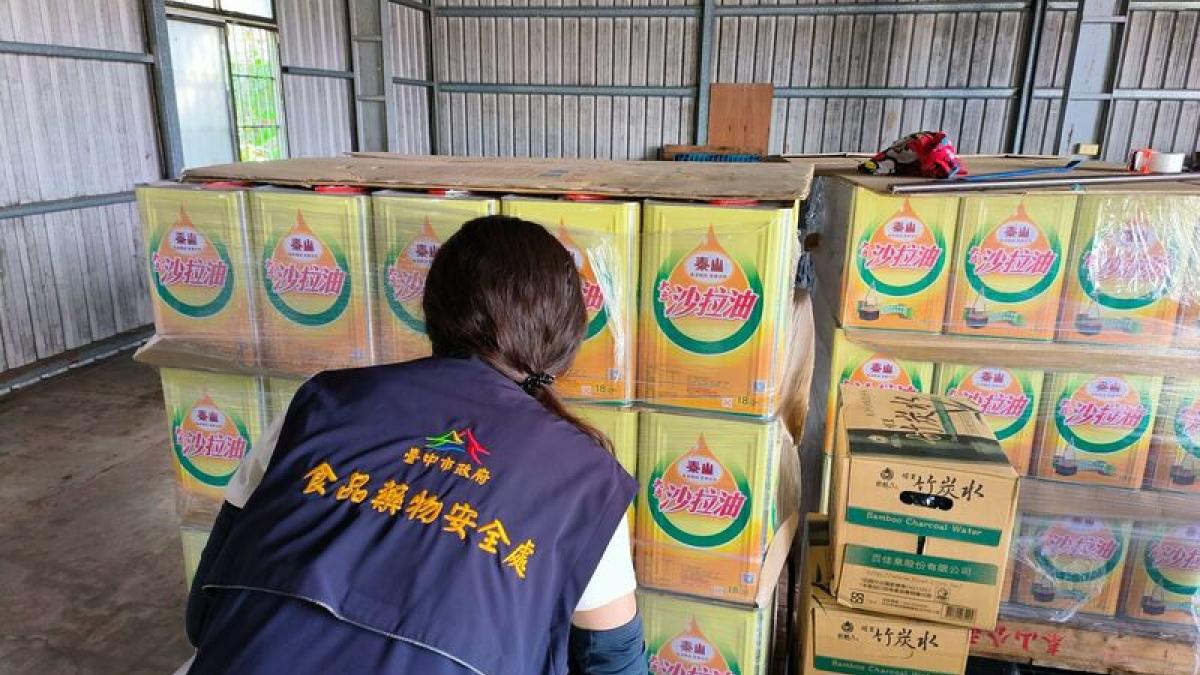
When the food oil benzo[a]pyrene exceeded the standard in July, the cancer-causing oil incident became uncontrollable. Public opinion was heated, and the public and legislators kept asking: 'Where did the poisonous oil from Chunglien Oil flow to?' 'Did Fushou, Fuma Oil, and Taishan use it? How much did they use?' At the press conference, when officials showed one chart after another, the outside world might have thought this was the result of some high-tech big data management. But the truth is, there was no AI behind this, and even the 'food cloud' that the government claimed to have built for many years was completely dysfunctional. This was a report made by 60 people who were urgently called back during the typhoon holiday, locked in the office of the Food and Drug Administration, using the most primitive 'worker wisdom', working day and night, using their eyes, hands, and even 'making phone calls' to check one by one. From the 'Silicon-based Persona' of DBS Bank, Looking at the 'Carbon-based Brawl' of Taiwanese Civil Servants To understand how absurd this 'worker wisdom' is, we might as well look at how the international financial industry uses AI. Singapore's DBS Bank (DBS) has already created a dedicated 'digital twin (Digital Twin)' for front-line customer service personnel. Under this framework, AI is no longer just a rigid search tool, but a 'living silicon-based persona'. This persona not only understands complex financial regulations but is also deeply integrated into the corporate culture. When a customer service representative faces a large and complex set of customer needs, his digital twin has already automatically completed data retrieval and compliance review in the background. This is not about replacing humans, but using 'silicon-based personas' to fend off the first wave of information, freeing humans (carbon-based) from repetitive, high-energy-consuming quagmires, allowing them to focus on more nuanced decisions. However, when we turn our attention to Taiwan, known as the high-tech island, the scene of food safety management, which is crucial to public health, is a most primitive 'carbon-based brawl'. When the Food and Drug Administration and local health units found that they could not grasp the complete upstream and downstream data, the officials had no choice but to directly dispatch personnel to Chunglien Oil, Taishan, Fuma, and Fushou, old-brand food factories, to collect data. What was brought back to the Food and Drug Administration was not cloud database connection files, but piles of paper and messy tables. The information chain within these food factories was not integrated at all: the procurement department knew which month and day the oil was received; the manufacturing department poured the oil into the mixing tank, made what products, and did not know; the shipping department shipped every day, but did not know which products used which oil. When the large factories themselves first argued among themselves and could not give an answer, the Food and Drug Administration had no 'digital twin' to take over, and could only regress to having grassroots civil servants use 'worker wisdom' to 'reconcile' with their eyes. More ironically, this incident completely exposed the government's long-chanted digital governance. According to statistics, the total amount of problematic oil products confirmed this time was about 3,915 tons (initially estimated at 1,300 tons), and the actual recall amount was only about 144 tons, with an overall recall rate of only about 3.3% to 3.7%. In other words, the problematic oil that exceeded the standard had already flowed into the market and was eaten by unsuspecting consumers. When the government initially invested in designing the 'food cloud', it looked very open and transparent. However, insiders know that what is called the 'food cloud' is essentially just a formal 'call for businesses to upload files'. It is a static file and has no ability to actively reconcile. What businesses report are rigid historical invoices or shipping documents, but the production line changes dynamically every day. Once it involves the 'large reservoir principle' of the mixing tank, the information chain immediately derails. This is similar to the school nutrition lunch system of educational institutions, which calls for catering businesses to upload menus every day, but similarly cannot reconcile when something goes wrong. As the poisonous oil spreads, the so-called big data eventually degenerates into 'public servants making phone calls one by one or personally inquiring verbally at downstream factories'. This absurd inspection method, even if all the civil servants in Taiwan are exhausted, the data will never be reconciled. Key generational gap: What if food safety management introduces Digital Twin? If DBS Bank can create a persona for customer service representatives, then food safety management, which concerns the health of all Taiwanese people, should have a 'digital twin (Digital Twin)' connecting the food supply chain to the government management system. In the concept of Industry 4.0, Digital Twin can perfectly replicate a real-world dynamic process in the virtual world. If AI Agent is used as the digital twin of Food and Drug Administration civil servants, the entire society's script for facing food safety storms will undergo a precise transformation: 1. Blocking food safety loopholes: Reducing the 'one-week time difference' to 'graded response' Currently, just manually investigating, reconciling, and making phone calls often drags on for more than a week. This fatal 'one week' is the golden period for black-hearted food to spread in the market, resulting in hundreds of tons of poisonous oil already eaten by the public. But if there is a Digital Twin, once the source of Chunglien Oil tank is found to contain carcinogens, the AI twin of civil servants can, in the 'first moment (within a few minutes or even a few seconds)', automatically track along the dynamic footprint in the virtual system to instantly trace where this batch of oil flowed to which factory's mixing tank, which batch number of products it was made into, and which shelves of which convenience stores it was stocked on. AI can lock on precisely in the first moment, issue warnings, and immediately recall, so that the public eats less problematic oil, controlling health risks to the lowest level. 2. Protecting industrial economy: Rejecting 'preventive recall' that might kill a hundred innocents Due to the broken information chain within traditional food factories, even large factories themselves don't know which products used the problematic oil. In this situation, the government, in order to appease public outrage, often has to adopt a brutal 'preventive recall' - as long as you have purchased from the problematic source, regardless of whether your products are mixed with poisonous oil, first recall and then say. This causes many manufacturers with compliant processes and problem-free products to suffer huge reputational and business losses. But if there is a precise strike by Digital Twin, since Digital Twin has strong dynamic analysis capabilities, it can accurately interpret the 'large reservoir principle (mixing tank)' in complex processes. AI can clearly distinguish: for example, Taishan's A production line mixed problematic oil at 2 pm, but B production line used completely clean raw materials. In this way, the government only needs to 'targeted removal' of truly problematic batches, and other safe products can continue to be sold. This not only protects innocent traditional industry players, avoids the entire industrial chain being sacrificed, and also maintains the public's confidence in the overall market. Perhaps some industries resist informatization because 'the less informatized and the more ambiguous, the safer for businesses, and the easier to mix when something happens'. However, the government has long lacked a medium- to long-term digital transformation roadmap and is only satisfied with the false KPI of 'businesses just need to upload files'. The ultimate destination of sovereign AI is the 'tangible protection' on the people's dining table This cancer-causing oil food safety storm has been burning for a month and still cannot be stopped, which is due to the serious negligence of the country's food safety management upgrade. This cancer-causing oil incident should be a heavy wake-up call for Taiwanese society: we cannot enjoy the economic fruits of a high-tech island while enduring the 'worker wisdom' way of working that cannot even track the flow of oil products. When we talk about 'sovereign AI', it should absolutely not just be a lofty technological term in the science park, nor should it just be a cold proprietary term in the budget book. True sovereign AI must be realized in the details of national governance and transformed into a concrete force to improve people's lives and enhance government efficiency. Every citizen's food eaten every day deeply affects the health of the people, the happiness of families, and even the foundation of national prosperity. And food safety management is the most down-to-earth and most tangible aspect of sovereign AI. When the government sings about digital development, please put real technology on the cutting edge. Build a 'sovereign AI' infrastructure that understands local industries and actively guards national health, and don't let grassroots civil servants use their burning livers to fill the most ironic digital black hole of this technological island. Because the strength of a country does not depend on how many chips we manufacture, but on whether we can use the wisdom behind these chips to let every citizen eat every meal with peace of mind.
FACT BOX
- Source: PR Times
- Category: 调查