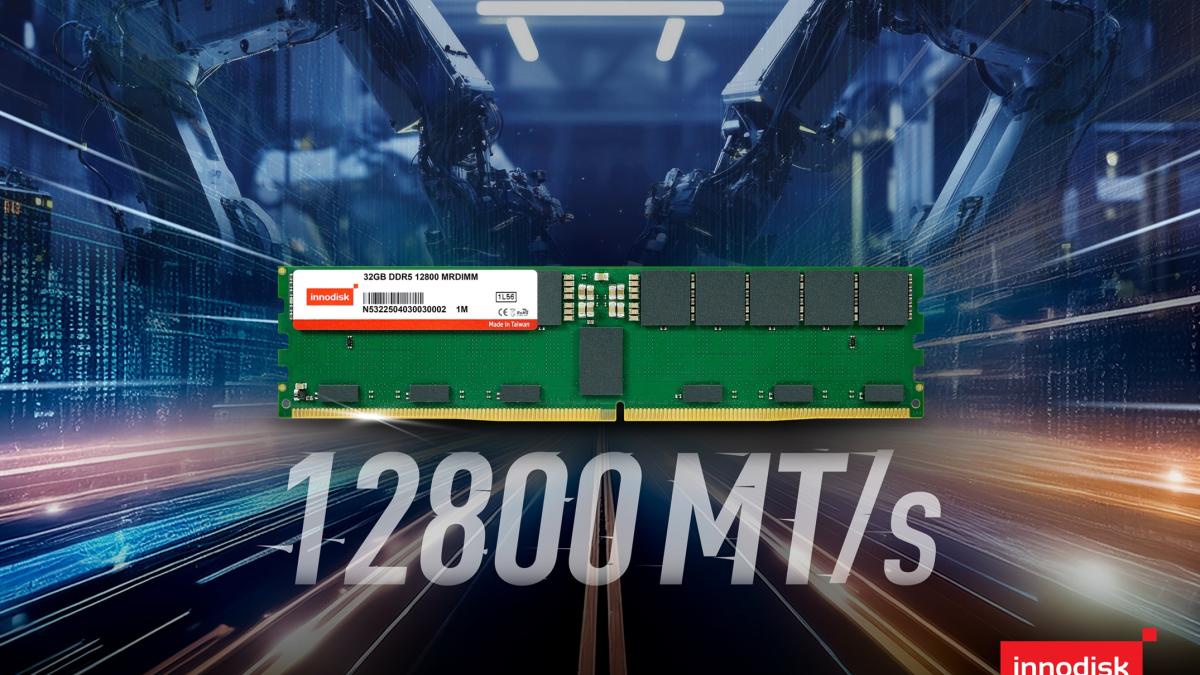
AI servers continue to scale up CPU core counts and GPU computing power, but the bottleneck slowing overall system performance is increasingly shifting to whether data can be delivered to processors in a timely manner. Industrial storage and memory module manufacturer Innodisk (5289) has announced the launch of its next-generation DDR5 MRDIMM. By incorporating MRCD (Multiplexed Rank Clock Driver) and MDB (Multiplexed Rank Data Buffer) components, along with an architecture enabling simultaneous access to two memory ranks, the module boosts data transfer rates to 12,800 MT/s—60% higher bandwidth compared to existing DDR5-8000 RDIMM. Targeting data-intensive applications such as generative AI, large language models (LLMs), cloud computing, and edge AI, samples are scheduled to begin shipping in the fourth quarter of 2026.
With the rapid development of generative AI, LLMs, and robotics applications, CPU and GPU specifications continue to upgrade to handle increasingly large model training and inference workloads. However, the faster processors become, the more critical it is for the system to move data at higher speeds. If memory bandwidth does not keep pace, even the most powerful computing cores may remain idle waiting for data, creating the so-called 'memory wall.'
In other words, CPUs and GPUs are like factories constantly adding machines to increase production capacity, while memory is responsible for supplying raw materials. If data supply cannot keep up, adding more computing cores will not fully unlock performance. This makes memory bandwidth the next critical bottleneck that system vendors must address as AI infrastructure continues to expand.
Simultaneous Access to Two Memory Ranks Boosts Bandwidth by 60% Over DDR5-8000 RDIMM
Innodisk’s newly launched DDR5 MRDIMM integrates MRCD (Multiplexed Rank Clock Driver) and MDB (Multiplexed Rank Data Buffer) components, utilizing an architecture that allows simultaneous access to two memory ranks to increase data throughput between the processor and memory.
With this architecture, Innodisk has pushed memory transfer rates to 12,800 MT/s—60% faster than current DDR5-8000 RDIMM. The company states that MRDIMM not only expands bandwidth but also reduces memory controller load and improves latency, enabling CPUs and GPUs to access required data faster and thereby enhancing overall system performance.
However, Innodisk’s claim of 'doubled bandwidth' primarily refers to the architectural feature of MRDIMM enabling simultaneous access to two memory ranks, not that all AI workloads will see a direct doubling of performance. Based on the company’s explicit comparison, 12,800 MT/s represents a 60% bandwidth increase over DDR5-8000 RDIMM. The actual improvement in model training and inference performance will depend on the CPU, GPU, software, and specific workload.
In terms of compatibility, Innodisk’s DDR5 MRDIMM uses a 287-pin design and maintains compatibility with DDR5 RDIMM slots, lowering the barrier for server and system vendors to redesign hardware. However, slot compatibility does not mean all existing DDR5 servers can directly swap in the module—actual deployment still requires CPUs, memory controllers, and server platforms that support MRDIMM.
Maximum Capacity 128GB: Innodisk Expands from Industrial Control and Edge AI to High-Density Computing
Product specifications include capacities of 32GB, 48GB, 64GB, 96GB, and 128GB to meet varying memory demands across different AI models and computing scenarios. The module supports operating temperatures from 0°C to 95°C and integrates eFuse electronic fuses and TVS transient voltage suppression protection to ensure stability under high-speed operation.
Innodisk has long focused on the industrial storage and industrial control memory markets and has recently expanded its edge AI product portfolio. This move into DDR5 MRDIMM reflects the company’s strategic expansion from industrial control and edge inference into data-intensive computing markets such as generative AI, LLM training, and cloud servers.
Chang Wei-Min, General Manager of Innodisk’s Industrial DRAM Business Division, stated that while the company continues to deepen its presence in industrial markets and expand edge AI demand, it is also developing next-generation memory solutions for more data-intensive AI applications.
'The DDR5 MRDIMM we are launching today achieves a breakthrough in memory performance through innovative architectural design,' said Chang. 'By aligning memory speed with CPUs and GPUs, we can further improve computing performance for applications such as generative AI and large language model training.'
Targeting LLM Training, Cloud, and Robotics: Sample Timeline Depends on CPU Platform Progress
Innodisk notes that when processing the same AI language model, systems using MRDIMM can improve token-based data processing efficiency through higher memory bandwidth and optimized core configurations. In addition to generative AI and LLM training, the product targets cloud computing servers, edge AI inference, 3D modeling, and robotic arms.
Innodisk’s DDR5 MRDIMM is scheduled to begin sample shipments in Q4 2026, with plans to expand into different capacities and customized specifications afterward. However, the company emphasizes that actual progress may be adjusted based on JEDEC standards and CPU platform development, indicating the product is still in the early stages of ecosystem validation and customer onboarding. Whether it can smoothly transition to mass production will depend on processor support, platform validation, and customer testing timelines.
FACT BOX
- Source: PR Times
- Category: New Product
- Products / services: DDR5 MRDIMM