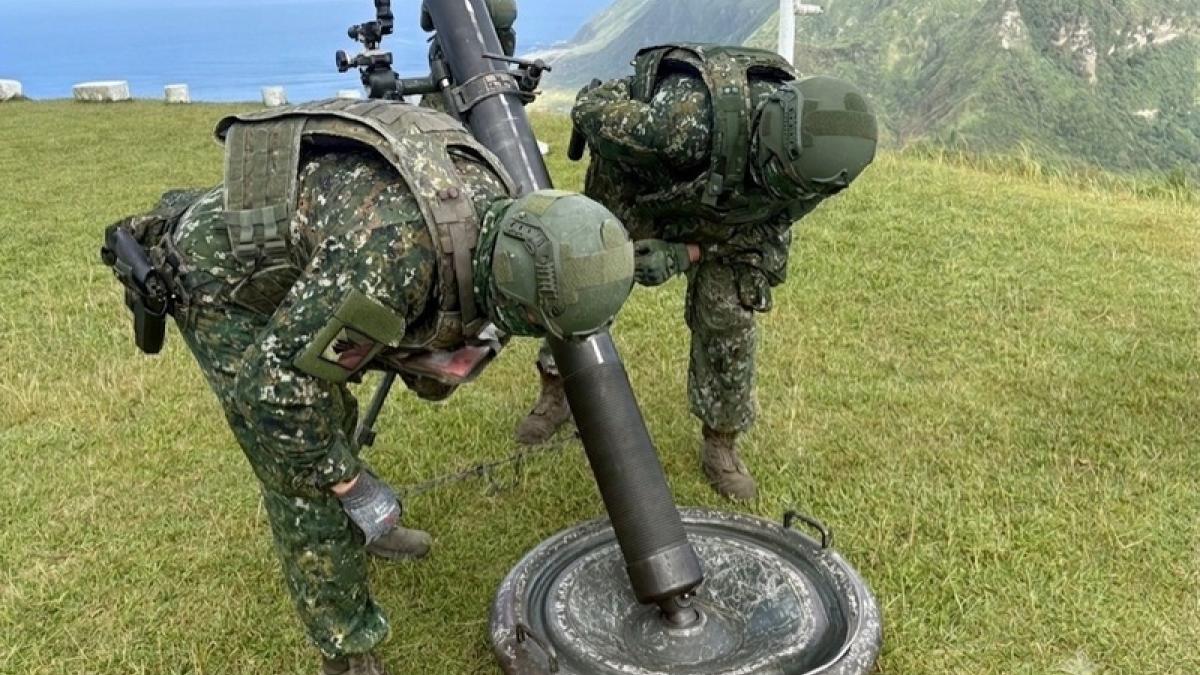
Following the conclusion of the 'Immediate Combat Readiness Drill,' the 'Joint Defense Drill' ended on July 17. The final phase of the military's summer 2026 exercise trilogy, 'Han Kuang 42,' will take place from August 5 to 14. This year, for the first time, the military conducted two five-day preliminary drills—'Immediate Combat Readiness' and 'Joint Defense'—before the main Han Kuang live-fire exercise. While these drills have significantly increased military visibility, they have also raised public questions about the need for such frequent and intensive training. Notably, during the recently completed 'Joint Defense Drill,' the military unusually deployed ground forces from the Second作战 Zone (Hua-Tung Defense Command) to reinforce Orchid Island and Green Island. The landing on Orchid Island marks the first such drill in nearly three decades, drawing significant attention and sparking debate over its strategic value.
Shift in Military Mission and Tactics
Why did the military conduct these two preliminary drills before Han Kuang this year? The shift reflects a broader change in the military’s wartime mission—from contesting air and sea control around Taiwan against the PLA to a strategy of 'denial.' The goal is no longer to win outright but to prevent the PLA from quickly seizing full control of Taiwan. To achieve this, the military has adopted an 'Erosion Strategy,' leveraging asymmetric warfare concepts. By exploiting Taiwan’s geographic advantages for prolonged defense, the military aims to wear down invading forces across six phases: 'routine crisis management,' 'combat readiness deployment,' 'joint anti-landing,' 'coastal and beach combat,' 'in-depth defense,' and 'protracted warfare.' The plan involves deploying layered defenses and multiple lines to inflict heavy casualties through sustained firepower, ultimately forcing the PLA to abandon its campaign.
In response to these strategic and tactical changes, Taiwan’s 'joint operational plans,' 'rules of engagement,' and combat doctrines have been substantially revised. This includes updates to troop movement routes, force preservation locations, tactical positions, command posts, main and reserve positions, defensive fortifications, communication nodes, and logistics supply points. However, since these revisions were finalized less than three years ago, many commanders and units still lack full familiarity with the new plans. Hence, the Ministry of National Defense introduced the 'Immediate Combat Readiness' and 'Joint Defense' drills before Han Kuang to deepen understanding and improve the effectiveness of subsequent live exercises and plan validation.
Differences Between the Two Drills
The 'Immediate Combat Readiness Drill' corresponds to the pre-war phases of 'routine crisis management' and 'combat readiness deployment.' A military invasion of Taiwan would not occur suddenly but would follow a period of escalating cross-strait tensions. During this phase, the PLA is expected to conduct high-intensity gray-zone operations around Taiwan—exerting pressure while concealing its initial deployments and justifying domestic mobilization and logistical preparations. As war has not yet begun, the military must handle potential incidents according to the new 'rules of engagement' to avoid giving the PLA a pretext for escalation. Simultaneously, it must gradually raise alert levels based on PLA invasion indicators—moving forces from garrisons to preservation sites, pre-establishing positions, setting up obstacles, and arranging supply points.
The 'Joint Defense Drill,' on the other hand, simulates post-war phases: 'joint anti-landing,' 'coastal and beach combat,' 'in-depth defense,' and 'protracted warfare.' Its focus is on troop mobility, cross-regional reinforcement, fortification construction, obstacle deployment, various defensive operations, decentralized command and control, and logistics resupply under enemy fire.
The Second作战 Zone recently conducted 'island defense drills' in Green Island and Orchid Island, using drones for tactical reconnaissance to prevent enemy occupation. (Provided by the Second作战 Zone)
In essence, the two preliminary drills help commanders and troops master the more predictable and fixed elements of the new rules of engagement and joint operational plans. During the August Han Kuang exercise, the command headquarters will introduce unexpected scenarios mid-operation, requiring participants to respond flexibly based on their understanding of their missions and the defense plan. This tests both unit responsiveness and the plan’s validity, identifying areas for improvement.
This is analogous to a professor guiding graduate students through key theories before an exam. The preliminary drills are like pre-exam reviews, while Han Kuang is the final exam—where students must apply theoretical frameworks to analyze and argue complex questions, not just write freely.
Orchid and Green Islands as Potential PLA Fire Support Bases
The decision to resume drills reinforcing Orchid and Green Islands after decades stems from the PLA’s growing power projection capabilities. There is now a real possibility that, shortly after hostilities begin—or even during the 'joint firepower strike' phase—the PLA could launch airborne operations from Type 075 or future Type 076 amphibious assault ships. With air cover from a carrier strike group operating about 380–420 km south of Miyako Island, PLA ground troops could seize Orchid and Green Islands via helicopter.
Once occupied, the PLA could use air-cushioned landing craft (LCACs) to transport long-range rocket artillery to the islands, transforming them into forward firebases. With 370mm rockets having a range of 280–300 km, nearly all key military targets in eastern Taiwan—including Su’ao Port, Hualien Port, the entrances and access roads to Jiashan Base in Hualien, and Shizishan Base in Taitung—would fall within range. Even some military facilities in southern Taiwan could be threatened.
During the PLA’s 'joint firepower strike' phase, long-range rockets capable of crossing the strait will be heavily used. However, due to their ballistic characteristics, these rockets are less effective against eastern Taiwan. By seizing Orchid and Green Islands early and establishing rocket artillery bases, the PLA could launch sustained precision strikes from both west and east, severely undermining Taiwan’s force preservation strategy.
During the 'Mission of Justice-2025' exercise from December 29–30, 2025, the PLA deployed an amphibious strike group centered on the Type 075 amphibious assault ship Hainan, comprising four warships, into waters about 296–315 km southeast of Eluanbi. According to the PLA Daily, the drills—supported by the Eastern Theater Command’s navy and drones—tested 'three-dimensional deployment' and 'precision raid' capabilities against simulated targets, verifying the ability to 'precisely strike key points.' This indicates a credible threat of PLA amphibious forces conducting airborne operations from southern or southeastern waters to seize Orchid Island, Green Island, or other eastern coastal targets.
Orchid Island as a Helicopter and Drone Base
If the PLA captures Orchid and Green Islands and secures local air superiority, the islands could serve not only as firebases but also as forward operating bases for army aviation helicopters. This would reduce transit times for transport and attack helicopters, increasing sortie rates and loiter time over eastern Taiwan. This would enhance the PLA’s ability to deliver firepower, conduct airborne assaults on key land targets, and support ground operations during an eastern invasion. It would also reduce the risk of exposing high-value assets like Type 075 or 076 amphibious assault ships to Taiwan’s land-based anti-ship missiles.
Recent Chinese military writings emphasize the importance of forward staging bases for army aviation in a Taiwan invasion. Orchid Island is about 90 km from Taitung’s Chihhang Air Base and 170–175 km from Hualien Airport and Port—ideal distances for serving as a helicopter staging base. With Orchid Island as a relay, PLA helicopters could loiter over eastern Taiwan for approximately 50 to
FACT BOX
- Source: PR Times
- Category: News