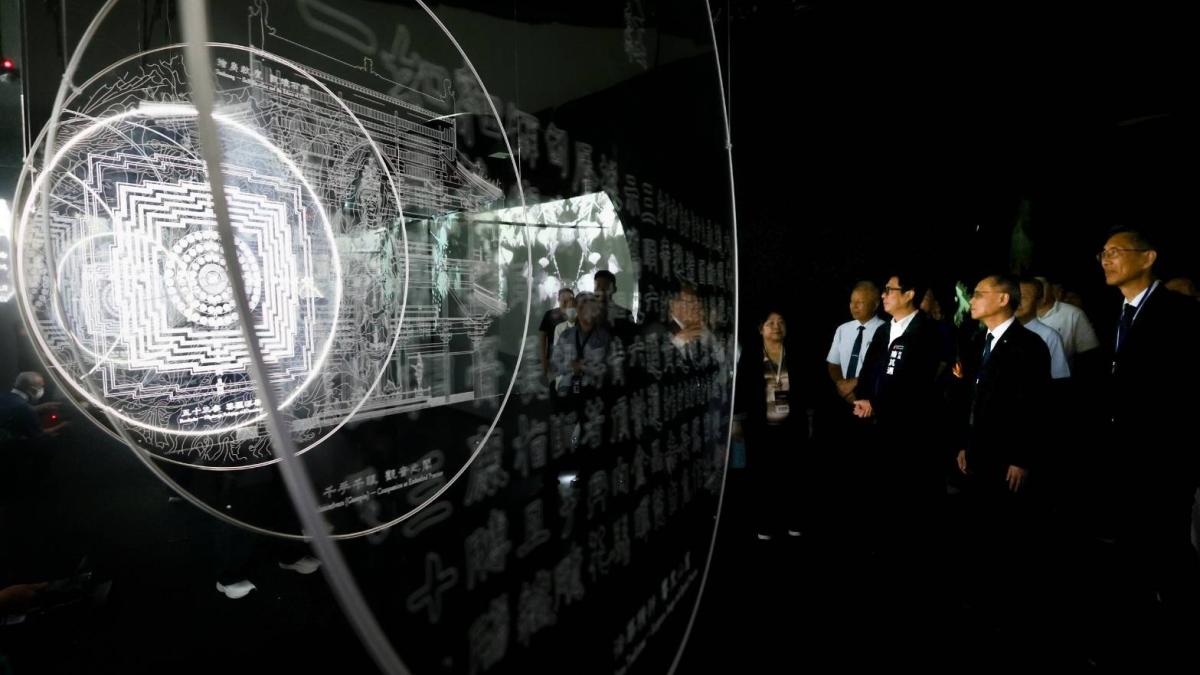
The 'Mingxin – Immersive Buddhist Cultural Art Exhibition,' co-curated by Tzu Chi Foundation and Harvard University's Cognitive Aesthetics Media Lab, held its opening press conference today (30) at the National Museum of Science and Technology. Kaohsiung Mayor Chen Chi-mai attended as a guest and joined dignitaries in the ribbon-cutting ceremony, witnessing the beautiful convergence of technological innovation and religious cultural heritage in Buddhist art.
Master Cheng Yen: 'When technology is used in the right way, it becomes a wondrous Dharma.'
Mayor Chen emphasized that Master Cheng Yen once said, 'When technology is used in the right place, it becomes a wondrous Dharma.' He noted that technology is not merely knowledge, but also embodies wisdom. For this exhibition, Tzu Chi Foundation has partnered with Harvard University's Cognitive Aesthetics Media Lab to recreate Buddhist art classics such as the Dunhuang Caves using 3D modeling and AI technology, presenting precious cultural assets in a new format to the public.
Mayor Chen expressed deep appreciation to Tzu Chi Foundation and Professor Wang Yuejin’s team at Harvard for making the exhibition possible. He praised the immersive presentation for integrating religious culture, technological innovation, and art education into one cohesive experience, allowing visitors to appreciate the beauty of Buddhist art and deeply understand the profound wisdom of Buddhist teachings and humanistic spirit.
Furthermore, Mayor Chen specially thanked Tzu Chi Foundation for its long-term commitment to social welfare and humanistic care. Whether supporting vaccination efforts during the COVID-19 pandemic or providing immediate assistance when citizens face disasters and hardships, Tzu Chi has always stood on the front lines, conveying the power of love and kindness through action, accompanying citizens through challenges. He expressed admiration and deep emotion for this selfless spirit of service.
Later, Mayor Chen toured the exhibition under the guidance of the curation team, experiencing digital representations of Buddhist cultural heritage such as the Mogao Caves in Dunhuang and the Xiangtangshan Caves through immersive visuals, sound-light technology, and digital reconstruction. He affirmed the achievements in combining cultural preservation with technological innovation and invited citizens to make reservations and personally experience the immersive fusion of technology and art, as well as the humanistic wisdom and spiritual values embedded in Buddhist art.
The 'Mingxin – Immersive Buddhist Cultural Art Exhibition' will be held from August 1 to November 1 at the National Museum of Science and Technology. Spanning 700 ping of immersive exhibition space, it features eight thematic units: 'Four Gates, Four Directions,' 'Deer Wild Dharma Proclamation,' 'Spirit of the Lotus Sutra,' 'Thousand Hands and Eyes,' 'Self-Sacrifice for Salvation,' 'Fifty-Three Visits,' 'Rightful Fruition of the Dharma Realm,' and 'Horizons of the Future.' Utilizing digital image restoration, 3D modeling, immersive projection, and multisensory narrative technologies, the exhibition digitally reconstructs world-class Buddhist cultural sites and artistic masterpieces such as the Mogao Caves in Dunhuang, Xiangtangshan Caves, Bodh Gaya in India, Sarnath, and Borobudur in Indonesia, creating a transcendent 'Pilgrimage of the Mind' across time and space.
Through the deep integration of technology and humanity, visitors can step into the heart of millennia-old civilizations without traveling far, experiencing the beauty of Buddhist art and the wisdom and humanistic spirit it embodies. The organizers sincerely invite the public to reserve visits and personally experience this internationally acclaimed exhibition where culture, art, and technology converge.
FACT BOX
- Source: PR Times
- Category: Event