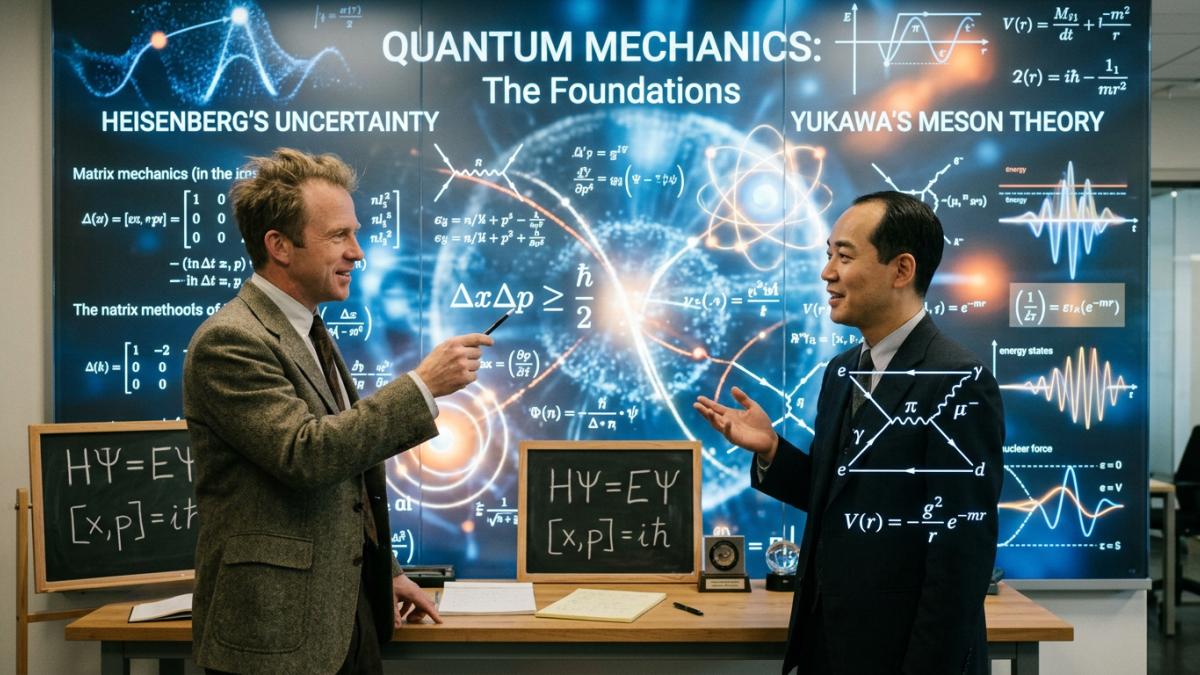
In the early 20th century, German physicist Werner Heisenberg (1901–1976) won the 1933 Nobel Prize in Physics for his establishment of quantum mechanics theory. Heisenberg was born on December 5, 1901, and after completing four years of elementary education at the age of nine in 1911, he immediately entered 'Grammar School (Gymnasium)' for his studies, graduating in the summer of 1920. That autumn, he continued his studies at the University of Munich to prepare for his future academic research. Heisenberg's doctoral thesis work was conducted under the guidance of the physics master Arnold Sommerfeld (1868–1951), focusing on atomic spectroscopy and fluid mechanics research. He submitted his doctoral thesis in the summer of 1923, exploring topics related to turbulence and hydraulics. (At that time, a doctoral degree in the German-speaking region was roughly equivalent to a master's degree in the current American education system.) During Heisenberg's teenage years, the grammar schools in the German (Bavarian) region were a type of nine-year senior high school education, with a curriculum primarily focused on classical literature (including Latin and Greek) and humanities. Students needed to complete a total of 263 credit hours over nine years. Among these, Latin accounted for 63 credit hours, Greek for 36, Mathematics for 31, German for 31, and Physics only 6. The remaining 127 credit hours were allocated to subjects such as History, Religion, Physical Education, French, and Natural Sciences. In summary, physics education in the grammar school system was merely a minor part, with actual class hours being two credit hours per year from grades seven to nine, using only one textbook over three years. The goal of grammar school education was to cultivate responsible, dutiful, and respected civil servants, lawyers, doctors, and other future pillars of government and society. At that time, the world was still centered around patriarchal societies. Fathers played serious, strict, and sometimes authoritarian roles, often working tirelessly outside the home for the family's livelihood, while mothers focused on caring for the family. School teachers were similarly cultivated to embody the characteristics and roles of fathers; they taught diligently, meticulously, and demanded high standards from students in both academics and conduct, often maintaining a stern demeanor. One could imagine a scene similar to that of a private school in late Qing China or a classroom in pre-World War II Japanese films: young Heisenberg, dressed neatly, standing beside his desk, nervously reciting a passage in Latin or Greek, while the teacher, holding a pointer, walked solemnly around the classroom, occasionally appearing beside him. In addition to school education, Heisenberg's father was a professor of Byzantine studies (medieval and modern Greek linguistics), who placed extreme importance on Heisenberg's classical language learning, constantly urging him to study. Therefore, Heisenberg had few moments of relaxation from a young age. Moreover, at that time, German intellectual families believed that learning musical instruments, excelling in classical music performance and appreciation, was a symbol of status and a necessary step for advancement. Thus, Heisenberg, from a young age, followed renowned teachers to learn piano, often practicing for several hours, deeply immersed in it. This 'artistic cultivation' was akin to the traditional Chinese and Japanese intellectual families' education of their children in reciting and composing poetry, as well as practicing calligraphy. It is likely that this artistic learning also cultivated Heisenberg's later high concentration, extreme perseverance, and unwavering determination when facing and overcoming physical problems. After entering the University of Munich, under the guidance of his mentor Arnold Sommerfeld, who led him step by step, and the scholarly guidance and encouragement of Paul Dirac (1900–1958, winner of the 1945 Nobel Prize in Physics), who was like an older brother, Heisenberg published four academic papers within two years, including three on atomic spectroscopy and one on fluid mechanics. Therefore, we must ask and ponder a sharp question: if grammar school education was primarily focused on training students in classical humanities, how did Heisenberg acquire his mathematical abilities and physical knowledge, enabling him to stand at the forefront of global atomic physics research in his early twenties? Heisenberg's mathematical abilities were cultivated from four aspects: family, school, era, and social atmosphere, explained as follows. (1) Heisenberg had an older brother who was nearly two years older (but only one grade apart in school). Their father often required Heisenberg to study and solve his brother's math homework together. Therefore, compared to the school curriculum, Heisenberg advanced his math learning. (2) Heisenberg's grammar school math teacher was an excellent teacher who taught both math and physics in Heisenberg's class. More importantly, at that time, grammar school science teachers taught from the first to the ninth grade. Therefore, when the science teacher noticed that Heisenberg's math learning ability far surpassed that of his classmates, he could appropriately guide Heisenberg to systematically but not prematurely learn ahead, and step by step guide Heisenberg to learn more difficult math problems. (3) The third point is the era factor. After Heisenberg advanced to the fourth grade of grammar school, the First World War broke out, with Germany as one of the major belligerents, thus seriously disrupting school education, and in the later stages of the war, it was often interrupted. There was even a period when, due to severe coal shortages in the cold winter, schools were forced to close. During the long days when school was frequently closed, Heisenberg studied at home the assignments given by his teachers, while reading math books borrowed by his father from the library. Interestingly, Heisenberg's father, in order to prevent Heisenberg from interrupting his Latin studies, borrowed all the books in the library that were seemingly in the field of mathematics but written in Latin. (Until the mid-to-late 19th century, Latin was still the official language of mathematics in Germany.) (4) The fourth point is due to German social customs. Although grammar school education in the early 20th century was still primarily focused on classical language education, after the unification of the German Empire in 1871, there was an emphasis on the development of science and technology, believing that culture and science were extensions and displays of national power, thus driving the scientific interests of young people. For example, during their grammar school years, Paul Dirac and Heisenberg were both inspired by Einstein's popular science book on relativity written specifically for high school students. As mentioned above, the emphasis on education and the pursuit of progress by intellectual families, the planning of a complete grammar school curriculum, excellent and responsible science teachers, independent study space and flexibility, and the industrialization and technologization of German society at the turn of the 19th and 20th centuries were the four key factors in cultivating Heisenberg's mathematical abilities, none of which could be dispensed with. Because he had early mastery of the basic language of theoretical physics—mathematics—solid foundation, therefore, after entering the university, once he obtained the guidance of an unparalleled professor and the rare enlightenment of his senior brother, Heisenberg, like the 'fish in the northern sea, named Kun', 'transformed into a bird, named Peng', 'angrily flying, its wings like clouds hanging from the sky', 'rolling and soaring upwards for ninety thousand miles', blossomed in the wind. Five years after graduating from grammar school, Heisenberg established 'matrix mechanics', together with Schrödinger's 'wave mechanics', jointly supporting the magnificent hall of quantum mechanics. Two years later, Heisenberg once again proposed the 'uncertainty principle' (or 'indeterminacy principle'), laying an unshakable foundation for the 'Copenhagen interpretation' of quantum mechanics. Not surprisingly, Hideki Yukawa (1907–1981, winner of the 1949 Nobel Prize in Physics), the first Asian to win a Nobel Prize in natural sciences, was familiar with the 'Zhuangzi' from a young age and loved it throughout his life. At the same time, under the insistence of his father (a professor of geology and geography at Kyoto University), he followed renowned teachers from a young age to study calligraphy for many years. After becoming famous, Hideki Yukawa often wrote the three characters 'knowing the fish's joy' from the 'Autumn Water' chapter of the 'Zhuangzi' and gave them to friends to keep. Hideki Yukawa's achievements in physics were completely cultivated and completed within Japan, and before making the work that won the Nobel Prize, he had never studied abroad. Incidentally, Toshihide Masukawa (1940–2021), a professor at Kyoto University in Japan who won the 2008 Nobel Prize in Physics, claimed to be afraid of speaking English, so before winning the award, he had never applied for a passport and had never stepped out of Japan. Additionally, Anthony Leggett (1938–2026), a professor at the University of Illinois in the United States who won the 2003 Nobel Prize in Physics, majored in classical humanities during his university years. Heisenberg constructed the theory of quantum mechanics as a basis for understanding atomic physics, but as mentioned above, his doctoral thesis was on fluid mechanics problems, due to Sommerfeld's concern that Heisenberg could not write a 'decent' atomic spectroscopy doctoral thesis at that time. Indeed, quantum mechanics had to wait another two or three years to be established. Therefore, breakthroughs in learning and the progress and development of new 'paradigms' require not only 'geographical advantages' (Germany at that time was a center for modern physics research) and 'human factors,' but also 'timing' (waiting for the right opportunity) to succeed. A contrasting example is that we have all read and recited in our middle school textbooks the works of Wang Anshi.
FACT BOX
- Source: PR Times
- Category: 教育