Samsung Electronics announced its financial results for the second quarter of 2026 on the 30th, reporting a consolidated operating profit of 89.4924 trillion Korean won (approximately $62 billion), a massive 1813.8% year-on-year surge. Quarterly revenue also increased by 130% to 171.4995 trillion won, with both revenue and operating profit setting new historical highs for Samsung. Notably, the operating profit even exceeded the single-quarter records of U.S. tech giants Nvidia and Apple.
At the earnings call, Samsung executives clearly stated their commitment to “implement and maximize shareholder return policies,” significantly calming market sentiment. Encouraged by this news, Samsung Electronics' stock price rebounded strongly during trading, helping the South Korean Composite Stock Price Index (KOSPI) shake off days of gloom and briefly approach the 6,000-point mark—though it retreated back to around 5,600 points by the time of writing.
Memory Price Surge Boosts Semiconductor Profits: DS Division Earnings Skyrocket 220x
According to Samsung’s business segment performance, the Device Solutions (DS) division, responsible for semiconductor operations, was the biggest profit contributor. The DS division achieved second-quarter revenue of 127.5 trillion won and an operating profit of 89.2 trillion won—more than 220 times higher than the same period last year.
Samsung attributed the surge to the rapid adoption of Agentic AI, which drove strong demand and higher average selling prices for server memory. The company not only expanded shipments of high-bandwidth memory HBM4 but also announced it became the world’s first semiconductor manufacturer to deliver samples of the next-generation HBM4E to key customers. Additionally, foundry and system LSI businesses benefited from increased demand from North American clients and higher shipments of smartphone application processors, achieving record-high revenues in the first half of the year.
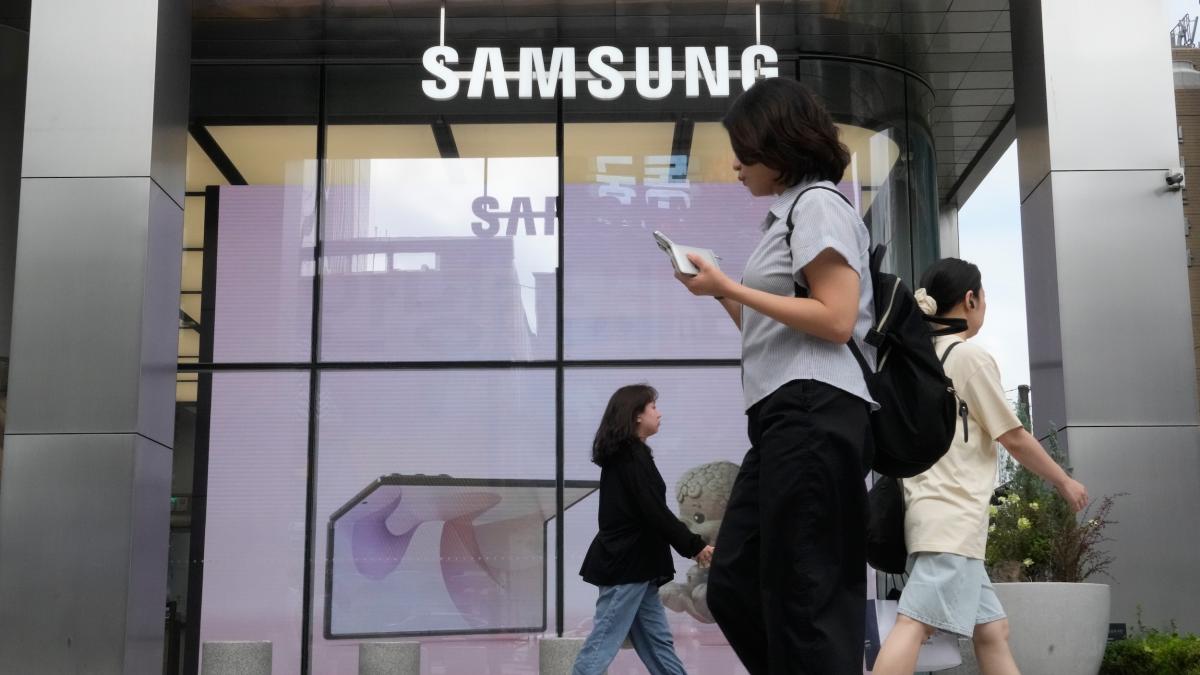
On July 30, 2026, Samsung Electronics' office building in Seoul, South Korea. (AP)
Component Cost Pressure Leads to First-Ever Quarterly Loss in DX Division
While soaring memory prices brought Samsung substantial profits, they also placed significant cost pressure on the company’s end-device businesses. The Device Experience (DX) division, responsible for finished products, saw second-quarter revenue drop to 48 trillion won (a 7.2% year-on-year decline) and posted an operating loss of 800 billion won—the first quarterly loss since the division’s inception. Furthermore, the Mobile Experience and Network business units incurred a 700 billion won operating loss last quarter due to rising component costs and industry-wide inflation. Although flagship Galaxy S26 series sales remained steady and supported revenue, profit margins were squeezed by high costs.
Beyond strong core business profits, market attention focused heavily on the dividend policy announced during the earnings call. Samsung executives stated: “The company will uphold the three-year shareholder return policy committed last quarter. The board and management are reviewing execution plans, including special dividends, and striving to achieve the optimal balance between reinvestment for future growth and maximizing shareholder returns.” According to The Chosun Ilbo, Samsung Electronics’ stock price surged over 7% during trading on the 30th following this announcement, with financial circles praising, “In critical moments, the big brother still delivers.” JPMorgan analysts offered a positive assessment of Korean equities: “After a strong deleveraging correction since mid-June, the Korean stock market now offers high attractiveness and valuation recovery momentum.”
On July 29, 2026, a trader at Hana Bank’s trading room in Seoul, South Korea, watches a computer screen. (AP)
Overnight U.S. Markets Face Three Major Headwinds
In contrast to the celebratory mood in South Korea, overnight U.S. markets faced multiple headwinds. Federal Reserve Chair Kevin Warsh stated publicly, “There is no magic wand to solve inflation,” and maintained the benchmark interest rate unchanged, causing all three major U.S. indices to decline. The yield on the 10-year U.S. Treasury bond rose to 4.668%. U.S. President Donald Trump issued strong remarks regarding the attack on a U.S. military base in Jordan, declaring, “We will strike back hard,” pushing Brent crude oil futures above $90 per barrel.
Additionally, Meta’s CFO admitted during its earnings call, “We have no clear forecast for 2027 capital expenditures,” sparking market concerns and causing the company’s stock to plummet over 7% after hours. Fortunately, Microsoft announced during its earnings call that it would continue expanding capital expenditures. Microsoft executives emphasized: “Although the industry experiences cyclical fluctuations, the overall trend toward ‘long-term structural growth’ is very clear, and we are extremely optimistic about it.” Wall Street analysts noted that Microsoft, once seen as the villain in the tech industry, has now become the superhero saving the Nasdaq market.
FACT BOX
- Source: PR Times
- Category: 財報
- Organizations: Nvidia / Apple / Meta
- Products / services: HBM4 / HBM4E