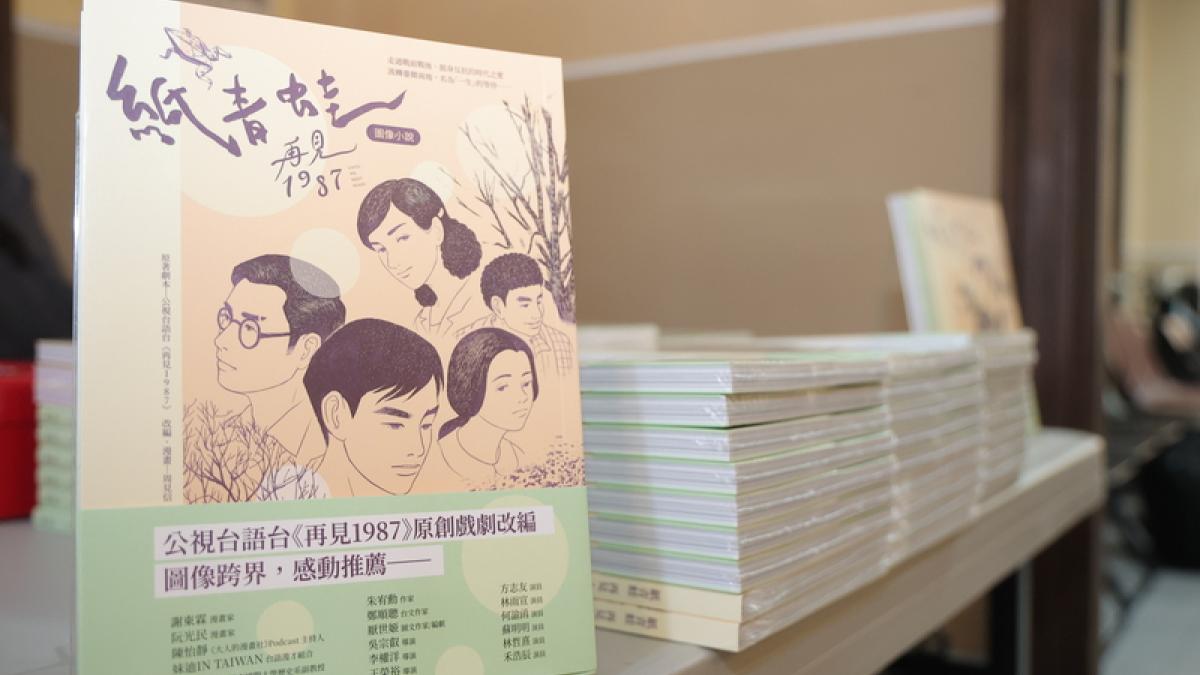
In recent years, Taiwan's graphic novel scene has flourished. Unlike comics, which often focus on serialized storytelling or visual narrative delivery, graphic novels are distinguished by their literary qualities—narrative depth, artistic illustration, novelistic use of silence, and multilingual expression. Zhou Jianxin, renowned for both graphic novels and comics, has created 'Paper Frog: Goodbye 1987' as a companion piece to the upcoming PTS Taiwanese drama of the same name. Using his signature artistic style, he meticulously constructs a timeline stretching from the 1940s to 1987, weaving a poignant historical narrative.
A Cross-Strait, Cross-National Tale Begins in Busan
The story opens on the coast of Busan, South Korea. The author’s brushwork is delicate, evoking warmth and poetic subtlety. Yet, the first page contains deliberate blank spaces—akin to literary ellipsis—inviting readers to fill in the silence. Though set in Busan, the characters speak Taiwanese Hokkien. Readers unfamiliar with this historical context may initially feel disoriented. However, as the narrative rhythm intensifies, readers are swiftly drawn into the 1950s Korean War. At this point, the art style shifts dramatically—denser, heavier lines convey a sense of oppression, pulling readers into the fog of history and uncertainty.
Art as Historical Reclamation
The protagonist, Junxian, is recruited by the U.S. military as a translator due to his linguistic talent. But he becomes entangled in war, captured as a POW during the Korean War, and ultimately unable to return to Taiwan, living out his life as an exile in Korea. Through a cherished yet faded photograph, the story introduces his wife, Qiu Xue (Yuki)—whose face in the photo is blurred. Philosophers Guattari and Deleuze proposed the concept of 'faciality'—a social construct of 'power and signifying machines.' In Yuki’s case, her blurred face symbolizes the erasure of identity under sorrowful history. In that era, people no longer possessed their own 'face'; instead, they continuously surrendered it to power.
Kaeru, Kaeru – The Double Meaning of Frog and Return
The narrative is tightly paced yet poetic. Zhou uses dark, heavy strokes to depict the POW camp, then shifts to soft, gentle lines in the next panel, showing Junxian and Yuki’s time in a theater troupe in Taiwan—evoking youth and tender ambiguity. When Junxian learns he has been accepted into Imperial University, he gives Yuki a paper frog. Here, Taiwanese and Japanese intermingle: 'Do you know how to say six field frogs in Japanese?' 'Mutsu kaeru,' Yuki replies. In Japanese, 'kaeru' means both 'frog' (蛙, kaeru) and 'to return home' (帰る), making it a symbol of safe return in Japanese culture. Yet Junxian never returns. Yuki, later renamed Qiu Sufen, works at a church to survive, still believing he will come back.
One striking panel reimagines Hokusai’s 'The Great Wave off Kanagawa,' incorporating a dripping faucet. This image metaphorically suggests an approaching tsunami. But in the next frame, a satirical drawing mocks Japanese police—implying that if the faucet is turned off, the wave will never come. This reflects the inner world of ordinary people within grand historical narratives.
The Art of Narrative – The Terror of Silence
Zhou employs extensive visual silence. One double-page spread is entirely blank—an emptiness that evokes fear. This void does not mean nothing happened; rather, it signifies that everything occurred (including White Terror-era torture). Even as a graphic novel, the preceding torture scene is unsettling. The core issue of the White Terror was how it destroyed social trust in Taiwan.
During the torture scenes, the language turns dark. These somber strokes suggest a dawn that never breaks—mirroring Taiwan’s 38 years of martial law. Zhou’s bold use of blank space carries multiple meanings: perhaps the missing history many readers lack, the trauma of the White Terror, or a prolonged state of suspension. As we read this missing piece of Taiwan’s history, we encounter restraint, cruelty, obedience, and helplessness—emotions that converge in this powerful work.
The graphic novel has already been published, and the drama is set to premiere. We live in a time of blooming freedom—free to breathe, love, and express ourselves. Yet, our generation has lost too much of Taiwan’s history. Perhaps now is the time to catch up—to become Taiwanese, not because we were born as such, but through conscious remembrance.
*The author is a writer and literary worker.
FACT BOX
- Source: PR Times
- Category: News