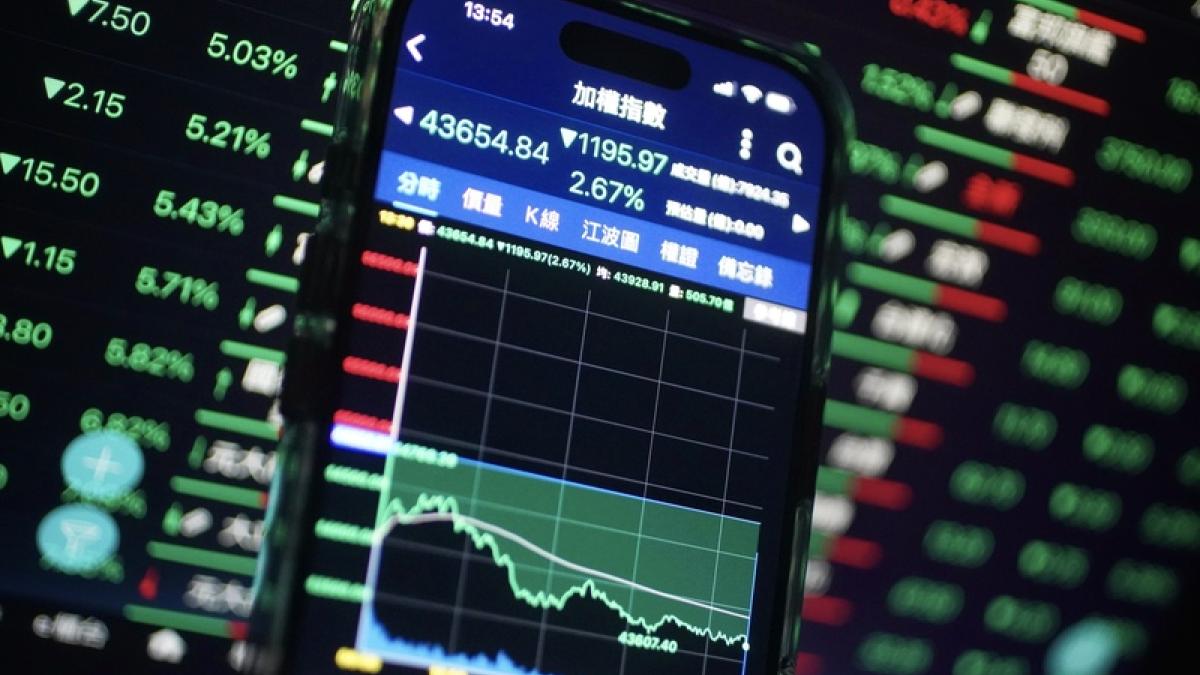
Over the past two years, Jensen Huang (CEO of NVIDIA), known as the 'Godfather of AI,' has driven a global AI wave. As of June 30, 2026, Taiwan's stock market has nearly 50 'thousand-dollar stocks,' more than half of which entered this elite club within the past year. Many of these stocks have seen consistent price increases, with some multiplying several times over the past six months, seemingly without a ceiling.
In early March 2026, Huang introduced the 'AI Five-Layer Cake Theory,' which divides the AI industry into five layers: 'Energy, Chips, Infrastructure, Models, and Applications.' Like a five-tiered cake, it spans from foundational power supply at the base to application services at the top, forming a complete AI industrial chain. Broadly speaking, Taiwan has over 300 AI-related companies: Energy layer (Layer 1): Delta Electronics, Hwa Cheng; Chip layer (Layer 2): TSMC, MediaTek; Infrastructure layer (Layer 3): Foxconn, Quanta; Model layer (Layer 4): Nanya Technology, Powerchip; Application layer (Layer 5): Advantech, Techman. A single company may span two to three layers.
NVIDIA is the leader of the AI wave, with over 40 suppliers in Taiwan. However, most are thousand- or hundred-dollar stocks, making them unaffordable for average retail investors. The author is no exception and has turned to AI-themed ETFs based on the 'AI Five-Layer Cake' framework.
While writing the 'ETF Investment Guide,' the author purchased 16 ETFs, including high-yield, market-cap, bond, and zero-dividend types. Table 1 shows eight high-yield ETFs bought, analyzed after one year. From October 2024 to September 2025, the first four monthly-distribution ETFs had annual dividend yields ≤5%. The next four quarterly-distribution ETFs had yields between 7.29% and 11.36%, but all eight high-yield ETFs showed negative price returns. Their prices remained low long-term, only gradually rising in mid-April 2026. With AI momentum, they reached their highest prices since listing by June 2025. The fastest to reach [issue price × 2] was item 4 (00929), taking 3.02 years.
Although items 4–8 in Table 1 now exceed [issue price × 2], their average purchase prices were too high to reach the self-set profit-taking target of [purchase price × 2]. This led to three conclusions:
- Monthly-distribution ETFs often have lower total returns due to frequent payouts. - High-yield ETF prices struggle to reach [issue price × 2]. - If the initial purchase price is ≥1.2× issue price, even with high dividend yields, price returns may still be negative.
How to Screen AI-Themed ETFs?
As of July 23, 2026, Taiwan's market has about 350 ETFs. Since ETFs typically hold 30–100 stocks, many may include some AI-related names. To select the best, we apply four criteria: (1) ≥70% AI-related stocks, (2) non-high-yield or non-monthly-distribution ETFs, (3) asset size ≥NT$6 billion, and (4) investor count ≥30,000. This yields 44 AI-themed ETFs. Due to space, Table 2 lists only 20 recently launched ones. Except for item 3 (009821) at NT$15, all others have an issue price of NT$10.
Sell High-Yield ETFs, Buy AI-Themed ETFs!
To ride the AI wave and boost returns, in April 2026, the author sold four monthly-distribution ETFs from Table 1 at about 2% unrealized gain (ensuring no loss) and bought six ETFs (items 10–15) from Table 2. In May 2026, the author sold four quarterly-distribution ETFs with ~30% gain and bought six more (items 2, 4–7, 9) from Table 2. The 12 AI-themed ETFs were bought between NT$9.35 and NT$10.52. The five ETFs (items 16–20) were skipped due to prices >1.3× issue price, avoiding the same mistake as items 3–8 in Table 1: high entry cost slowing total return growth.
Although the author sold all eight high-yield ETFs in Table 1 and switched to 12 AI-themed ETFs (green-marked items) in Table 2, this does not mean high-yield ETFs are inferior. ETFs like 0056 (Yuanta High Dividend) and 0050 (Yuanta Taiwan 50) have their own loyal followers. Looking at Table 1, items 3–6 show recent annualized dividend yields >10% ('exploding dividends'). Based on the author’s average cost from June–September 2024, six out of eight (75%) high-yield ETFs achieved such high yields. Therefore, investors in high-yield ETFs should commit to holding for at least three years and adding more when prices drop 15%.
From Table 2’s '30-Day Post-IPO Low' column, we see that within 30 days of listing, only item 11 (009816) had a low price exactly at NT$10 (issue price). None closed above issue price. Thus, there’s no rush to buy AI-themed ETFs; bargains below [issue price × 1.1] may appear in the first 30 days.
Unlike traditional high-yield ETFs, which rely on high-dividend stocks, AI-themed ETFs derive income mainly from capital gains via trading component stocks. Theoretically, their dividend yields should be lower—just as 0050’s yield is lower than 0056’s. Yet, items 17, 18, and 20 in Table 2 have paid 2–4 dividends, with annualized yields >8%, despite not being high-dividend ETFs. Whether this is sustainable remains to be seen. However, their prices are already over twice the issue price, making them unsuitable for chasing. If bought, one should adopt Buffett’s advice: 'Assume the market will close for five years.'
Main screening criteria for AI-themed ETFs: (1) ≥70% AI exposure, (2) non-high-yield or non-monthly; because ETFs can be delisted (assets < NT$200 million). Since the first ETF (0050) launched on June 23, 2003, over 40 have been delisted. The shortest-lived was the well-known New Global S&P Electric Vehicle ETF (00925), listed April 18, 2023, and delisted June 5, 2025, after exactly two years, with net assets below NT$100 million, only 548 investors, and a price of NT$16.1 (still above issue price of NT$15). Historically, funds raising NT$6 billion typically attract over 30,000 investors within a week. Thus, for safety, (3) asset size ≥NT$6 billion and (4) investor count ≥30,000 became supplementary criteria.
Finally, as of July 24, 2026, the author holds three AI-themed ETFs (items 13–15) from Table 2, all of which more than doubled within half a year (slightly down on July 23). Should they be sold? No! ETFs bought near issue price, with assets >NT$40 billion and >100,000 investors, should be held for further gains and dividends unless urgently needed for cash.
★ Sincere advice: This article is a personal financial experience report for reference only. Investing involves risks; please act within your capacity and bear your own profits and losses.
FACT BOX
- Source: PR Times
- Category: News
- Dates in source: 2024/10 / 2025/9
- Products / services: 00929 / 009821