"AI boom" and "AI bubble"—these two concepts have alternately emerged amid stock market fluctuations in recent years. The reason Jensen Huang is hailed as the "father of the nation," and why U.S. and Taiwanese stocks have soared, all stem from this "AI boom." However, as stock prices clearly reverse, concerns are rising again about whether AI giants can recoup their massive investments, or if this industry will suffer the same fate as the dot-com bubble of the past. The South Korean stock market hitting circuit breakers for consecutive days has once again brought the risks of an "AI bubble" into focus.
The Economist pointed out on July 29 that amid this AI frenzy, America's tech giants have transformed from "money printers" into "money burners." Due to extravagant spending on data centers, Alphabet (Google's parent company), Amazon, Meta (Facebook's parent company), and Microsoft are all projected to have negative free cash flows (operating cash flow minus capital expenditures) next year. Although these Silicon Valley titans face deficits, their bets on the future are currently generating real wealth.
On the other hand, some companies within the AI supply chain are expected to generate up to $200 billion in free cash flow next year—Nvidia, Samsung, and SK Hynix. However, South Korea, which experienced a stock market boom this year, is now confronting the reality that stock prices can fall as well as rise. Since their June peaks, Samsung and SK Hynix shares have plunged 41% and 52% respectively (as of July 29), wiping out $1.2 trillion in market value from South Korea's stock market. Despite SK Hynix reporting record-breaking profits, the slide in Korean stocks on July 29 could not be halted, and Samsung's stock volatility reached levels unseen since the dot-com bubble era.
October 8, 2019, an SK Hynix chip at the Korea Electronics Show in Seoul. (AP)
The Economist notes that South Korea has fused two extreme phenomena—"state capitalism" and "market speculation." After last year's failed martial law declaration by President Yoon Suk-yeol, current President Lee Jae-myung has attempted to use stock market performance as a policy goal to boost national morale. As a result, KOSPI (Korea Composite Stock Price Index) rapidly surged to the government's target level. Amid the stock market boom, many citizens rushed to withdraw funds from insurance companies and banks to invest in stocks. Workers threatened strikes to pressure management into awarding Wall Street-level bonuses, and Samsung Semiconductor and SK Hynix eventually agreed to bonuses amounting to 10% of operating profits—meaning individual SK Hynix employees could receive $500,000, rising to $800,000 next year (compared to Goldman Sachs employees' average total compensation of $400,000 last year).
Encouraging public market participation, the South Korean government approved leveraged ETFs (exchange-traded funds) linked to individual Korean stocks in April. These funds use derivatives to allow investors to earn multiples of stock returns. For example, if SK Hynix's stock rises 1%, investors might gain 2%; but if it falls 10%, investors could be devastated. While no one seemed to mind during the market's upward surge, when selling pressure emerged in June, regulators halted new ETF issuances, leveraged ETF investors were required to post additional margin, and some were forcibly liquidated (positions automatically sold to cover debts). On July 29, South Korea's finance minister apologized, and the government pledged to strictly regulate such funds.
July 29, 2026, a display at the Korea Exchange in Seoul shows the KOSPI (Korea Composite Stock Price Index). (AP)
For South Korean investors, this lesson has cost a trillion dollars. Yet the crucial question remains unclear—when will memory prices peak?
Bulls argue that with data center construction and robotics advancing, memory demand will continue to outstrip supply into the 2030s. But an increasing number believe memory chips will repeat the commodity cycle—within one or two years, as supply grows, prices and profits will sharply decline. The Economist also notes that despite soaring stock prices, Samsung and SK Hynix's average P/E ratios over the past year remained in single digits, clearly indicating low market valuations and suggesting investors believe memory profits have already peaked or are near their peak.
The Economist warns that South Korea may be the first country to reap AI's promised riches, but also the first to have them stripped away. The threats facing Korea's memory giants today lurk in other corners of the AI field: the threat of Chinese competitors (such as ChangXin Storage, which debuted last week) gaining market share, U.S. AI model giants facing challenges from Chinese open-source models, and growing concerns that the "long-term supply agreements" claimed by Samsung and SK Hynix might be nothing more than empty promises made by AI giants during optimistic market conditions—once the market turns, buyers will likely seek to escape these contracts.
Finally, Jensen Huang, the AI titan most familiar to Taiwanese people, is also under scrutiny by The Economist. The publication acknowledges that Nvidia is once again playing a crucial role in stabilizing this crisis. Huang not only defended open-source models last week, but Nvidia is also negotiating with OpenAI (ChatGPT's parent company) to write checks covering OpenAI's hundreds of billions of dollars in funding gaps. Last week, Nvidia even announced a $500 billion partnership with SK Hynix.
However, The Economist warns that just as central bank governors intervening in markets can backfire, the more Huang intervenes today, the more investors should be wary—because the eventual collapse could be even more brutal.
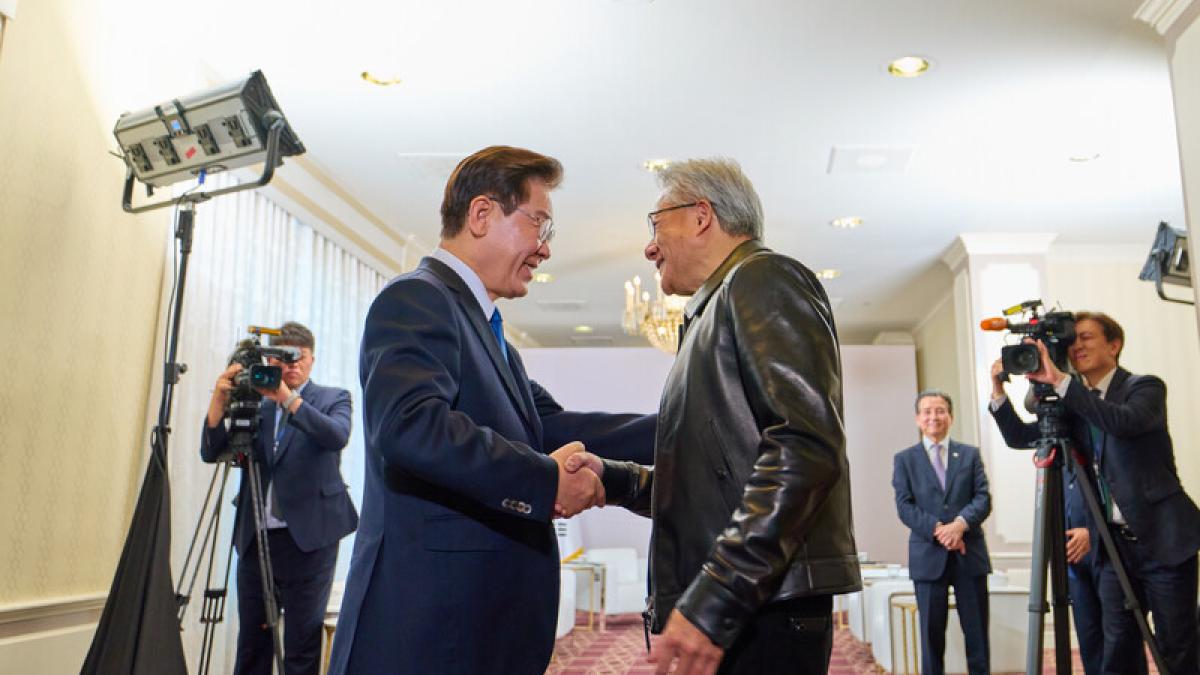
South Korean President Lee Jae-myung (right) visits San Francisco, USA, for a private meeting with Nvidia CEO Jensen Huang. (From the Presidential Office's official social media)
FACT BOX
- Source: PR Times
- Category: News
- Organizations: Alphabet / Google / Meta