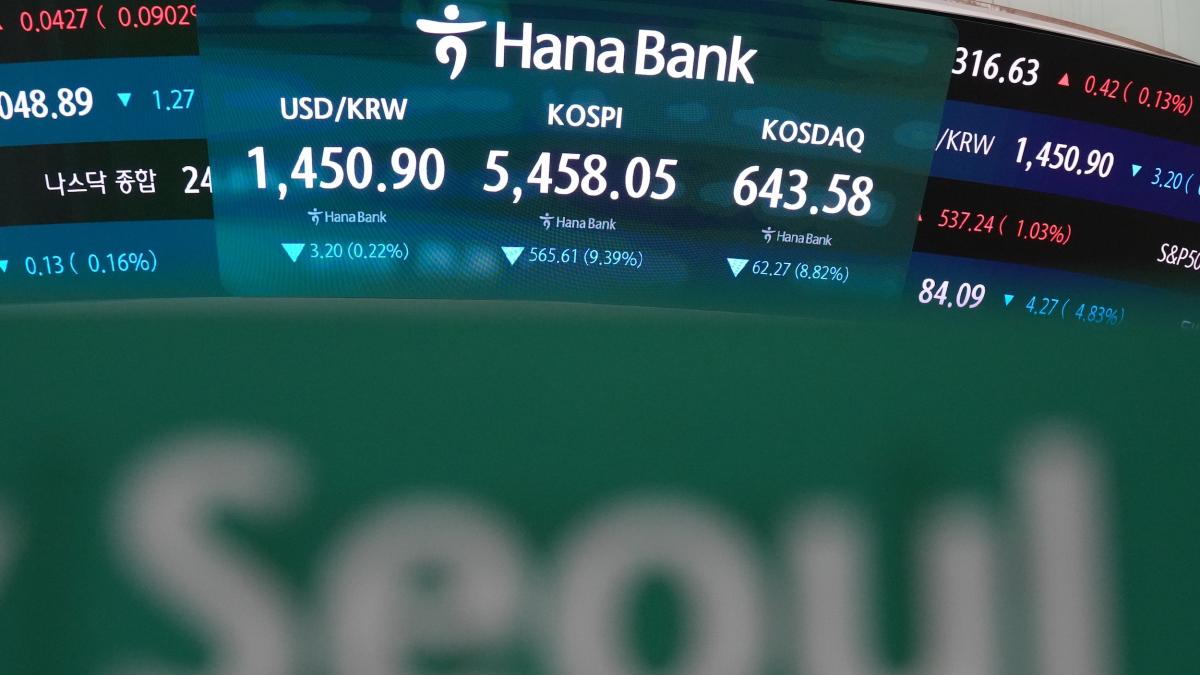
South Korea's stock market surged due to a memory chip boom, with Samsung Electronics and SK Hynix skyrocketing as retail investors flocked to leveraged stock trading. However, the rally was short-lived. Amid a global stock market correction, South Korean equities have experienced a historic crash, triggering circuit breakers nine times this year alone. Many retail investors who overused leverage have been forcibly liquidated.
According to foreign media outlet BeInCrypto, in the first half of 2024, KOSPI briefly became one of the world's best-performing stock markets, with the index doubling and reaching a maximum gain of 116%. In June 2024, it hit a record high of 9,385.59 points, temporarily ranking as the world's sixth-largest stock market.
South Korea's Worst Stock Market Crash in History: Where Is the Next Support Level?
The report indicates that on a monthly chart, KOSPI opened July 2024 at 8,591.50 points, reached a high of 8,620.15, and plunged to a low of 5,262.77, suffering a 38.95% monthly decline. From the all-time high set in June 2024, the maximum drawdown has approached 44%.
This decline has already surpassed the 2020 market crash during South Korea's initial wave of the COVID-19 pandemic, when the peak-to-trough drop was about 31.1%, followed by a multi-year bull market.
Currently, buyers are holding the critical support zone between 5,100 and 5,300 points, with a mild rebound observed on Thursday. However, if the 5,100-point support breaks, the market could fall further. The next major support zone lies between 3,200 and 3,400 points, representing approximately 40% downside from current levels.
What Ended South Korea's Historic Bull Run?
The report identifies 'leveraged funds' as a key driver of the rally. By early July, outstanding margin debt in South Korea's stock market had reached a record high of 29.2 trillion KRW, with massive retail inflows into leveraged ETFs tied to Samsung and SK Hynix.
However, the bull market abruptly reversed. As global AI-related stocks cooled and the Bank of Korea raised interest rates for the first time since 2023, KOSPI officially entered a technical bear market in mid-July. The market then faced consecutive negative shocks: on July 28, news emerged that China had begun mass-producing its self-developed DUV lithography machines; the next day, SK Hynix reported earnings that fell short of market expectations, further igniting market panic.
A Vicious Cycle: Multiple Negative Factors Collide
The report notes that over the past month, SK Hynix's stock has plunged 46.69%, while Samsung's has fallen 35.45%. This market crash was not caused by a single event but by multiple negative factors converging, creating a vicious cycle:
- Stock price declines trigger margin calls - Investors are forced to sell - Forced liquidations further depress prices - Leveraged ETFs mechanically continue selling, worsening the decline - Market panic continues to spread
On July 28 and 29, South Korea's stock market triggered circuit breakers for two consecutive trading days—an unprecedented event in history. Within just two days, the market's total valuation evaporated by approximately 864.5 trillion KRW. This forced South Korea's financial regulators to hold an emergency meeting. The country's finance minister announced they would re-examine the approval system for high-leverage financial products.
Additional exclusive reports from Feng Media:
- From heaven to hell: South Korean media reveal shocking numbers behind the market crash—'30 trillion KRW (about $220 billion) wiped out in just two weeks' - South Korea's retail investors 'borrowed to trade stocks' and suffered massive losses—unable to repay margin loans, 400 billion KRW forcibly liquidated - A 26-year-old Hong Kong trader 'embezzled $20 million in company funds' to bet on SK Hynix—company incurs $60 million loss, tragic outcome revealed
FACT BOX
- Source: PR Times
- Category: News