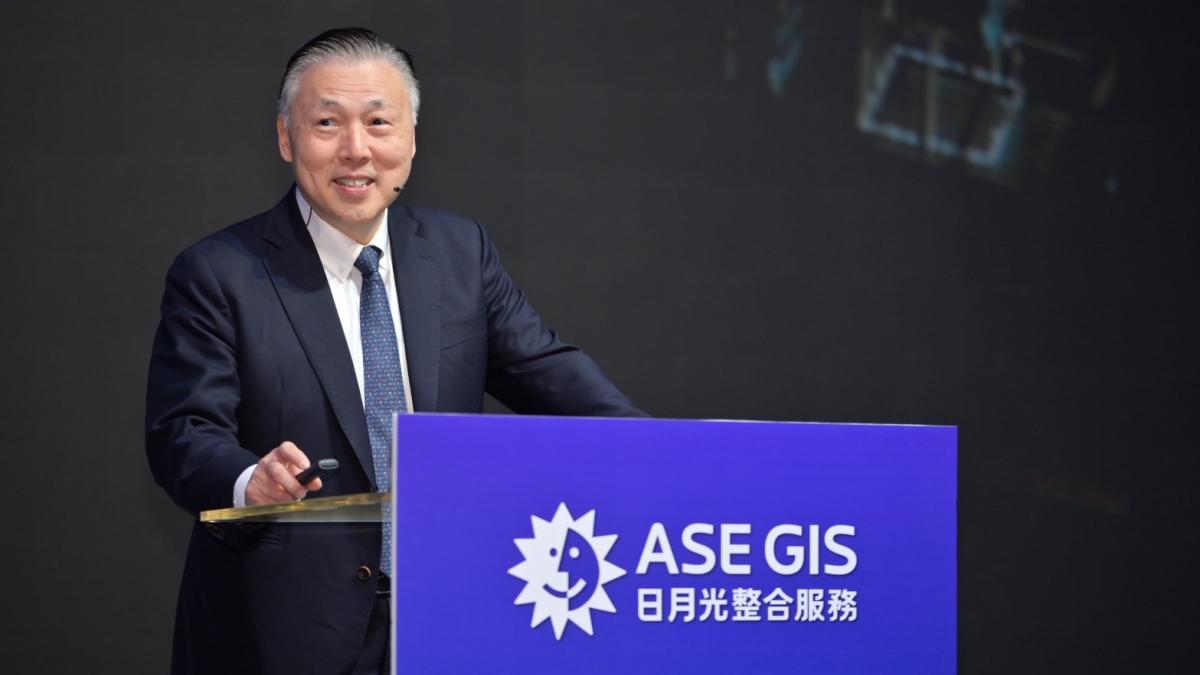
While market discussions on the AI race focus primarily on GPUs, models, and cloud computing, Wu Tianyu, COO of ASE Holding (3711), believes the next real constraint on AI development has shifted to hardware manufacturing capacity. At today’s (30th) earnings call, Wu stated that AI requires new hardware that didn’t exist before, with increased size, complexity, and integration levels. With only a limited number of manufacturers capable of mass production, hardware infrastructure has become a 'new bottleneck not experienced in the past 40 years' for the packaging industry.
'AI requires new hardware that never existed before—different in size, complexity, and integration level from anything in the past,' said Wu. He emphasized that AI represents a paradigm shift, still in its early stages, and will go through multiple transformation phases. Currently starting with AI data centers, it will next extend to Agentic AI, then into physical AI and humanoid robots—each requiring hardware distinct from previous mass-produced products.
AI demands go beyond GPUs—power, connectivity, and storage needs are also expanding. AI systems require not only higher compute density but also more memory, higher bandwidth, more complex power delivery, faster interconnects, and more efficient thermal dissipation. These demands will further drive markets for industrial, power, connectivity, and storage devices.
Wu pointed out that the current hardware bottleneck facing the industry isn’t just about insufficient capacity, but also whether automation and innovation capabilities can keep up. Technologies like panel-level packaging, CoWoS, glass substrates, voltage regulation modules, silicon photonics, and CPO must ultimately answer the same question: Can a scalable, mass-producible hardware platform be rapidly established under highly complex design requirements?
'Hardware infrastructure has become the new bottleneck—a situation we haven’t experienced in the past 40 years,' said Wu. As AI demand rapidly expands, the number of manufacturers capable of producing such complex hardware remains limited.
Packaging is no longer just a backend process—it’s moving toward system architecture value. With the rapid development of chiplets, heterogeneous integration, and optoelectronic integration, packaging is no longer just about protecting chips or connecting circuits. It now plays key roles in bandwidth, power delivery, thermal management, and system integration.
Wu believes that system architecture has long occupied the upper tier of the electronics industry value chain. Now, through higher integration complexity and system capability, packaging is gradually approaching the value position of system architecture. This has shifted ASE’s competitive focus from simply increasing packaging capacity to simultaneously building technology, speed, automation, capacity, and customer trust. The company aims to leverage Taiwan’s semiconductor ecosystem, scale, and pure-play positioning to support customers’ long-term AI strategies.
The pure-play model avoids conflicts of interest, enabling collaboration across all supply chains. Wu specifically emphasized ASE’s pure packaging and testing foundry positioning. Compared to companies that also own wafer fabrication, substrate production, or other proprietary products, ASE does not have direct conflicts of interest with foundries, substrate suppliers, or customers—enabling seamless co-development with various supply chain members.
'Being pure-play allows us to collaborate seamlessly with all supply chain members, which will become a key competitive advantage in this era of complex AI integration,' said Wu. ASE’s first-mover advantages include technology, speed, capacity, and most importantly, customer trust. As AI systems grow increasingly complex, no single company can complete everything alone—multi-party collaboration will become even more critical.
CoWoS and EMIB are not zero-sum competitors. The market is watching whether Intel’s EMIB technology could threaten CoWoS and ASE’s existing positioning. Wu stated that the real issue in current AI infrastructure is capacity constraints. As long as alternative technologies can help alleviate bottlenecks with appropriate yield, performance, and efficiency, ASE welcomes their development.
'This is not a zero-sum game, nor is it a choice between only one technology,' said Wu. Over the past 40 years, the packaging industry has seen over a thousand designs, but only a few have survived. However, alternative materials and competing architectures have always been part of R&D. ASE will continue to fully support CoWoS, continuously increasing capacity, scale, and production efficiency. But if customers choose EMIB or other alternatives, ASE will also incorporate those technologies into its development roadmap.
Since ASE is a pure packaging and test foundry, if EMIB substrates become a customer choice, the company can directly purchase the substrates and handle back-end assembly—without conflict of interest or the need to predict which technology will ultimately win.
Expanding U.S. sites from 2 to 4—mass production still scaled up first in Taiwan. In response to global supply chain localization trends, Wu revealed that ASE currently has one factory each in Fremont and San Jose, California, and is expanding to a third and fourth site.
These U.S. sites primarily support Bay Area customers in chip front-end design, test development, technology R&D, and system architecture collaboration. For large-scale mass production, Taiwan remains the primary base for now.
Wu explained ASE’s collaboration model with key customers: first establishing fully automated, high-efficiency, and sufficiently scaled production lines in Taiwan. Once processes, talent, yield, resources, and production efficiency mature, the relevant capabilities will be transferred to the U.S. or other regions per customer demand.
In other words, U.S. sites will initially handle joint development and early technical support, while Taiwan continues to serve as the core base for advanced packaging mass production and efficiency enhancement. As AI hardware demand enters a new phase, the ability to integrate Taiwan’s supply chain cluster, pure-play flexibility, and overseas customer service capability will be key to whether ASE can maintain its first-mover advantage.
FACT BOX
- Source: PR Times
- Category: New Product
- Organizations: Intel
- Products / services: CoWoS / EMIB