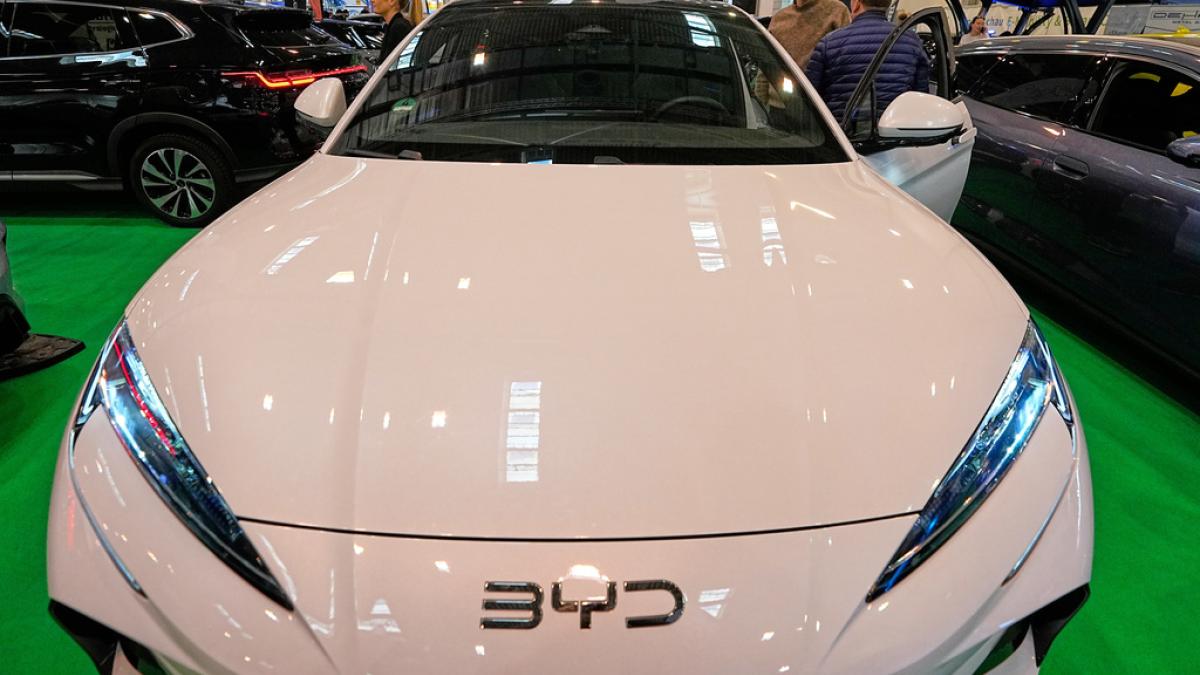
Compared to just 1 million vehicles in the year 2000, China's auto exports this year could surpass 12 million units. This surge has heightened tensions among traditional manufacturing powerhouses like Western nations and Japan, while also drawing accusations of "overcapacity" against China. Experts note that China’s current auto export volume is already double Japan’s peak output, and that the automotive industries in the U.S., Europe, South America, and Southeast Asia are facing mounting pressure.
Is China’s auto industry on the verge of "dominating the world"?
The U.S.-based think tank Asia Society hosted an online seminar this week titled "Riding the Wave: Assessing the Impact of China’s Booming Auto Exports." Wendy Cutler, Senior Vice President of the Asia Society Policy Institute, moderated the discussion, which featured Michael Dunne, CEO of Dunne Insights—a U.S. automotive market consultancy—Jorge Guajardo, former Mexican ambassador to China, and Michael Kovrig, Senior Advisor for Asia at the International Crisis Group. They discussed the implications behind China’s rapidly growing auto exports.
Dunne stated, "The scale and speed of (China’s) export growth are simply unbelievable." He added that Chinese vehicles are flooding global markets at a rapid pace, creating an unexpected shock that has caught many off guard and placed unprecedented pressure on competitors. In comparison, Germany’s Volkswagen recently announced 100,000 job cuts—an unprecedented move in automotive history. Meanwhile, Japan’s Honda reported its first loss since the 1950s.
Dunne analyzed that Chinese automakers realized that if they remained confined to the domestic market, they would be trapped in price wars and eventually overwhelmed by overcapacity. As a result, Chinese manufacturers have repurposed their factories and are exporting vehicles overseas at an unprecedented scale. "Although they may offer different narratives externally, the reality is that the domestic market offers neither growth nor profit. To survive, their only path forward is to push their products into global markets."
Dunne even predicted that market observers anticipate China’s auto exports could exceed 15 million units by 2030 if this trend continues. "In the extreme, perhaps one day, all cars will be manufactured in China."
The Asia Society hosted an online seminar this week to discuss the global impact of China’s surging auto exports. (Image: Asia Society Zoom livestream)
Is China’s auto export surge a threat to other nations?
Guajardo argued that China’s current export volume is equivalent to the entire European market. "Europe’s annual car sales amount to 11 million units, while China is exporting 12 million. For any auto-producing nation or industrialized country, this situation is unsustainable."
Guajardo interpreted that for non-industrialized nations, China’s massive auto exports are "a godsend," as consumers gain access to high-quality, low-cost vehicles. However, for any industrialized nation, he warned, "a rapid awakening is necessary." "Mexico imposed a 50% tariff on Chinese vehicles in January. I believe this is just a good start."
Guajardo analyzed that the average price of Chinese exported vehicles dropped from $21,000 in 2023 to $16,000 by March 2025—a 25% decline during this period. Therefore, relying solely on a 50% tariff, as Mexico does, is insufficient to block the influx of Chinese vehicles. "But I do believe countries are waking up."
He also noted that while European tariffs vary between 8% and 35%, Chinese auto exports to Europe continue to rise. "A key feature of European tariffs is that they apply only to electric vehicles (EVs), while China has begun exporting hybrid vehicles. Hybrids are not subject to European tariffs."
A large number of vehicles line up at a Sinopec gas station in China for refueling. (AP)
What happened after Canada opened its market?
Kovrig interpreted Canada as a "living experiment"—a real-world case showing what happens when a previously closed market is suddenly opened to China’s auto industry.
On January 16, 2025, Canadian Prime Minister Mark Carney visited mainland China, aiming to rebuild Sino-Canadian relations and steer bilateral ties toward a more normal and balanced direction. The final agreement allowed Canada to import 49,000 Chinese electric vehicles annually, subject to a 6.1% tariff. Kovrig viewed this as essentially standard "Most Favored Nation" (MFN) treatment. The quota will increase to 70,000 units over five years, with a review scheduled for the third year.
In exchange, Canada secured a five-year tariff reduction on canola, though reductions on canola meal, lobster, peas, and crab were limited to just 10 months. Kovrig argued that China linked these tariff issues to Canada’s tariffs on aluminum and other products. "Ultimately, this is a major commodity-producing country making a trade-off: sacrificing market access for high-value manufactured goods in exchange for continued opportunities to sell its primary commodities to China."
Kovrig also pointed out that China’s initial tariff hikes on these goods were merely retaliatory measures against Canada. "Canada originally imposed a 100% tariff on Chinese EVs to align its policy with the U.S. during the Biden administration." Many Canadians believe their government’s actions were entirely due to U.S. pressure. In his view, while past U.S. pressure was indeed a significant factor, the other reality lies in the massive influx of Chinese vehicles. "Just as water always finds permeable cracks, trade flows do the same."
FACT BOX
- Source: PR Times
- Category: News