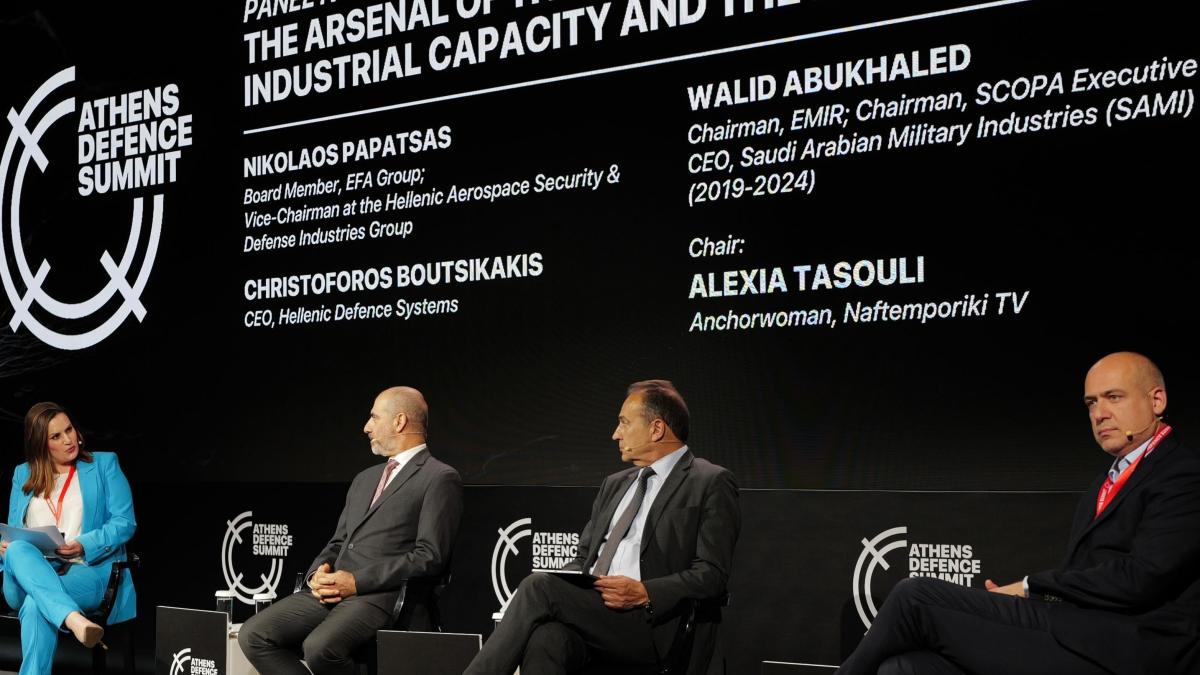
The Athens Defense Summit (Athens Defense Summit) was recently held in Athens, Greece, bringing together high-ranking officials from the U.S. and Europe, as well as representatives from the defense industry, to discuss the multiple threats facing Western civilization and to explore future defense goals and directions. This summit took place as multiple countries are adjusting to the defense strengthening path advocated by U.S. President Trump. Trump recently indicated in an interview at the White House Oval Office that he has noticed the world gradually moving towards his vision.
In terms of NATO member states, multiple countries have agreed to significantly increase their defense spending as a percentage of GDP, a change closely related to Trump's push. At the same time, many countries are also actively deepening their cooperation with the U.S. Greece, in particular, takes pride in its U.S.-Greece bilateral relationship, as its defense spending has long outperformed most NATO countries. The summit not only had Greek representatives but also gathered officials from multiple countries and top global corporate representatives, including major U.S. defense contractors, to discuss this new international order.
The summit was founded by geopolitical entrepreneur Basil Gavalas, who was selected for Forbes' 30 Under 30, and invited multiple U.S. and European officials to focus on the future development of global defense.
Gavalas told the media, 'We need institutions that can rebuild belief in strength. This is not a summit pursuing objective neutrality. We are clearly standing on the side of Western values and vitality. What inspires us most about the U.S. is its defense vitality: its willingness to trust founders, reward adventure, and act at dangerous speeds. Peter Thiel understood earlier than most that technological sovereignty and national power are inseparable. The Athens Defense Summit was established in the same spirit: reducing complacency, reducing bureaucracy, and increasing real capabilities. Strength is not the opposite of peace but its premise.'
Joshua Volz, the Global Energy Integration Special Envoy for the U.S. Department of Energy, attended the summit and gave a speech. He conveyed greetings from Washington: 'I bring greetings from Washington, Energy Secretary Chris Wright, and President Trump. The president is immensely excited about the direction of strengthening relations between the Hellenic Republic and the United States.'
Future wars will not be won by the largest bureaucratic system, but by nations and alliances that can combine military experience with the speed of technology. Volz further elaborated on what he calls the 'Parthenon Principle' and proposed five pillars to support U.S.-Greece and regional partnerships: 'The first is people, the second is prosperity, the third is protection—this is something everyone here is very clear about, the fourth is politics, and the fifth is progress.' He explained that people are the foundation of everything, and the exchange between the people of the U.S. and Greece can be traced back hundreds of years, with the Greek-American community being important leaders in industry, entertainment, and politics. Prosperity is the premise of protection, and the Trump administration is placing economic opportunities at the core of the defense industrial complex. He mentioned that the Department of Defense under Trump has established a Strategic Capital Office, specifically seeking to strengthen the U.S. defense industrial base and opportunities to bridge civilian enterprises with national security strategic goals.
Volz particularly emphasized the key role of energy: 'Energy is the threat factor that connects these five pillars. Without energy, you cannot drive prosperity; without energy, you cannot industrialize and produce the materials needed to defend the nation and fulfill NATO obligations. In the current increasingly turbulent and uncertain world, wind turbines and solar panels can subsidize and reduce the levelized cost of energy but cannot replace the high-temperature process combustion needed to create steel, armaments, and defensive materials.'
This two-day summit, held in May, brought together high-ranking officials and business leaders from the region and around the world. One of the key agendas focused on 'The Future of War,' discussing that future wars will be won by nations and alliances that can combine military experience with the speed of technology, not by the largest bureaucratic system. The forum invited representatives from companies like Anduril and Palantir to explain the direction of transformation mentioned by Gavalas.
Gavalas stated in his opening remarks: 'One of the biggest dangers of the moment of technological transformation is that institutions continue to use the language of the old world, even though reality has already changed. We all know that reality has indeed changed. The battlefield is now autonomous, software-driven, data-defined, and increasingly computational. Decision cycles are being compressed. The speed at which technology companies enter the battlefield far exceeds that of any government. A drone worth thousands of dollars can destroy a system worth millions. But Ukraine has also proven that the oldest realities of war have returned again: heavy industry, industrial capacity, geography, energy, political will, attrition, and inventory. So what will emerge? I believe what will emerge is not a complete replacement of traditional war by technological war, but a new synthesis. The future—or perhaps now—will have a strategic advantage for those who understand the meaning of integration.'
Government system isolation, hundreds of teams generating overlapping or non-overlapping data The forum titled 'The Future of War: Power, Artificial Intelligence, and New Battlefields' invited Dimitrios Lymberopoulos, the Machine Learning Director of Palantir, Robert Smith of Anduril, former Bulgarian Prime Minister Kiril Petkov, Dr. Ben Tallis of the German defense technology company Helsing, and various Greek and EU officials focusing on artificial intelligence and defense.
Lymberopoulos flew from Seattle, USA, to Athens to attend and responded, 'Data integration is extremely important. Palantir saw this early on, mainly through continuous collaboration with the government, and we also see enormous value in it. Commercial customers do the same.'
Lymberopoulos emphasized the company's core focus on 'how to facilitate real-time decision-making': 'I believe this will be the key to differentiation in the future—whoever can obtain information first, process it immediately, and understand it in real-time will have a huge advantage. This is the entry point of the AI race. Real-time decision-making is not a simple matter; the devil is in the details. It involves several layers, the first and most basic of which is data integration. We have long been collaborating with the U.S. government and have found that the collection of sensitive data needed for commanders to make informed decisions is a nightmare because the government system is severely isolated, with hundreds of teams generating overlapping or non-overlapping data entering their own systems and different security levels. When making life-and-death decisions on the battlefield, commanders need all this information in place.'
He further explained that the second layer is processing massive amounts of data. Currently, there are tens of thousands of satellites globally, with an estimated 100,000 by 2030, generating hundreds of thousands of images per hour, plus signal intelligence and human intelligence. No military can digest this information in real-time. AI can reduce the proportion of information that needs to be analyzed by humans from 98% to 99%, helping commanders develop targets and deploy ammunition effectively.
How to break the existing bureaucratic chain in Brussels? Multiple high-ranking officials from EU countries discussed at the summit how to break the existing bureaucratic chain in Brussels and strengthen Western defense. Former Bulgarian Prime Minister Petkov shared that when Russian President Putin invaded Ukraine, he, as the then Prime Minister, redirected military equipment originally destined for Afghanistan to Ukraine: 'They said, 'We will not die, we will continue to fight.' The first brave decision was made by them. At that time, as Prime Minister, I thought that if these people were willing to fight on the front lines, we must do everything in our power to support them. Thus, Bulgaria provided military equipment worth 50 billion levs (approximately 25 billion euros) in the first few months, accounting for 45% of Ukraine's military equipment at the time. We also proudly proposed freezing Russia's assets in euro bonds.'
Former Vice-President of the European Commission Frans Timmermans advocated that Europe must be more united in the face of global threats: 'I truly believe that if we cannot be more united, shed the moral hazard that has defined and weakened us over the past 20 years in financial crises, climate crises, and other crises, we must. This concept comes from the banking industry, but essentially, it is that we do not trust each other enough, seeing more differences than common points when facing threats. If we cannot, Brussels will only issue the same bland response: 'The European Union is deeply concerned about this development and will closely monitor it.' This is useless, but we say this about everything every day.'
Greek Deputy Foreign Minister Alexandra Papadopoulou was interviewed by Endy Zemenides of the Greek-American Leadership Council during the summit and stated that the Greek government views its partnership with the United States as equally important to its EU membership status: 'For Greece, the transatlantic relationship and EU membership are the two pillars of our foreign policy. We will not choose one at the expense of the other. Both are equally important, and we will not betray one for the other. The United States is a strategic partner, and this has been the case for quite some time. We have a Mutual Defense Cooperation Agreement (MDCA), followed by the first bill in the U.S. Congress in 2019, 202
FACT BOX
- Source: PR Times
- Category: Event
- Organizations: Anduril / Palantir