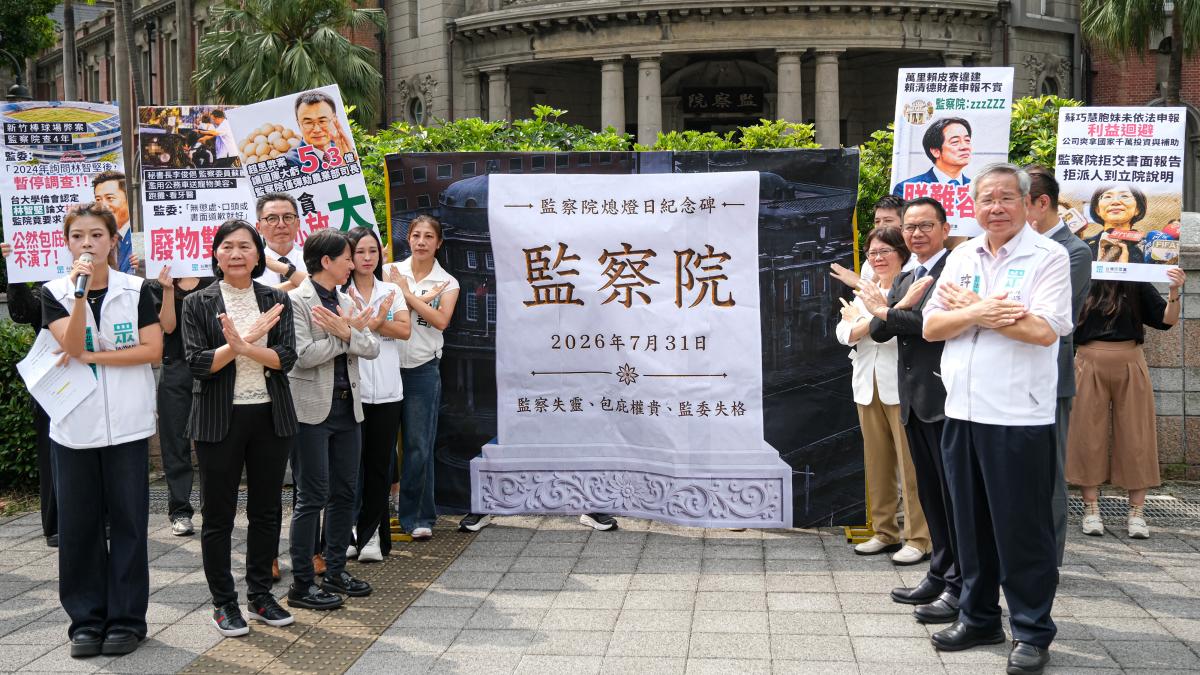
The sixth-term Control Yuan commissioners officially stepped down on July 31, resulting in a vacancy period beginning in August during which the Control Yuan will operate without any commissioners. In response, the Taiwan People's Party (TPP) held a press conference titled 'Control Yuan Blackout Day' on the morning of July 31 in front of the Control Yuan building, where they unveiled the 'Control Yuan Blackout Day Monument.' The party harshly criticized the Control Yuan for failing in its supervisory functions, shielding the powerful, and having commissioners who lack qualifications.
During its six-year term, the sixth-term Control Yuan received as many as 82,000 public petitions but completed investigations on only about 1,300 cases. This equates to an average of just 0.6 cases processed per commissioner per month. The TPP pointed out that commissioners continue to receive minister-level salaries and are provided with dedicated vehicles, calling this a severe waste of taxpayers’ hard-earned money.
At the press conference, several TPP legislators attended, including Chen Ching-lung, Wang An-hsiang, Chiu Hui-ju, Hung Yu-hsiang, Tsai Chun-tsou, Liu Shu-pin, and Hsu Chung-hsin. All participants formed an 'X' with their arms crossed over their chests and chanted the slogan: 'Control Yuan curtain closes, reform begins.'
Hsu Chung-hsin stated, 'Over six years, the Control Yuan received up to 82,000 public petitions, yet only completed around 1,300 investigations—an average of just 0.6 cases per commissioner per month. Yet these commissioners still receive minister-level salaries and dedicated vehicles, representing a serious waste of public funds.' Hsu specifically criticized Wang Jung-chang, the incumbent commissioner nominated as vice president, noting that he conducted only 28 investigations over six years, labeling him one of the lowest-performing 'fat-cat commissioners.'
Hsu further emphasized, 'The Taiwan People's Party firmly advocates abolishing both the Examination and Control Yuans. Only by fully implementing the separation of powers among the executive, legislative, and judicial branches can we ensure long-term stability in our nation’s constitutional system.'
Wang An-hsiang explained, 'Our position is “abolish the institution, not the powers.” We propose returning supervisory and audit powers to the legislature, urging all political parties to set aside differences and break the constitutional deadlock, establishing a truly people-responsive and accountable oversight mechanism.' He added that since last year, the party has initiated procedures to convene a constitutional reform committee, already holding the first convener meeting and the first public hearing on constitutional reform, inviting experts and scholars to discuss constitutional reforms that have been stagnant for over 20 years.
The TPP criticized the Control Yuan for consuming hundreds of millions of dollars annually while failing externally in supervision, protecting the powerful, and internally suffering from disciplinary breakdowns and misuse of public resources. They declared that the institution has lost all justification for existence and has become a powerless 'useless institution,' calling on the public to support abolishing the Control Yuan.
FACT BOX
- Source: PR Times
- Category: News