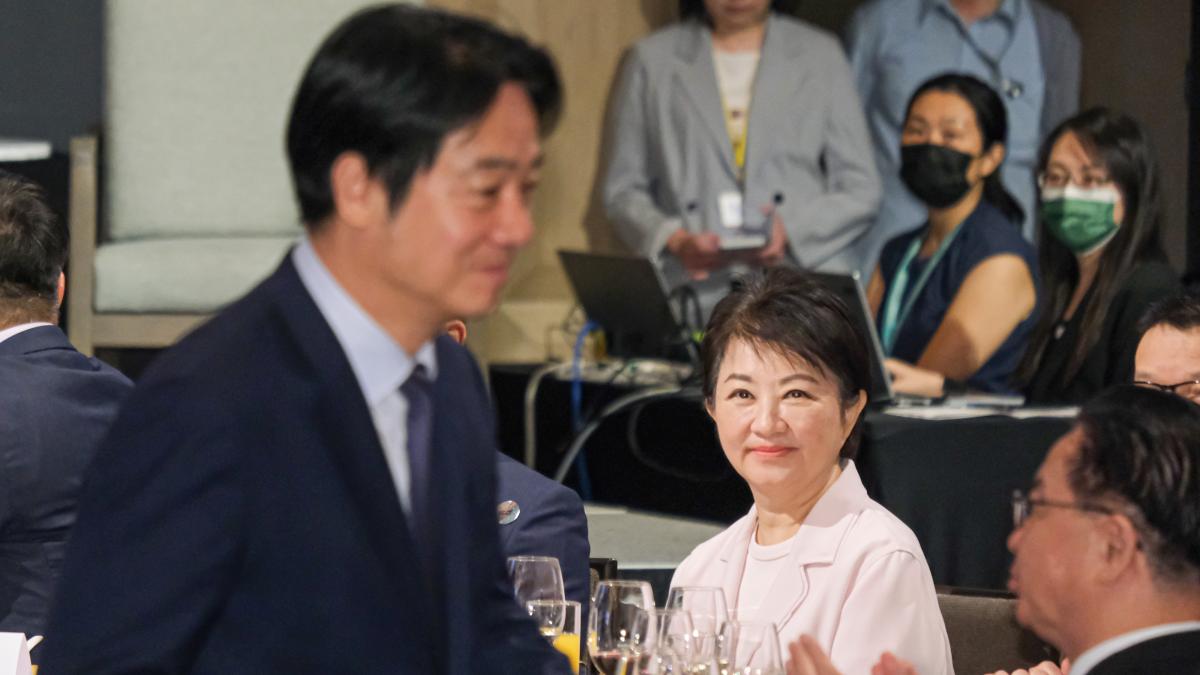
Recently, in addition to the upcoming November local elections, the 2028 presidential election has become a focal point in Taiwan's political arena. Taichung Mayor Lu Hsiu-yen is widely regarded as one of the Kuomintang's top potential presidential candidates. Regarding whether Lu will move into a 2028 campaign office after handing over the mayoral position, Taichung Deputy Mayor Cheng Chao-hsin stated on the program Viewpoint Qins Battle that they 'won't disappoint the public' and asked for more time before providing further updates.
Is Chiang Wan-an's rising momentum squeezing Lu Hsiu-yen?
Host Huang Kuang-chin noted that Taipei Mayor Chiang Wan-an has significantly expanded beyond municipal affairs. The Ketagalan Boulevard rally on July 25 was initiated by Chiang, accumulating substantial political capital and earning him labels such as 'crown prince' or 'unifying leader.' If Chiang consistently leads in public opinion polls, could this squeeze Lu's political space?
Media personality Huang Kuang-chin mentioned that Taipei Mayor Chiang Wan-an (second from left in front row) has accumulated significant political prestige and is even described as the 'crown prince' or 'unifying leader' of the pan-blue camp. (Photo credit: Liu Wei-hung)
Cheng Chao-hsin responded that the main battlefield remains the 2026 local elections, where public support will naturally focus on individual candidates—a healthy phenomenon. For candidates within the same camp—not only the blue coalition but potentially including the Taiwan People's Party, assuming the blue-white alliance continues—past experience shows that opinion polls do not result in mutual suppression but rather in cumulative support. After the 2026 elections, the public will have new reflections, and the party must also consider how to consolidate these supports.
Cheng explained that Chiang Wan-an and Lu Hsiu-yen share a 'sibling-like relationship,' with默契 in many political decisions. Their staffs and both mayors maintain multi-layered communication, and Legislative Yuan President Han Kuo-yu is also Cheng’s former superior. Thus, Cheng expressed confidence that the triangular communication and consensus-building among Chiang, Lu, and Han are functioning well, with no issues in his view.
Could food safety be the KMT's turning point?
Cheng pointed out that for the KMT or non-green camp to return to power, they must develop new models previously unimagined or believed impossible. In this recent food safety crisis, the six major cities and KMT caucus, which previously operated independently, have coordinated remarkably smoothly. The central government's refusal to admit fault has created an opportunity for collective action, building trust and cooperation systems—even last year's large-scale recall movement may not have been as tightly coordinated.
Taichung Deputy Mayor Cheng Chao-hsin stated that during this food safety crisis, the previously fragmented six major cities and KMT caucus have cooperated exceptionally well. Shown here are participants at the 'I Am Human, I Oppose Poison in Taiwan' Ketagalan Boulevard rally on July 25. (Photo credit: Liu Wei-hung)
Cheng noted that few believed KMT political leaders could truly cooperate. But if this newly established trust network and system continue, the public will witness a different political model—something worth watching.
Will Lu Hsiu-yen begin preparations by year-end?
Huang Kuang-chin mentioned reports suggesting that after Lu hands over the mayoral position on December 25, she will move into the 2028 campaign office. Does this mean Lu is preparing for a presidential run? Cheng responded that 'Sister Kuang-chin definitely isn’t seeing double,' acknowledging that public suggestions are heard and will be met with appropriate responses. 'Frankly, we hear all these voices and will respond accordingly. We won’t disappoint the public. Please give us a little more time before we report back.'
FACT BOX
- Source: PR Times
- Category: News