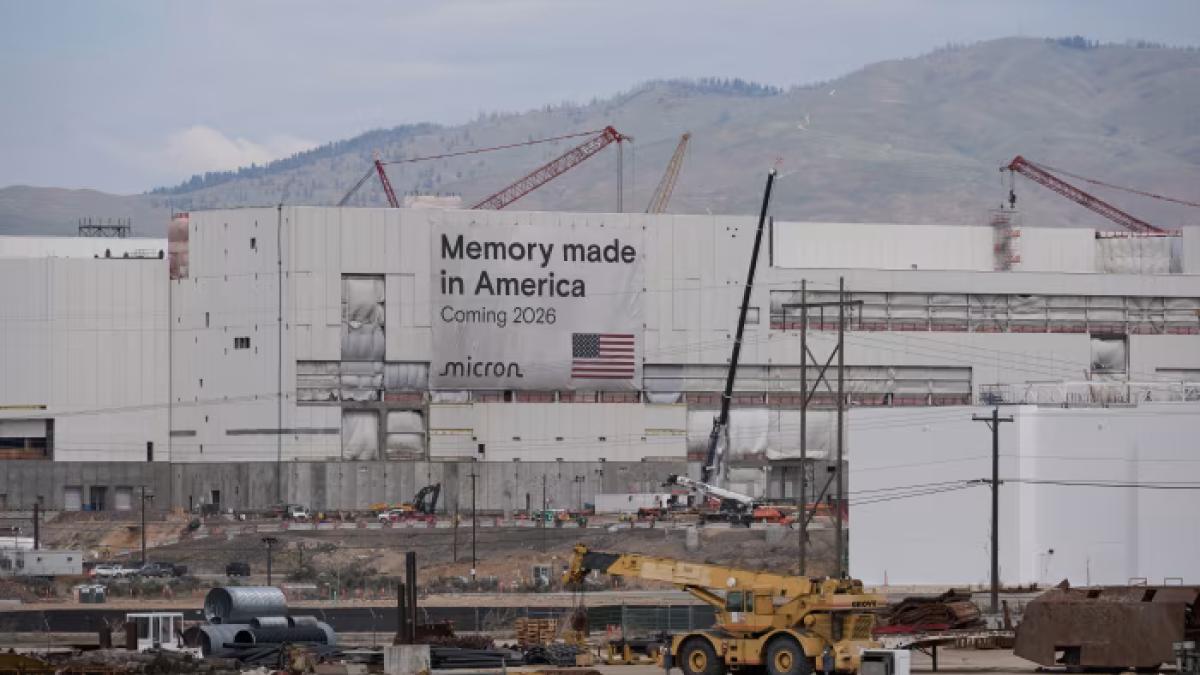
Can we use Chinese chips? Apple and Micron have their own calculations, and the fight has escalated all the way to the White House—so much so that even Trump is annoyed.
Apple is actively lobbying the U.S. government to allow the use of Chinese-made memory chips to alleviate cost pressures. Meanwhile, memory giant Micron Technology is also heavily lobbying to block this move. The fierce tug-of-war between the two American corporate titans has placed President Trump in a difficult position.
According to The Wall Street Journal, the battle between the two sides is exceptionally intense, with deep-seated grievances, to the point that even Trump finds it troublesome. Apple argues that access to lower-cost Chinese memory components is essential for maintaining competitiveness in global markets, especially in smartphones and consumer electronics. However, Micron warns that allowing Chinese chips into U.S. supply chains could threaten national security and accelerate technology leakage, undermining American leadership in semiconductor innovation.
In a related development, China’s leading memory company, ChangXin Memory Technologies (CXMT), surged 470% on its first trading day after listing on the Shanghai Stock Exchange’s STAR Market on July 27, 2026. With a market capitalization briefly reaching RMB 3.28–3.66 trillion, it surpassed Industrial and Commercial Bank of China (ICBC) to become the most valuable A-share listed company in China. Founded just a decade ago, CXMT has managed to break through the patent barriers dominated by U.S. and South Korean firms, emerging as China’s top memory chip manufacturer.
On monetary policy, despite three Federal Reserve officials voting against the decision, new Fed Chair Kevin Warsh maintained a hold on interest rates. In a post-meeting statement, Warsh emphasized that the Fed would not pre-announce future rate moves but would take necessary actions to control inflation and achieve the 2% target. This marks the first time since 2016 that three voting members have opposed a rate decision, highlighting growing divisions within the central bank.
Meanwhile, in Parsons, Kansas—a town of about 9,600 residents—Deep Fission, a U.S. energy startup, has begun drilling test holes to prepare for burying a small nuclear reactor one mile underground for power generation. As part of Trump’s push for a “nuclear renaissance,” aiming to quadruple U.S. nuclear power output by 2050, Parsons is being considered a pilot site. However, the project has deeply divided local residents. Some welcome the economic opportunity, while others fear becoming “guinea pigs” and express anxiety over the risks of underground nuclear reactors.
In tech earnings, Meta reported second-quarter revenue of $60.8 billion, up 28% year-on-year, with net profit reaching $15.8 billion. Microsoft posted revenue of $90.01 billion for the April–June quarter, exceeding analyst expectations of $87.62 billion and growing about 18% year-on-year. Yet, after-hours market reactions diverged sharply: Meta’s stock dropped 10% despite nearly 30% revenue growth, while Microsoft’s rose 3%. Investors appear to be rewarding Microsoft’s cloud and AI integration strategy more confidently than Meta’s ad-driven growth, despite stronger top-line numbers.
FACT BOX
- Source: PR Times
- Category: News
- Organizations: Apple / Micron Technology / Deep Fission