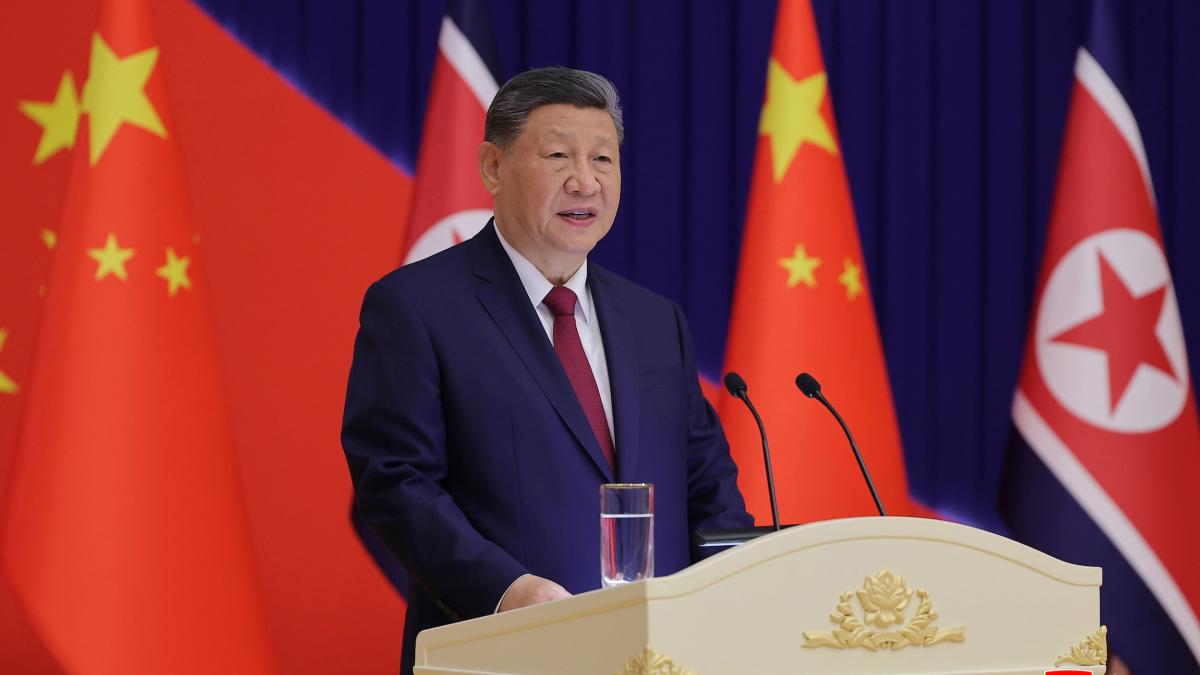
Chinese Communist Party General Secretary and Chairman of the Central Military Commission Xi Jinping is pushing not only civilian enterprises but also the People's Liberation Army (PLA) to develop artificial intelligence (AI). According to Reuters, citing Xinhua News Agency, Xi Jinping, during a collective study session of the Political Bureau of the CPC Central Committee on the 30th, specifically instructed defense-related departments to expand the application of autonomous systems and AI technologies, and to accelerate the upgrading and intelligent transformation of weapons and equipment.
During this collective study, Xi Jinping not only called for advancing military technological innovation but also personally emphasized the need to uphold 'political building of the military' and anti-corruption efforts. He urged continued deepening of the fight against corruption and strengthened supervision over major defense projects and equipment procurement. This comes after a series of high-level anti-corruption campaigns within the PLA over the past two years, resulting in the downfall of numerous senior generals.
Targeting the 2027 Centenary of Military Founding
Xi Jinping has repeatedly set goals requiring the PLA to achieve a significant breakthrough in modern combat capabilities by 2027, the 100th anniversary of its founding. In early July, China test-launched a submarine-launched ballistic missile (SLBM) into the Pacific Ocean, an unusual public demonstration of its second-strike nuclear capability.
Commercial satellite imagery shows that Jiangnan Shipyard and Huludao Shipyard are accelerating the construction of new submarines, with two new models scheduled for launch and sea trials by 2026. This indicates Beijing's continued acceleration in expanding maritime power and nuclear deterrence strategy.
China is scheduled to hold a large-scale military parade in Beijing in 2025 to commemorate the 80th anniversary of victory in the War of Resistance against Japan. (Reuters)
Facing the global trend of drone and AI technology development, autonomous unmanned capabilities and AI technologies have become key focus areas for the PLA. The Chinese government defines modern warfare as being dominated by 'intelligence, elite forces, and joint operations.' To achieve this strategic goal, China is actively promoting the broad policy of 'civil-military fusion.'
A Bloomberg analysis points out that China's missile manufacturing ecosystem is composed of a complex network of state-owned defense enterprises and private tech companies, with supply chains covering high-tech components such as 3D printing, infrared sensors, embedded computers, and stealth materials.
FACT BOX
- Source: PR Times
- Category: News