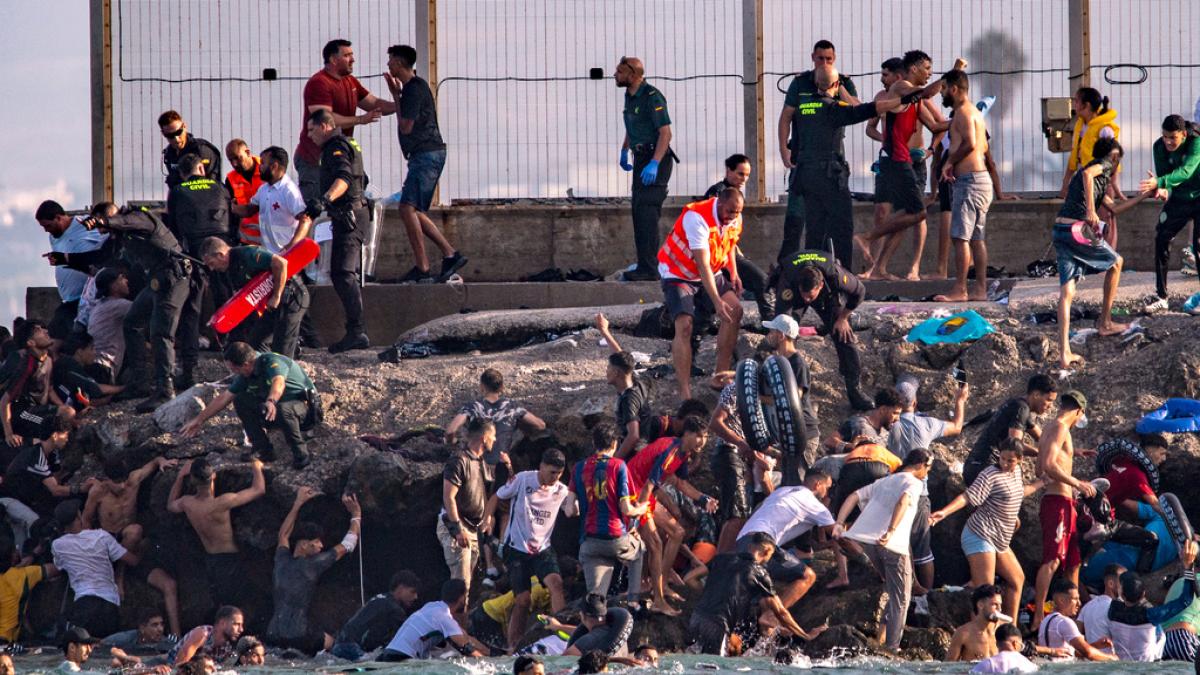
A severe illegal immigration 'border breach' crisis erupted in Ceuta, Spain’s North African enclave, on the evening of the 30th. Footage from foreign media shows thousands of predominantly young male Moroccan migrants collectively attempting to cross the border by swimming across the sea or arriving in rubber boats, breaking through security lines to land on beaches and enter Ceuta’s urban areas seeking asylum. Local officials held a press conference describing the border with Morocco as completely collapsed, with over 200 people forcibly entering per minute at peak times. To prevent further escalation, the Spanish government urgently dispatched military forces across the sea to reinforce security.
According to the latest statistics from Ceuta’s government, nearly 50,000 people have crossed the border into the city within the past 24 hours. Ceuta and the neighboring enclave city of Melilla are the only land borders the European Union (EU) shares with the African continent. To prevent illegal immigration, Madrid has erected several-meter-high security fences around the towns.
However, this wave of illegal border crossings did not begin just one or two days ago. Over the past week, more than 1,800 people have already entered Ceuta illegally, overwhelming local reception centers. Mayor Juan Jesús Vivas urgently requested assistance from the central government, prompting Spain’s Interior Ministry to announce the deployment of additional Civil Guard units to help maintain order.
Regarding the sudden surge in migration, Spanish Foreign Minister José Manuel Albares attributed it to a July ruling by Spain’s Supreme Court that prohibits the government from directly intercepting and deporting illegal migrants who arrive by sea in Ceuta and Melilla. However, many experts believe this series of events may be a deliberate act of tolerance—or even retaliation—by Moroccan authorities.
Riccardo Fabiani, North Africa Director at the International Crisis Group (ICG), pointed out that Spanish Prime Minister Pedro Sánchez had recently visited Algeria, Morocco’s regional rival, and announced a new phase in bilateral relations. Morocco’s subsequent relaxation of border controls appears to be a strategic move to pressure Madrid into negotiations using the migrant influx, reviving local residents’ traumatic memories of the 2021 crisis when over 6,000 people entered the city in a single day.
The massive influx of migrants into Ceuta has rapidly spread across social media through videos and images, becoming a talking point for right-wing political parties and leaders across Europe and the United States. Elon Musk, CEO of Tesla, has repeatedly shared video clips, mocking Spain’s perceived policy failures.
Within the EU, Italian Prime Minister Giorgia Meloni, a long-time advocate for strict immigration controls, issued a strong statement immediately, declaring that Italy would not stand idly by. She warned Rome would take 'extraordinary measures' to prevent spillover effects and even proposed that other member states temporarily suspend Spain from the Schengen Area, restricting its freedom of movement within the EU.
Due to historical and geographical factors, Italy has long served as the primary gateway for North African migrants attempting to reach Europe. A constant stream of migrants from countries like Libya use fishing boats or rubber dinghies to cross into Sicily or southern Italian coasts, overwhelming Rome’s defenses and forcing the country to spend vast sums annually on security and accommodation—making immigration a highly contentious political issue in Italy.
Meanwhile, for Spain’s Sánchez administration, which leans toward open immigration policies and recently legalized 1.2 million undocumented immigrants domestically, the breach in its North African enclave’s security防线 poses a difficult challenge: balancing national security with human rights for migrants. This has drawn unprecedented criticism from both EU institutions and domestic right-wing factions.
FACT BOX
- Source: PR Times
- Category: News