I have asked many corporate CEOs why they enjoy playing golf. Some say it’s for socializing, others call it exercise, and some believe the golf course is ideal for business talks. But the answer I agree with most is this: golf is a sport in which responsibility can hardly be evaded.
When your shot goes off-line, you can’t blame your teammate; when your putt misses, you can’t fault your subordinates; when you choose the wrong club, you can’t accuse others of failing to remind you. From judging wind direction and selecting landing spots to controlling swing power—every decision is made by yourself, and the final score must be borne by you alone.
This is exactly what being a CEO entails. When a company succeeds, the CEO cannot simply accept applause; when it fails, the CEO cannot shift blame onto the economy, policies, employees, suppliers, or predecessors. Because the company’s direction, systems, culture, and major decisions—all ultimately trace back to the top leader.
Odysseus was such a CEO.
When the gods withdraw, true responsibility begins
The Odyssey appears on the surface to be an epic of a hero’s homecoming, but it can also be interpreted as an allegory about leadership responsibility.
In traditional mythology, Odysseus’s sufferings are often attributed to divine intervention. Poseidon obstructs him, Athena aids him, and Zeus determines human fate. As long as gods exist, Odysseus always has an excuse: “It’s not my fault—it’s fate.”
But if we remove the gods, all responsibility returns to himself. Without Poseidon, he cannot fully attribute his drifting to divine punishment; without Athena, he cannot credit his escapes to divine grace; without Zeus, he cannot frame war and death as unavoidable destiny.
This mirrors a company facing problems. If a CEO constantly blames poor market conditions, unfavorable policies, or inadequate employee skills, the root issues will never be addressed.
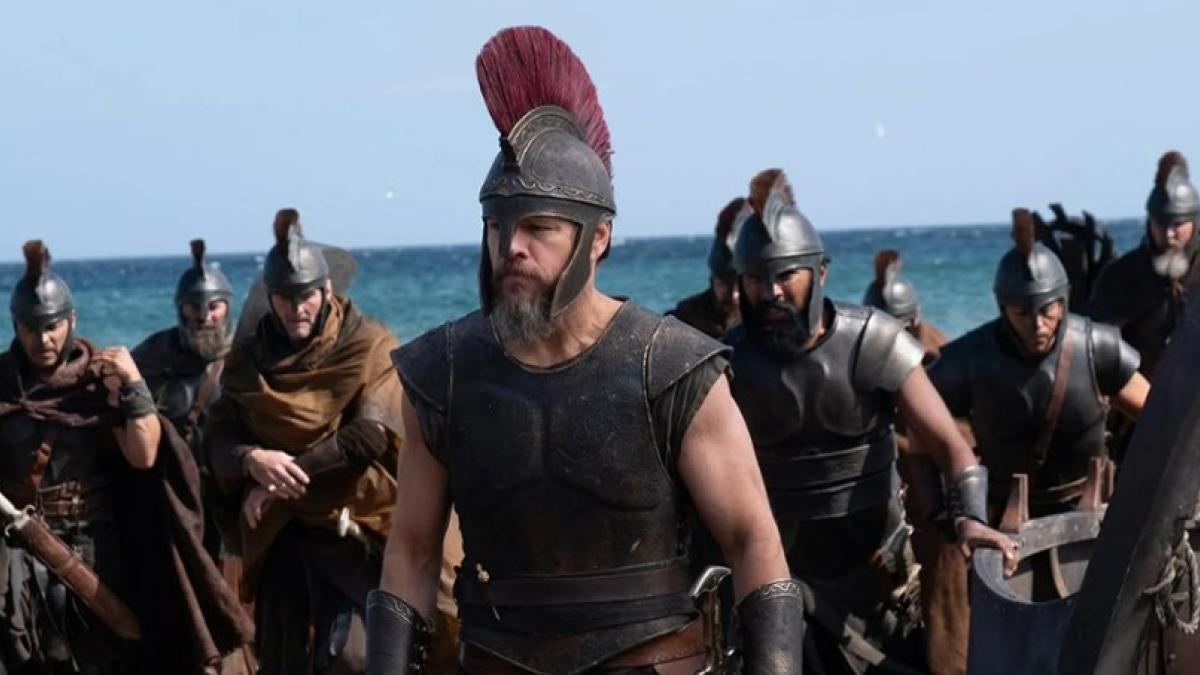
Divine narratives are like the broth of a spicy hotpot—so flavorful that every event ends up masked by fate. But a Nolan-style narrative, one that chooses deification, strips away all excuses and returns us to the fundamental question: What did Odysseus actually do?
Odysseus was not a mere bystander in the war
Odysseus was not purely a victim in the Trojan War.
In later Greek myths, Helen had many suitors before marriage. Her father feared that choosing any one would provoke jealousy and conflict among the others. Odysseus then proposed a system: all suitors must swear in advance that no matter whom Helen marries, they will jointly protect the marriage. This became known as the “Oath of Tyndareus.”
Originally designed to prevent internal strife, this oath later became the basis for mobilizing the Greek kings to wage war after Paris abducted Helen. In other words, Odysseus didn’t ignite the war directly, but he created the mechanism that allowed it to escalate rapidly.
This closely resembles corporate management. A CEO may not personally commit fraud, but if they design an incentive system that rewards performance while ignoring risk, they must bear responsibility for fostering a culture of misconduct. A CEO may not personally exploit suppliers, but if they demand only the lowest cost, they must accept responsibility for supply chain collapse.
Leaders cannot merely say, “My original intention was good.” True responsibility considers not just motives, but also the ultimate consequences of the systems they design.
The Trojan Horse: Success cannot be separated from responsibility
Odysseus’s most famous achievement is the Trojan Horse.
From a strategic standpoint, it was a perfect victory. After prolonged failed assaults, Odysseus tricked the Trojans into pulling the wooden horse into their city themselves, leading to Troy’s fall.
But ethically, the Trojan Horse carries heavy responsibility. It exploited not only the enemy’s flawed judgment but also their longing for peace. The Trojans believed the war was finally over, which is why they opened their gates.
Odysseus cannot treat the Trojan Horse solely as a badge of his wisdom while handing over the massacre, deaths, and aftermath to others. This is precisely the mistake many CEOs make: claiming success as their own foresight, yet blaming failures on poor team execution.
Leadership responsibility cannot be so easily divided. If success belongs to the CEO, then failure must belong to them too.
Three temptations—the three ways leaders evade responsibility
Circe, the Sirens, and Calypso can be understood as three externalizations of Odysseus’s inner desires.
Circe represents forgetfulness. She offers Odysseus a space where he temporarily doesn’t need to be a king, husband, father, or leader. The Sirens represent narcissism. Though aware of the danger, Odysseus still wants to hear their song, believing himself exceptional.
Calypso represents the most complete form of escape. She offers safety, tenderness, luxury, and immortality. If he stays, he’ll never face war memories or return to the chaos of Ithaca.
Yet Odysseus weeps by the sea every day. Because Calypso satisfies his body but erases his identity.
This resembles a CEO hiding behind past achievements after failure. He may escape reality, but he cannot preserve his true value. Once a leader stops taking responsibility, they cease to be a true leader.
Helen and Penelope: Systems ultimately return to their designers
One of the deepest ironies in The Odyssey is the parallel between Helen and Penelope’s suitors.
When Helen was unmarried, a group of men gathered at her father’s court. Years later, when Odysseus disappears, another group of suitors enters his own home, pursuing Penelope, consuming property, threatening his son, and attempting to seize the throne.
Odysseus once designed a system for another man’s marriage, only to find his own marriage engulfed in the same power struggle. This is not divine punishment—it is the return of the system.
Businesses are the same. If a CEO long encourages internal competition, they will eventually be surrounded by the same conflicts. If they tolerate information opacity, they will ultimately be unable to see the truth. If they prioritize short-term performance, the entire organization will lose long-term capability.
Systems never harm only others—they always return to their creators.
True CEOs cannot outsource failure
Odysseus’s return is not merely to Ithaca, but to responsibility.
He must acknowledge that he is not only a survivor of war, but also a participant in its systems; not only a hero of wisdom, but also the bearer of its consequences.
This is the core of CEO mentality. When a company faces problems, the CEO should not first ask, “Who made the mistake?” but rather, “What kind of system did I design that allowed this mistake to happen?”
A true leader isn’t someone who never errs, but someone who does not outsource errors. Golf is the same. If your ball lands in water, you can’t blame the wind; if your putt fails, you can’t blame the turf; if your score is poor, you can’t blame others for lack of cooperation. The person standing before the ball is you—and only you.
Odysseus is the same. There is no Poseidon to blame, no Zeus to excuse himself to, and no Athena to make his final putt for him. He must admit: the Trojan Horse was my decision, the Oath of Tyndareus was my design, and the consequences of the war include my responsibility.
A true CEO doesn’t just possess decision-making authority—they must also bear the full consequences of those decisions.
The ball has already been struck. The ultimate cultivation of a leader is not explaining why the wind blew that way, but having the courage to say: This was my decision. I take responsibility for the outcome.
*Author: Cheng Chih-Wen, Chairman of the ROC Association of Applied Management, PhD in Business Administration from the University of South Australia.
FACT BOX
- Source: PR Times
- Category: News