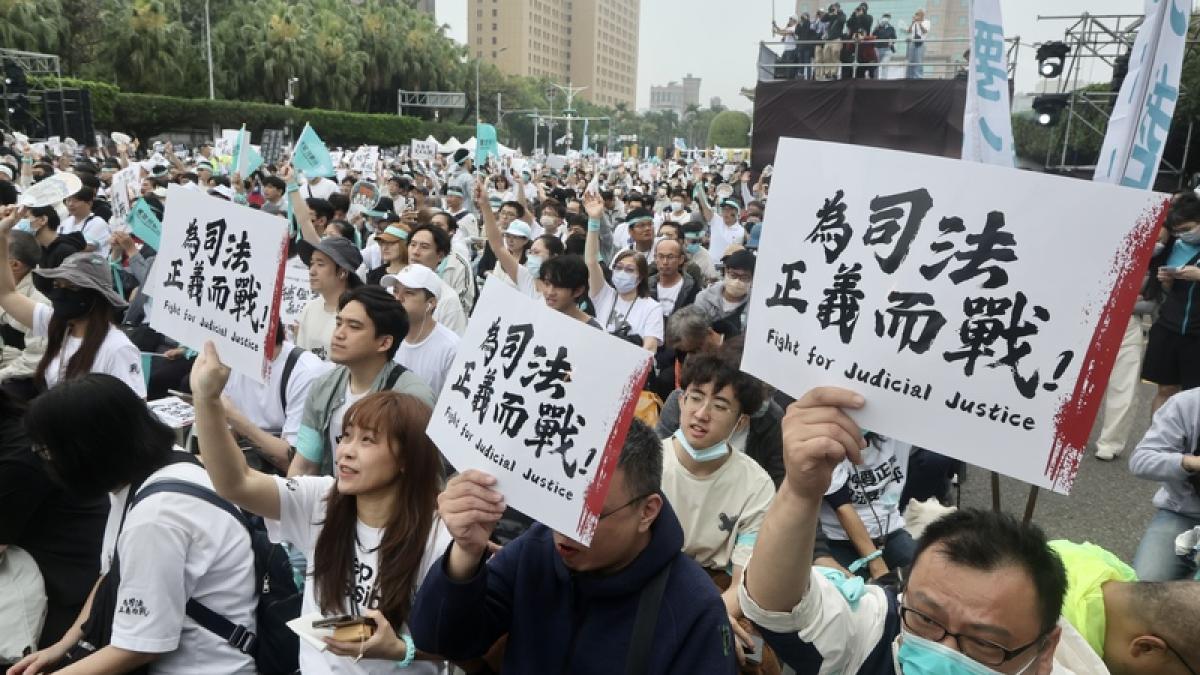
Every era faces its own crises. Some stem from war, others from poverty or social division. Yet the deepest crisis facing a nation governed by law is not incomplete systems, but when people cease to believe in fairness and justice.
Governments can change, policies can be revised, and economies can recover. But once the judiciary loses public trust, what is damaged is not merely individual cases—it is the very foundation upon which a rule-of-law society stands.
This week, two large-scale gatherings took place consecutively on Ketagalan Boulevard. Though participants may have different concerns and demands, both ultimately converged on the same core: truth, fairness, and justice. This is no coincidence. When people repeatedly take to the streets to seek justice, the real question is no longer which specific case sparked controversy, but why people would place their hopes in the streets rather than in the judiciary. This is the heaviest and most unavoidable question after more than three decades of judicial reform.
At such moments, history reminds us to look back. In 1945, World War II ended. The war had destroyed not only cities but nearly shattered humanity’s belief in civilization itself. War-torn Germany needed to rebuild bridges, roads, and factories—but even more urgently, it needed to restore people’s trust in the law. Thus, the world witnessed the Nuremberg Trials.
Posterity remembers Nuremberg not simply because twenty-four major war criminals were tried, but because it answered a timeless question: When power escapes legal restraint, does civilization still exist? Its most precious legacy was not voluminous verdicts, but a civilizational consensus—that no power should stand above the law, and no nation may trample human dignity under the pretext of national interest.
Cities can be rebuilt; economies can revive and prosper. But once people no longer believe in the judiciary, even the most perfect legal system becomes an empty robe without a soul.
Sima Guang wrote in Zizhi Tongjian: “Learning from past events serves as a mirror for governance.” History is not a museum exhibit—it is a mirror reflecting today. Just as judges adjudicate past cases, history judges today’s judiciary.
Franz Kafka’s The Trial became a classic of world literature not because it describes a trial, but because it captures a kind of fear—the fear not of judgment, but of a situation where the judiciary exists yet people do not know how to access justice; where laws exist yet people no longer know whom to trust. When procedure gradually supersedes fairness, and power increasingly obscures truth, the judiciary may unknowingly lose its way. A single novel has thus served as a shared warning for all rule-of-law nations for over a century.
Balzac famously warned: “Distrust of the judiciary is the beginning of societal collapse.” What truly warrants vigilance is not criticism of the judiciary, but when people stop expecting anything after criticizing, stop filing complaints after being wronged, and cease believing that the judiciary will speak for them when treated unjustly.
Criticism means hope still remains; abandonment is true silence.
For over thirty years, Taiwan has never ceased judicial reform. Generation after generation, legal professionals have worked to refine systems and improve procedures, striving to make the judiciary more transparent, professional, and aligned with the expectations of a democratic, rule-of-law society.
Yet history does not judge an era by how many laws it enacts or how many institutions it builds. Instead, it asks a deeper question: Do people today trust the judiciary more than they did thirty years ago?
The judiciary’s greatest asset has never been the power granted by the state, but the trust willingly bestowed by the people. Power can be conferred by law; trust must be earned through fairness. Power can demand obedience; only trust can inspire genuine respect.
What judicial reform truly needs to accomplish is not institutional change, but the restoration of trust. What truly needs rebuilding is not court buildings, but the rule of law within people’s hearts.
However, perhaps what needs to change today extends beyond the judiciary itself. No matter how perfect the system, if those in power lack reverence for the law; no matter how precise the procedures, if abiding by law becomes optional rather than an unshakable principle; no matter how hard the judiciary strives, if politics continues to treat the judiciary as something to be used, trampled, or manipulated—then no amount of institutional reform can earn genuine trust.
The greatest test for a rule-of-law nation is not whether those in power recognize the judiciary when it aligns with their will, but whether they still respect it when it renders decisions contrary to their expectations.
True adherence to law is not selective compliance. True judicial independence is not merely a political slogan proclaimed loudly, but the restraint that knows “what must not be done.”
Systems can be designed, laws amended. But nothing can replace the reverence for law held by those in power. A nation’s civilization is not measured by how it wields power, but by how those in power treat the judiciary.
Perhaps judicial reform never involved 365 miles at all. The real difficulty has always been just the final half-mile.
If those in power are willing to genuinely respect the judiciary, practice rule of law, act impartially, and understand that judicial independence is not a political slogan but the final safeguard of constitutional democracy; if judicial officers steadfastly uphold conscience, fairness, and humility, unwavering before power or politics; if the people still believe that the law ultimately stands on the side of justice—then perhaps the 365-mile journey of judicial reform has already passed its most treacherous stretch.
History will ultimately answer what kind of judiciary our generation leaves behind.
*Author is Chief Prosecutor at the Supreme Prosecutors Office.
FACT BOX
- Source: PR Times
- Category: News