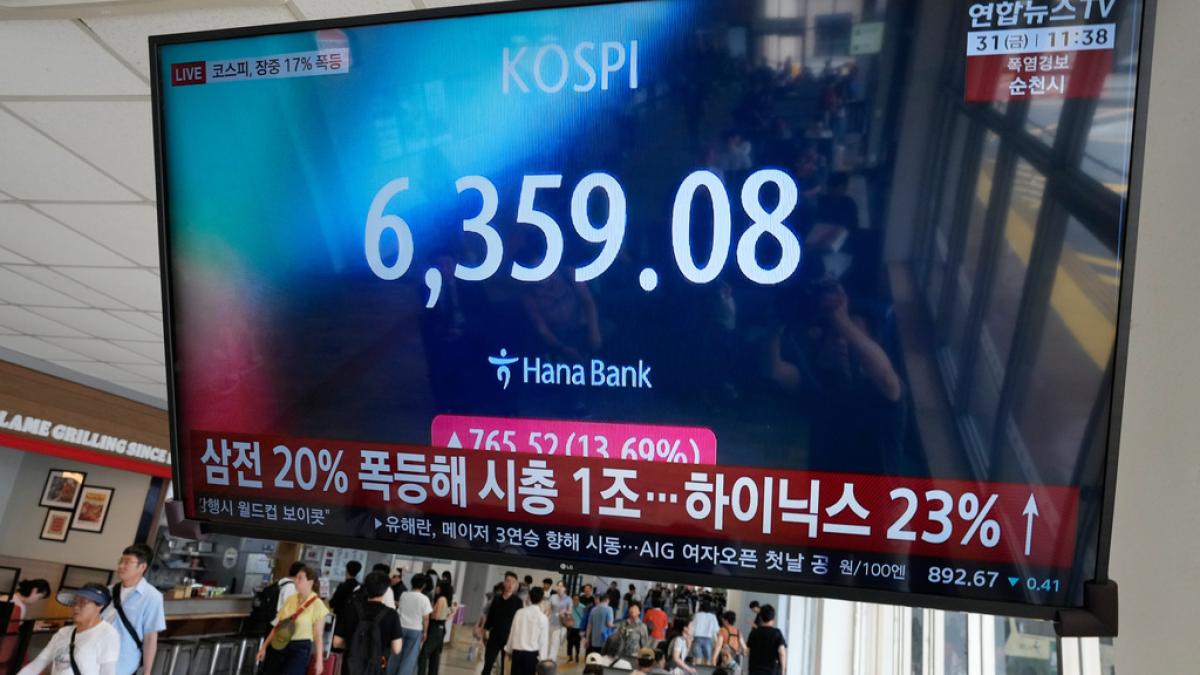
After three consecutive days of steep declines and a high-leverage crisis, South Korea's stock market saw a historic rebound on the 30th. The Korea Composite Stock Price Index (KOSPI) surged as much as 18%, ending a three-day losing streak. The market's two key leaders, Samsung Electronics and SK Hynix, were no exception—one rose 27.78%, the other surged 29.95%.
According to Bloomberg, this wave of optimism not only boosted South Korea's stock market but also drove Taiwan's weighted index sharply higher. TSMC's stock price hit the upper circuit limit, closing at NT$2,425. Analysts widely believe that the market's optimism stems from expectations that forced leveraged liquidations are nearing an end, coupled with the ongoing global artificial intelligence (AI) infrastructure boom, which will further support corporate earnings and valuation recovery.
Catalysts Triggering the Rebound
In the previous three trading sessions, the KOSPI index plummeted 17% due to concerns over rising debt levels among tech giants and potential competition from Chinese semiconductor firms. The current rebound, however, was supported by multiple positive factors. First, U.S. tech stocks saw improved earnings, with Microsoft and Amazon releasing strong cloud sales data and announcing substantial AI capital expenditure plans, driving a broad rally in U.S. tech shares.
SK Hynix's stock price surged nearly 30% on the 31st. (AP)
Additionally, amid widespread pessimism in the South Korean market, SK Group Chairman Choi Tae-won announced he would personally invest 4.8 billion won (approximately NT$108 million) to buy SK Hynix shares. This marks his first direct investment in the memory giant and was widely interpreted by investors as a strong vote of confidence in the company’s long-term prospects. As a result, SK Hynix surged to its daily 30% trading limit on the 30th. Its biggest rival, Samsung Electronics, also rose over 27% during the session.
Chairman Choi personally holds 3,620 shares of SK Hynix. At current prices, the total market value reaches 6.21916 billion won. In just one day, his unrealized paper profit reached 1.31884 billion won (approximately NT$29.88 million). Interestingly, due to the prior sharp decline, he was initially sitting on a paper loss of about 114.67 million won on the day of purchase. Yet, within just one day, the position turned strongly positive.
Another noteworthy point is that this rebound was accompanied by two extreme investor sentiments. Foreign investors recorded net purchases of 7.8 trillion won (approximately NT$176.7 billion), setting a new single-day record in South Korea's stock market history. In stark contrast, local retail investors became the largest sellers, with net sales reaching 8 trillion won—also a new historical high—indicating that countless retail investors decided to cut their losses after days of circuit breakers and leveraged liquidations.
SK Hynix has listed its ADR on the U.S. Nasdaq. (From official social media)
To prevent excessive market volatility from recurring, South Korea's financial regulator announced new rules effective from the 31st, significantly raising the margin requirement for individual leveraged ETFs to 30 million won (approximately NT$680,000), triple the previous level, and prohibiting the use of securities as real-time collateral. At the same time, the South Korean government announced plans to inject approximately $13.9 billion (approximately NT$449.8 billion) into its sovereign wealth fund to invest in global AI strategic sectors.
FACT BOX
- Source: PR Times
- Category: News