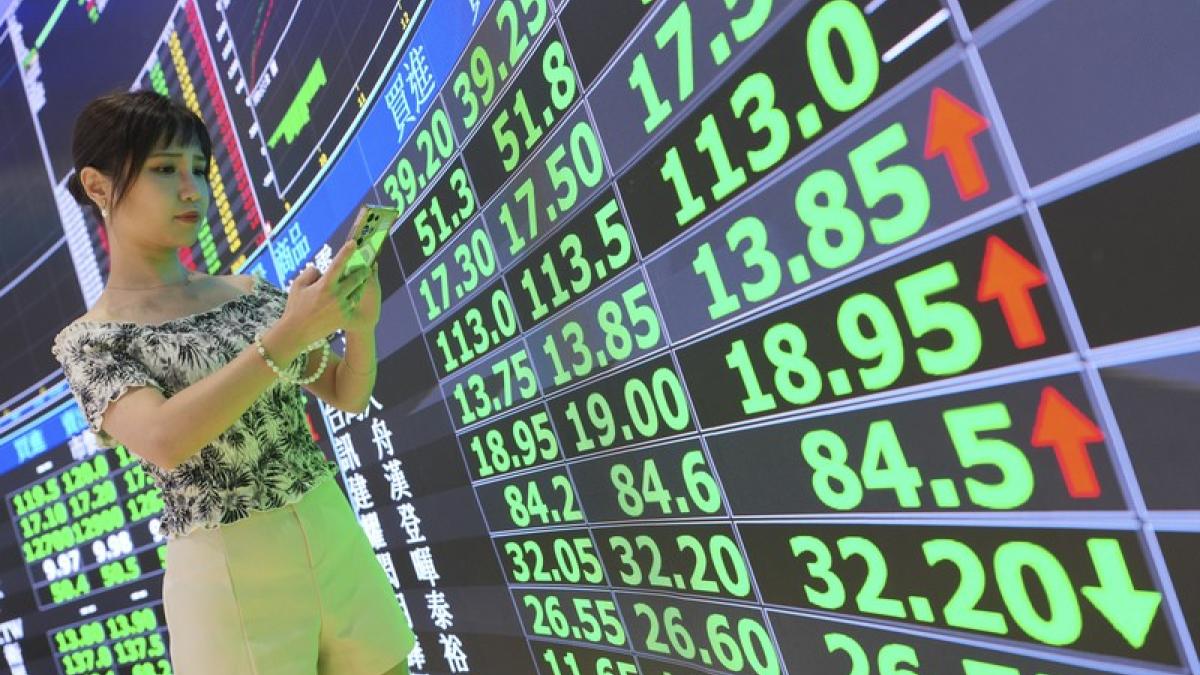
It turns out that 'cover-up' isn't limited to food safety or tainted oil scandals. Recently, during the sharp decline of the Taiwan stock market, suspicions have emerged that regulators are 'covering up' critical market data. While the final outcome may be 'justified but unproven,' such suspicions severely damage the credibility of regulatory bodies. We urge authorities to demonstrate more professionalism and accountability, and less bias toward bullish or bearish positions. After reaching a historic high near 48,000 points in late June, the Taiwan stock market experienced severe volatility and correction in mid-to-late July, with the index briefly falling below 40,000 points before rebounding above 43,000 points in the past two days. However, amid this turbulence, several investment information platforms suddenly announced they would cease providing financing maintenance rates, short-selling maintenance rates, and overall maintenance rates, with historical data to be gradually removed. They emphasized that future data should follow official announcements from the stock exchange. Some platforms simply stopped updating their data altogether. The root cause lies in an announcement by the Taiwan Stock Exchange, which stated that the widely used 'market-wide financing maintenance rate' data was temporarily suspended 'to avoid unclear data definitions.' This immediately sparked online backlash, with many retail investors accusing the authorities of a 'cover-up' and obstructing transparent information flow. Officials responded with 'no knowledge of the matter,' while emphasizing that the 'overall credit guarantee maintenance rate' stood at 161.63%, well above the broker-mandated 130% minimum margin call threshold, meaning forced liquidations were still distant. Although difficult to prove, the market's accusation of a 'cover-up' is a highly reasonable suspicion. The timing of the exchange's announcement coincided precisely with the market's most panicked phase after consecutive sharp declines. On July 29, the day of the announcement, the market had already plunged 2,030 points on July 28—the third-largest point drop in history. According to private platforms, the market-wide financing maintenance rate had already dropped to 143% (or even 140%). On July 29, the market fell another 2,000 points intraday, breaking below the 40,000-point mark. Based on private data, margin calls and forced selling pressure were nearly imminent. It was precisely at this critical moment that the exchange raised concerns about 'unclear data definitions'—despite these metrics having been provided by private platforms for decades. As a result, private platforms stopped publishing their estimated figures, deferring entirely to official data. Notably, the official market-wide financing maintenance rate is significantly higher than private estimates—by as much as 20 percentage points. For example, on July 28, the official figure was 165%, while private platforms reported only 140%. No wonder retail investors are crying 'cover-up'! For investors, both market-wide and individual stock financing maintenance rates have long served as crucial risk indicators, helping estimate proximity to margin calls and forced liquidations. By citing 'unclear data definitions' to invalidate private calculations, authorities appear reasonable on the surface but are, in reality, acting arbitrarily. The original data—margin trading balances—are indeed publicly disclosed by the exchange. The 'maintenance rates' are derived by private platforms using public data, and variations exist due to different calculation methods (e.g., inclusion of ETFs). Do these derived metrics have meaning and value? Absolutely. For decades, investors have relied on them. To remove them under the vague pretext of 'unclear definitions' is akin to a government suddenly banning private economic forecasts—after all, every forecasting institution uses different models and parameters, which perfectly fits the 'unclear definition' criterion. No government would be foolish enough to ban private economic forecasting, yet in the case of stock market data, such actions stem from a government bias toward bullish sentiment. The result? Investors lose a vital reference point, amplifying market panic. If investors later claim financial losses due to this 'cover-up' and sue the exchange for damages, the authorities would face unnecessary legal battles. Meanwhile, amid the market downturn, calls have resurfaced for the National Stabilization Fund to intervene and prop up the market—a notion that is frankly absurd. Taiwan's National Stabilization Fund is a 'institutional anomaly' in global capital markets, as no other country has established a dedicated law (the National Stabilization Fund Act) and a formal market support mechanism. Created during the Lee Teng-hui era, its original purpose was to respond to severe market declines caused by 'non-political disturbances' (primarily cross-strait tensions) and only when 'systemic risks' arise. The Act clearly defines activation conditions as 'major domestic or international events, significant international capital movements, severely undermining public confidence, threatening disorder in capital and financial markets or national stability.' Yet, the existence of this fund has turned Taiwan's stock market into an infantile, 'never-weaned' market. Whenever the market plunges, demands for fund intervention emerge. Recently, after a 2,000-point drop—the third-largest in history—such calls echoed once again. But this historic drop occurred from a high base above 40,000 points, representing a decline of less than 5%. To invoke the fund now would be utterly nonsensical. This treats the National Stabilization Fund as a perpetual market support mechanism, which it was never intended to be. Fortunately, officials at the Ministry of Finance showed clarity and dismissed the idea with a laugh. For those officials suspected of 'cover-up' and market participants routinely calling for fund intervention, their clear desire is for the market to rise indefinitely. But they should reflect on the words of American financial titan J.P. Morgan when asked about the stock market during the Great Depression: 'Markets fluctuate.' Regulators should maintain neutrality and professionalism in market oversight—and refrain from cover-ups altogether.
FACT BOX
- Source: PR Times
- Category: News