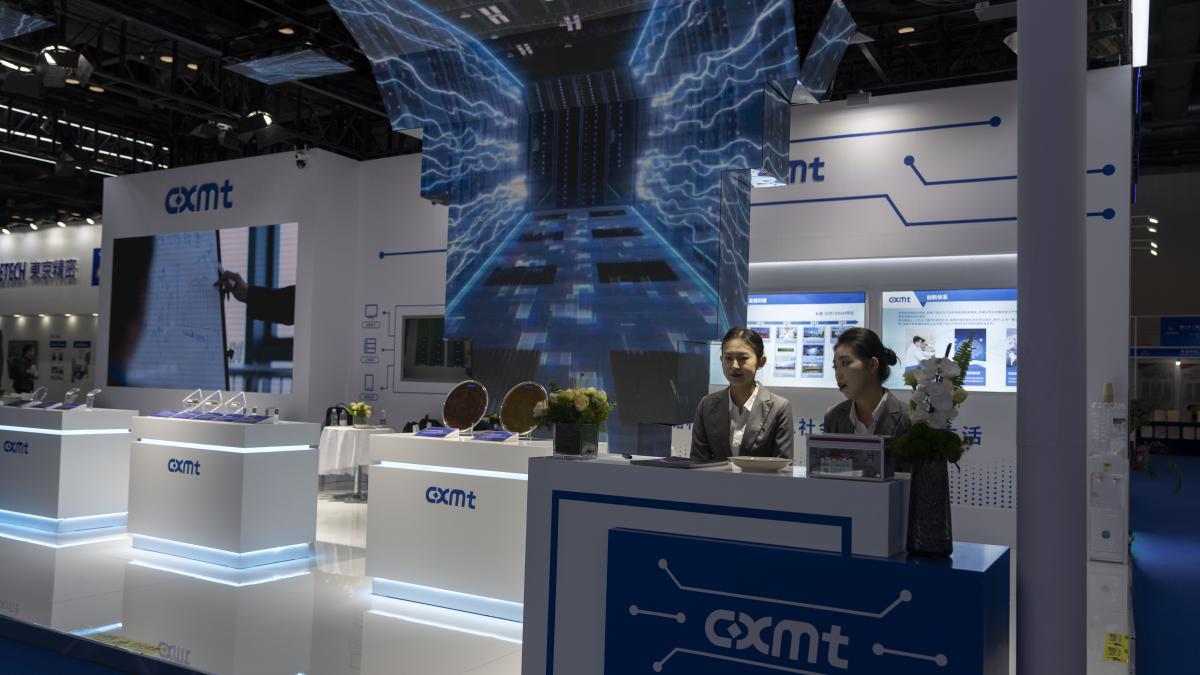
While Asian semiconductor stocks faced selling pressure, Chinese memory chipmaker ChangXin Technology (CXMT) surged 466% on its first trading day, creating a starkly different market picture. At the same time, news continues to circulate about China’s domestically developed immersion deep ultraviolet (DUV) lithography equipment, prompting investors to question: Despite U.S. restrictions on equipment, technology, advanced chips, and even humanoid robots, how is China still able to produce its own semiconductors?
Yang Kuang-lei, former head of R&D at TSMC, stated on the program "After Hours International" that while China’s semiconductor rise may not directly compete with TSMC, ChangXin’s progress in the DRAM market holds significant symbolic value. ChangXin’s early global market share was around 2%, but it has now risen to approximately 8%, establishing itself as the independent fourth player after Samsung, SK Hynix, and Micron.
Yang emphasized that ChangXin’s 8% market share is not insignificant. As ChangXin expands, Micron’s share has dropped from about 25% to 22%, and Samsung’s from about 41% to 38%, meaning ChangXin has captured some orders from both Samsung and Micron. In China’s capital markets, ChangXin is not just a company but is seen as a "national hero" breaking through U.S. technological blockades.
Yang pointed out that China’s semiconductor industry started later than Taiwan and the U.S. SMIC (Semiconductor Manufacturing International Corporation) was only established around 2000 by Zhang Ruiguang’s team, lagging far behind the equipment, materials, and technological foundation the U.S. had accumulated since the 1950s. In the past, China heavily relied on external equipment and technology, so when the U.S. imposed export controls, it was widely assumed the industry would suffer severe damage.
However, Yang noted that China possesses a unique advantage other countries cannot easily replicate: its massive domestic market. China can use its own market to nurture its semiconductor industry. ChangXin doesn’t need to immediately defeat Samsung, SK Hynix, and Micron outright. With policy support and adoption by local customers, the company can increase production volume, improve yield rates, and gradually close the gap with international competitors.
As semiconductor export controls tighten in the U.S., Europe, and Japan, SMIC is expected to be the biggest beneficiary.
Talent isn’t the biggest issue—time and market access are key
Regarding the origins of ChangXin’s technology, Yang explained that China has long attracted talent globally, including engineers from Taiwan and other regions. Some early technology came from Taiwan’s Nanya Technology and Winbond, but once companies acquire initial capabilities, they gradually build their own R&D and mass production experience. For China, the real constraints are its late start, equipment blockades, and the long manufacturing experience required for advanced processes. However, with domestic market support, latecomers can still catch up over time.
In contrast, Taiwan’s competitiveness in the global DRAM market has always been limited. Nanya Technology and Winbond are smaller in scale than the three global leaders. Vanguard International Semiconductor once entered the DRAM market but eventually withdrew. That ChangXin has entered the global top four in such a capital-intensive and highly concentrated industry carries strong political and industrial symbolism for China.
ASML’s Deep Ultraviolet (DUV) lithography equipment. (Photo source: ASML)
Domestically developed DUV is one step behind, but sufficient for a massive market
China’s self-developed DUV equipment cannot match the most advanced EUV tools and cannot directly support TSMC’s cutting-edge processes. However, Yang warned that globally, only about ten customers truly require the most advanced nodes. A vast number of automotive, industrial, consumer electronics, and control chips do not need 2nm or 3nm processes—28nm, 40nm, or even more mature nodes are sufficient. As long as China can use domestically developed equipment to stably supply mature processes, it can reduce reliance on foreign equipment and build a supply chain based on cost, scale, and local market access.
This shows that while U.S. export controls can make China’s advancement in cutting-edge processes slower, more expensive, and more difficult, they may not halt the entire Chinese semiconductor industry. When China cannot board the high-speed train of the most advanced processes, it may instead shift toward mature processes, memory, and application markets, carving out an alternative route.
Yang Kuang-lei, former head of TSMC’s R&D division, appeared on Feng Media’s "After Hours International" hosted by Lu Yi-chen on the 29th. (Photo by Ko Cheng-hui)
Can 'massive force creates miracles' propel ChangXin into the top three?
Host Lu Yi-chen referenced the common Chinese phrase "massive force creates miracles" and "mobilizing the nation’s resources" to describe China’s strategy of building a self-reliant supply chain through national-level support. Whether ChangXin can challenge Micron from fourth place depends not only on technology but also on production capacity, pricing, yield rates, and policy subsidies.
Yang emphasized that ChangXin’s development, along with China’s DUV and mature process advancements, does not fully overlap with TSMC’s service to the U.S. AI market. TSMC continues racing toward advanced nodes along Moore’s Law, while China is forced to focus more on mature technologies, memory, and domestic applications. China’s domestic demand allows ChangXin to grow without fully relying on global customers, but if massive capacity expansion triggers price competition, Samsung, SK Hynix, and Micron could face greater pressure. Especially since DRAM is a highly cyclical industry, oversupply can shift market dynamics faster through price wars than through technological battles.
China’s DRAM giant "ChangXin Storage." (Image: Official website screenshot)
FACT BOX
- Source: PR Times
- Category: News
- Organizations: TSMC / ASML
- Products / services: DRAM