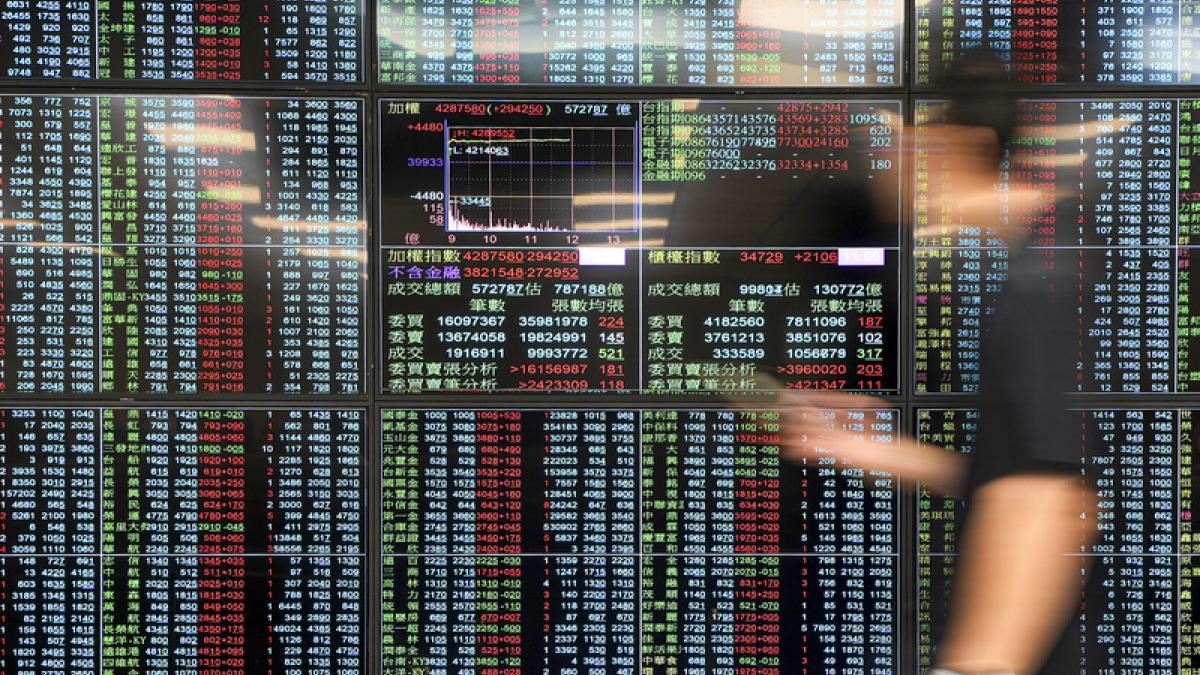
Taiwan's stock market ended July with a surprising note, as the weighted index, after a significant drop in the previous days, staged a revenge rally on Friday (July 31), setting a historic record of nearly 3,200 points. On the same day, DPP legislator Wang Shih-chien posted on Facebook under the title 'A 30-year-old outdated system is becoming a killer of Taiwan's stock market liquidity,' contrasting that 30 years ago, Taiwan's single-day trading volume was only a few hundred billion, while now it often reaches several thousand billion. Managing the market with the past framework is severely out of touch, for which he proposed three claims to the FSC, including the 'circuit breaker mechanism,' to benefit the free market's liquidity.
How volatile was Taiwan's stock market in July? Breaking the 40,000-point mark and setting a rebound record
Taiwan's stock market rode the roller coaster in the first half of this year. However, the volatility intensified in July, and this week was a 'sit and jump' scenario. On July 28, the weighted index plummeted 2,030.19 points, closing at 41,603.36 points, marking the third-largest drop in history. On July 29, it dropped another 1,564.18 points, closing at 40,039.18 points, the seventh-largest drop in history. In just two days, it plummeted nearly 3,600 points. On July 30, although it surged over 1,000 points intraday, it eventually closed down 105 points at 39,933.30 points, breaking the 40,000-point mark. On July 31, it staged a revenge attack, with the weighted index opening high and blue-chip stocks igniting across the board.
Is Taiwan's stock market disposal mechanism already outdated? Trading volume has reached the scale of several thousand billion
On July 31, the weighted index closed up 3,186.45 points, an 8.03% increase, closing at 42,895.52 points, with a turnover of approximately NT$957.7 billion. This week, investors experienced a roller coaster ride of surges and drops, and a battle to defend the 40,000-point mark. Regarding this, Wang Shih-chien revealed that many citizens reflected that the stock market crash was already painful, but the most terrifying thing was that once the stock was 'disposed of,' it could not be sold at all. He contrasted that the current single-day trading volume of Taiwan's stock market is at the level of several thousand billion, and the market scale has already changed significantly from the past, but it is still being regulated with a 30-year-old framework, which is a serious disconnect.
Can Taiwan's stock market align with the 'circuit breaker mechanism'? Is the disposal indicator already rigid?
Wang Shih-chien stated that he would propose three specific reform suggestions to the FSC and continue to supervise the competent authority to propose a clear reform timetable to quickly restore trading freedom and liquidity to the free market. The three suggestions are as follows:
Comprehensive review of the disposal mechanism: It is necessary to discuss relaxing the split restrictions during upswings and downswings and returning the right to self-stop losses to investors.
Study the alignment with international 'circuit breaker mechanism': If the market needs cooling, it should refer to mature international markets and adopt a circuit breaker mechanism that temporarily stops trading for a few minutes and then resumes matching, rather than arbitrarily closing for more than ten days, which affects free market trading.
Disposal indicators should have a flexible mechanism: Regulation should not only look at the nominal data of the rise and fall, but should also consider the company's market value and fundamentals to avoid good-quality enterprises being innocently affected.
In the article, Wang Shih-chien pointed out international benchmarks, stating that mature capital markets such as the United States, Japan, and South Korea do not implement long-term disposal systems. The current international mainstream cooling mechanism mostly adopts a short-term 'circuit breaker mechanism' during the trading day. Taiwan, however, implements split trading for as long as several dozen days. Such forced intervention in market trading freedom has become a rigid mechanism that cuts off market liquidity and exacerbates investor damage. He warned that the outdated system not only harms ordinary investors but also market-capitalization companies worth hundreds of billions with good fundamentals, which may be 'locked up,' seriously affecting the company's normal capital increase and business planning.
More Wind Media Exclusive Insights:
• Taiwan's stock market surged nearly 3,000 points. Can 0050 be bought at 100? Xie Jinhe analyzes the panic drop: The rebound is led by 'them' • Can 0050 be bought at 97? The largest split in history is confirmed. Rumors say next month '1 becomes X' - Yuan Da Investment Trust gives the answer • Should TSMC be bought back at 2,350? Xie Jinhe reveals 'the top 6 bottom-fishing moments in history': This opportunity has come again • Can Taiwan's memory still get on board? Xie Jinhe lists 7 'heartbreaking moments' with the worst drop of over 50%: 300,000 accounts are cut off
FACT BOX
- Source: PR Times
- Category: 政策