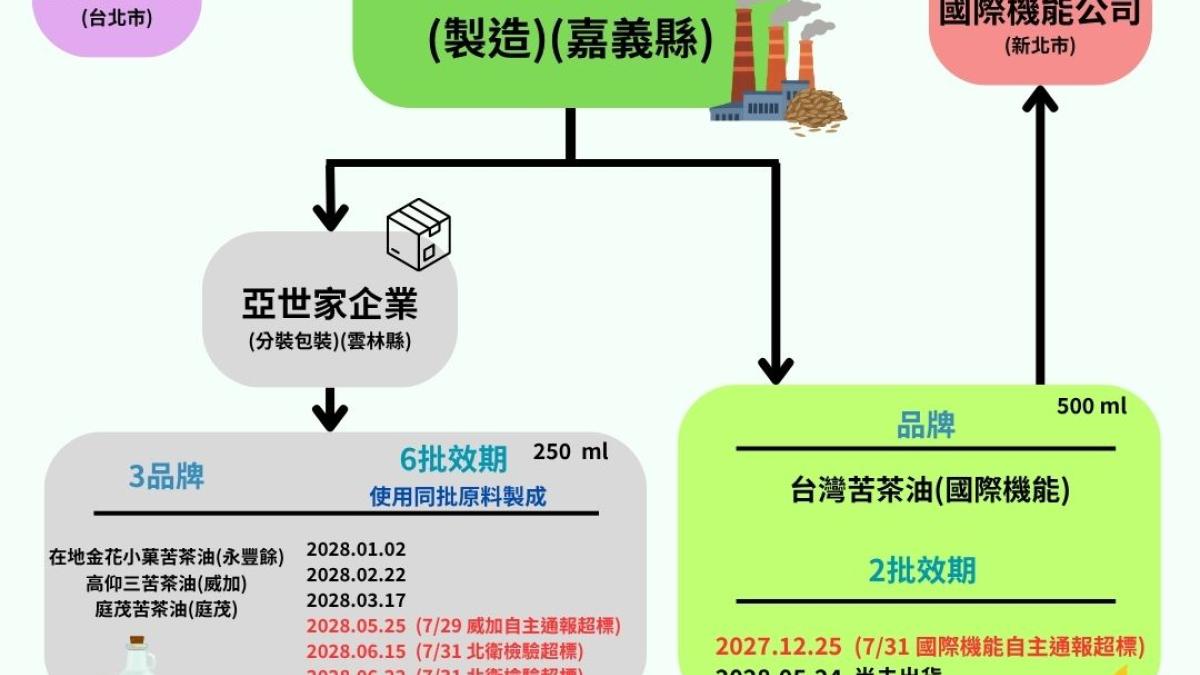
The Food and Drug Administration (FDA) announced today (1st) that the benzopyrene contamination incident involving camellia oil has expanded significantly. Initially triggered by a report from YFY Biotech regarding its commissioned product 'Local Golden Flower Small Fruit Camellia Oil' manufactured by Yuan-Chun Oil Factory in Chiayi County, which tested positive for 2.9 ppb of benzopyrene, further investigation revealed widespread impact.
It was discovered that Yuan-Chun Oil Factory used the same batch of camellia seeds to produce three products: 'Local Golden Flower Small Fruit Camellia Oil,' 'Gao Yang San Camellia Oil,' and 'Ting Mao Camellia Oil,' totaling six batches with expiration dates ranging from January 2, 2028, to June 22, 2028.
Additionally, yesterday, International Function Company reported that its commissioned product 'Taiwan Camellia Oil 500ml (expiration date: 2027/12/25)' also tested positive for benzopyrene at 2.6 μg/kg. A total of 780 bottles were produced; one was used for internal testing, 773 were sold to consumers through retail stores and the official website, and an additional unshipped batch of 599 bottles (expiration date: 2028/5/24) has been ordered off shelves and recalled by New Taipei City Health Bureau.
According to Liu Fang-Ming, Director of the FDA’s Northern Regional Management Center, the agency received notification on July 29 from YFY Biotech about excessive benzopyrene levels (2.9 ppb) in its 'Local Golden Flower Small Fruit Camellia Oil'—exceeding the regulatory limit of 2 ppb. The supply chain was traced: YFY Biotech placed an order with Wei-Jia Company, which commissioned Yuan-Chun Oil Factory to produce bulk camellia oil, later bottled and labeled by Asia World Company.
Taipei City Health Bureau has mandated preventive recalls of all related products using the same raw material batch from both YFY Biotech and Wei-Jia Company. Testing of Wei-Jia’s inventory samples—'Gao Yang San Camellia Oil' (exp. 2028/6/22 and 2028/6/15)—revealed benzopyrene levels of 2.4 μg/kg and 2.6 μg/kg respectively, prompting immediate removal from sale.
Further inspections by the FDA and Chiayi County Health Bureau found that Yuan-Chun Oil Factory not only engaged in contract manufacturing but also produced its own branded camellia oil. Approximately 150 kg of self-manufactured oil was seized and placed under on-site quarantine with sales suspended. The factory has been ordered to halt operations until the source of benzopyrene contamination is identified and production processes are improved.
Notably, there is currently no verifiable documentation tracing the origin of the raw camellia seeds. To resolve this, the FDA has formally referred the case to prosecutorial authorities for joint investigation.
In response to this escalating crisis, the FDA confirmed it will continue its annual edible oil inspection project in 2026 and, due to the severity of this incident, will initiate a special domestic edible oil manufacturer guidance program in the second half of the year. This initiative will involve commissioning professional domestic institutions or organizations to conduct on-site factory consultations, alongside planning the 2025 fiscal year edible oil manufacturing industry inspection project.
FACT BOX
- Source: PR Times
- Category: News
- Dates in source: 2028/1/2 / 2028/2/22