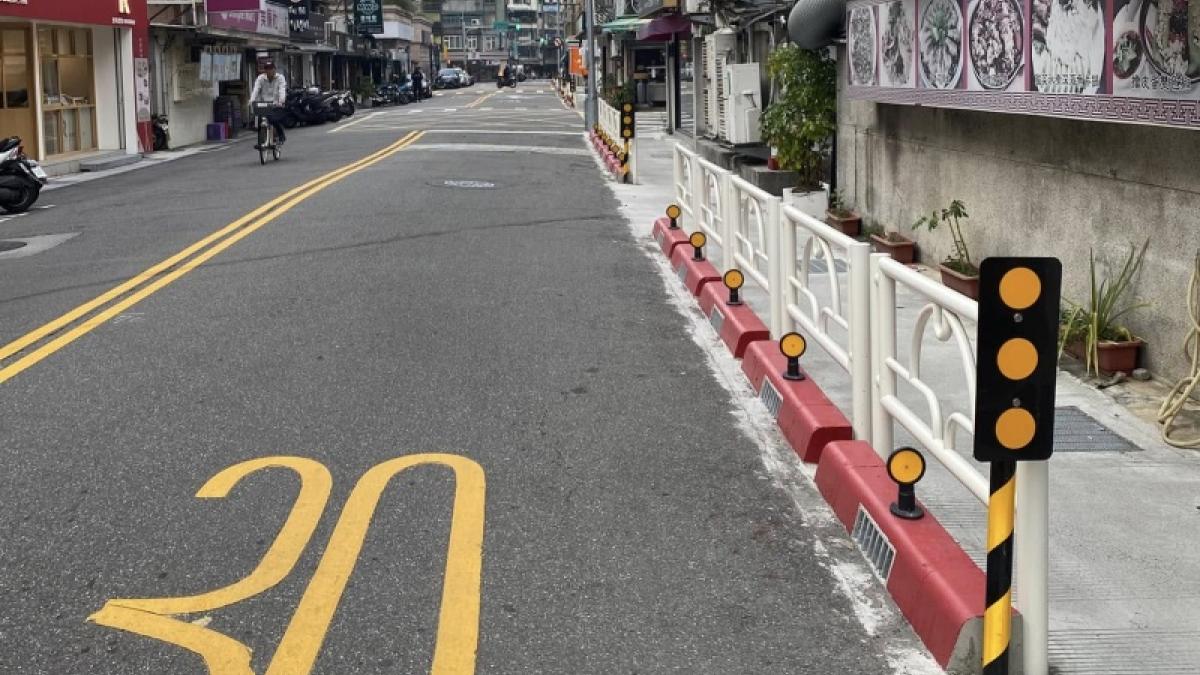
Wang Wan-yu, chair of the New Power Party, cited government open data indicating that only 21.1% of roads across Taiwan have sidewalks. Even when limited to urban roads, the coverage rate stands at just 39.29%. Based on recent average annual construction progress, it would take approximately 127 years to complete sidewalks on all urban roads, and over 300 years if all roads are included. Wang stated that the 'Taiwan Forward' team recently released a 'nationwide sidewalk audit,' compiling data from central and local governments, revealing that Taiwan's total road length exceeds 40,000 kilometers, with urban roads totaling about 22,000 kilometers—yet most roads still lack physical sidewalks. She bluntly stated, 'Even if we keep building for another 100 years, Taiwan’s sidewalks still won’t be complete.'
How many kilometers of sidewalks are added each year in Taiwan? According to the audit data, from 2022 to 2024, Taiwan added an average of about 103 kilometers of sidewalks annually. At this pace, completing sidewalks on urban roads would take approximately 127 years; including all roads, the timeline exceeds 300 years. Wang lamented, 'Not even my grandchildren will live to see the day when sidewalks are fully completed.' She compared Taiwan to Japan, noting that over 80% of Japan’s urban roads have sidewalks, highlighting a significant gap. In terms of municipal performance, only Taipei City exceeds a 50% sidewalk coverage rate, while 16 counties and cities fall below 30%, and seven have rates under 10%.
Wang also questioned the inconsistent methods used by counties and cities to calculate sidewalk coverage, leading to distorted data. Using Taoyuan City as an example, the official coverage rate is reported at 54.6%, but this only includes roads the city government deems 'suitable for sidewalk construction.' If all roads in Taoyuan are included, the actual coverage drops to about 29%. The 'Taiwan Forward' survey also found that some municipalities calculate sidewalk length without deducting duplicated measurements from both sides of the road, while others only include specific corridors or arterial roads. Wang emphasized that the central government should standardize calculation formulas and data criteria; otherwise, municipal data cannot be compared, and actual improvement outcomes cannot be properly evaluated.
Beyond low coverage, the survey also revealed that the government currently lacks comprehensive statistics on sidewalk obstructions by motorcycles or clutter, and does not track the total length of painted-line sidewalks. Although the Executive Yuan has allocated NT$40 billion to improve pedestrian safety, only 12 counties and cities have reported sidewalk coverage rates around schools, while data from the rest remain incomplete. Wang criticized that sidewalk obstructions, painted-line sidewalks, and improvements to school commuting environments are all critical indicators for assessing pedestrian safety, yet the government lacks unified and complete statistics. She urged the central government to set long-term national sidewalk goals and require local governments to publicly disclose specific improvement sections and timelines. 'Without this,' she said, 'how could sidewalks ever improve?'
FACT BOX
- Source: PR Times
- Category: Survey