Recently, Moonshot's newly launched Kimi K3 has once again raised the hopes of many 'long-suffering under American dominance' pro-China netizens. However, among the arguments praising Kimi K3, the most baffling claim is that 'the U.S. cutting off high-end AI chip supplies to China has forced Chinese engineers to find ways to make AI models smarter despite lacking advanced chips.'
Well, at least this statement implicitly admits that China's hardware computing infrastructure lags behind others, and that past claims of 'hand-polishing chips' or surpassing the U.S. and Taiwan in semiconductor technology were all nonsense (ah, I might have said too much—I just saw another absurd article claiming 'China's lithography machines have succeeded, ASML from the Netherlands is doomed.' Since some people can't survive without such 'emotional value,' perhaps we shouldn't keep disturbing them).
Can clever teaching turn an intellectually disabled child into a genius surpassing Einstein?
In fact, the claim that 'the U.S. cutting off high-end AI chip supplies to China has forced Chinese engineers to find ways to make AI models smarter despite lacking advanced chips' can be understood like this: a couple不幸ly gives birth to a child with intellectual disabilities, and someone suddenly claims that with smarter parenting, this child will surely surpass Einstein in achievement.
Just as brainpower represents human intelligence, hardware computing power determines the functional limits of AI models—this is a physical law. If the argument 'our AI design is smarter, so we don’t need as much electronic computing power' were valid, then why are countless companies scrambling to build data centers, and governments desperately seeking power sources to run them? Are all these people fools, except the Chinese?
In the AI era, building AI computing server centers has become an urgent goal for major tech companies. (Photo credit: Liu Weihong)
But seriously, if you've lived long enough, you know that Chinese exaggeration isn't new. The recent shocking incident in the military tech world—the 'disappearance of the father of the J-20'—is clearly cut from the same cloth.
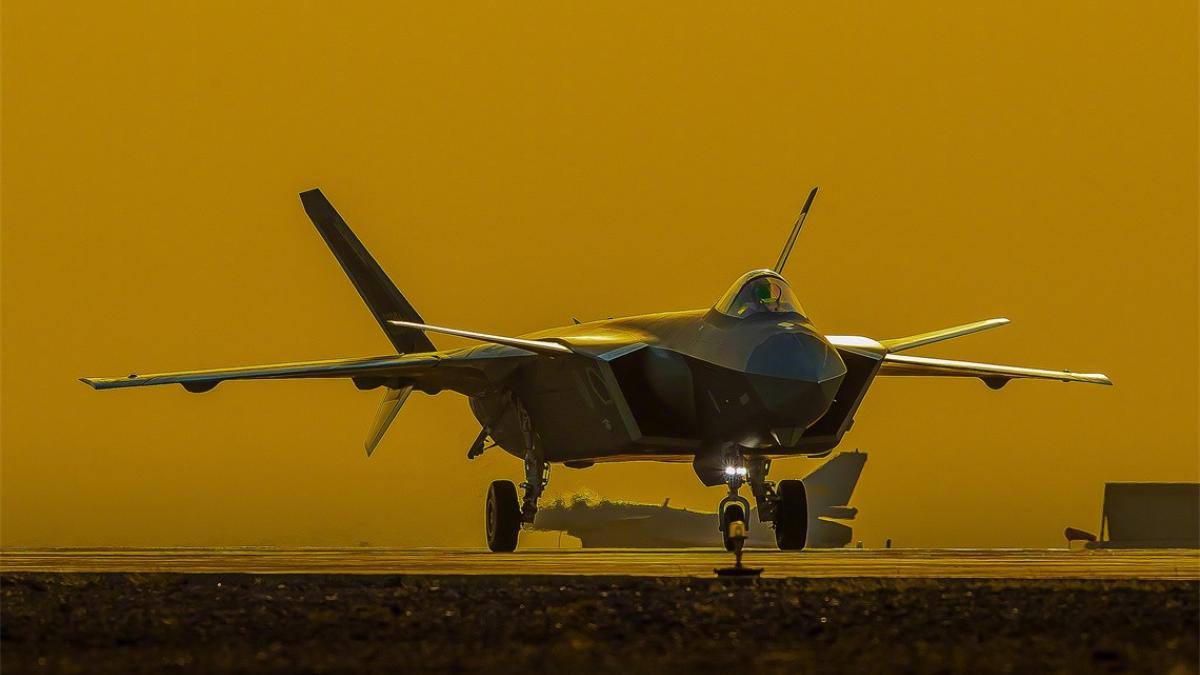
Just as today’s pro-China netizens boast 'our AI models are so advanced they don’t need massive computing power,' years ago another group of netizens firmly believed that the J-20, with its canards, was a stealth fighter superior in performance to the F-22 (seriously, how can a plane with canards be 'stealthy'? Why do so many self-proclaimed military experts not know this basic fact?).
The reason these two cases are comparable is that the J-20 'had to' adopt canards because China couldn’t build engines with sufficient thrust—yes, even with Russian engine designs to copy, they still couldn’t produce them.
Without powerful engines, stealth airframes can't even take off
Stealth fighters are designed to minimize radar reflection, often sacrificing aerodynamic efficiency. Thus, they naturally generate less lift than non-stealth fighters like the F-15 or F-16. The U.S. solved this problem bluntly—by increasing engine thrust. The F-22’s Pratt & Whitney F119-PW-100 engine produces nearly twice the thrust of the F-15’s F100-PW-100 without afterburner (F119: ~116 kN, F100: ~65 kN), giving the F-22 unprecedented supercruise capability—supersonic flight without afterburner.
The problem is, China can’t build monsters like the F119-PW-100, nor even engines at the level of the 1970s-era F100-PW-100. But the leadership had already declared the new Chinese fighter a 'F-22 killer.' The 'killer' can’t even fly! So the J-20 had to add two canards to increase lift.
The F-22’s Pratt & Whitney F119-PW-100 engine delivers astonishing thrust. (Photo credit: U.S. Air Force)
Interestingly, military discussion forums were gripped by a strange atmosphere for years—everyone pretended not to see the J-20’s large canards, continuing to claim that China’s self-made stealth fighter now posed a significant threat to the U.S. military. It wasn’t that everyone was blindly flattering China (though such people certainly exist), but rather that the narrative of 'China has made its own stealth fighter' benefited everyone: the Chinese military and R&D institutes could report progress to leadership, while the U.S. and anti-China nations could justify requesting more funds from Congress to develop next-gen fighters (more spending means more profits for someone).
In reality, as of 2026, there are only two true stealth fighters in human skies: the U.S. F-22 and F-35 (and perhaps the B-2 bomber). But if you browse military forums from over a decade ago, you’d see a bizarre scene of stealth fighters 'flying everywhere'—countries were either investing heavily or pretending to develop stealth tech, flooding the internet with speculative concept images.
If the fighter can't disappear, make the father disappear
Even more absurdly, in the peak era of leftist rhetoric, anyone who pointed out, based on science, national technological development, and fiscal reality, that these 'stealth fighters' were impossible, was immediately labeled 'racist,' accused of thinking like 'Nazis or fascists' for daring to say 'impossible.'
But no amount of bluffing becomes reality. China’s 'J-20 bluff mode' didn’t 'fake it till you make it.' In early 2026, during two U.S. military operations in Venezuela and Iran, Chinese-made 'F-22 killers'—the air defense networks used by China’s allied regimes—failed to stop even non-stealth fighters like the F/A-18 and F-15E, let alone real stealth fighters like the F-35. U.S. aircraft operated with impunity, striking wherever they pleased.
During U.S. operations in Venezuela and Iran, 'pre-stealth era' fighters like the F/A-18E operated with impunity. (Photo credit: U.S. Southern Command)
Naturally, Zhongnanhai panicked. Air defense systems that couldn’t stop U.S. fighters in Venezuela and Iran won’t suddenly become 'effective' in Shanghai or Beijing. Judging from the 'disappearance' of the 'father of the J-20,' it’s likely these Chinese-made 'stealth fighter killers' were designed based on the J-20 (since China has never captured an F-22 or F-35 to use as a target). The most likely reason they can’t stop the F-35 is that the J-20 itself lacks stealth capability—the 'stealth killer' can detect a fake like the J-20 but is helpless against a real stealth fighter like the F-35.
If the fighter can’t disappear, disappearing its father makes perfect sense.
Don’t think I’m citing highly specialized military knowledge—these are basic 'common sense' concepts, understandable with high school physics and chemistry. So the real question is: why didn’t the high-ranking officials and generals in Zhongnanhai know their engines lacked the thrust to fly aerodynamically inefficient stealth airframes? Why did they still believe the J-20 had stealth capability when they saw those canards?
China remains a 'Zhi Ba' nation—incapable of seriousness
China’s approach to lithography machines, wafer fabs, and now AI follows the same pattern: 'with enough will, airplanes can dive and submarines can fly'—in other words, any miracle defying physics can be 'achieved' (using Chinese terminology here adds authenticity). Hence, we get 'hand-polished nanotechnology' and AI models that 'surpass America without building computing centers.' The key is these absurd claims serve political purposes (likely as smoke screens to unsettle opponents before real confrontation). In other words, China isn’t devoid of rational people who know these are lies, but those who question them and shout 'the emperor has no clothes' are likely to be 'arrested en masse.'
Legend has it Confucius once misread 'true' as 'Zhi Ba' and taught his disciples that in chaotic times, pursuing truth makes survival difficult. Thousands of years later, the Chinese still cannot afford to be 'serious'—truly lamentable.
More exclusive Wind Media news: · 'China’s bluff' against America—fearing the final desperate kick · How China’s 'semiconductor great leap forward' created the Wuhan Hongxin scam · Will U.S. tech blockade make China stronger? Then you should abandon your child on the street and starve them
FACT BOX
- Source: PR Times
- Category: News
- Organizations: Moonshot / ASML
- Products / services: Kimi K3