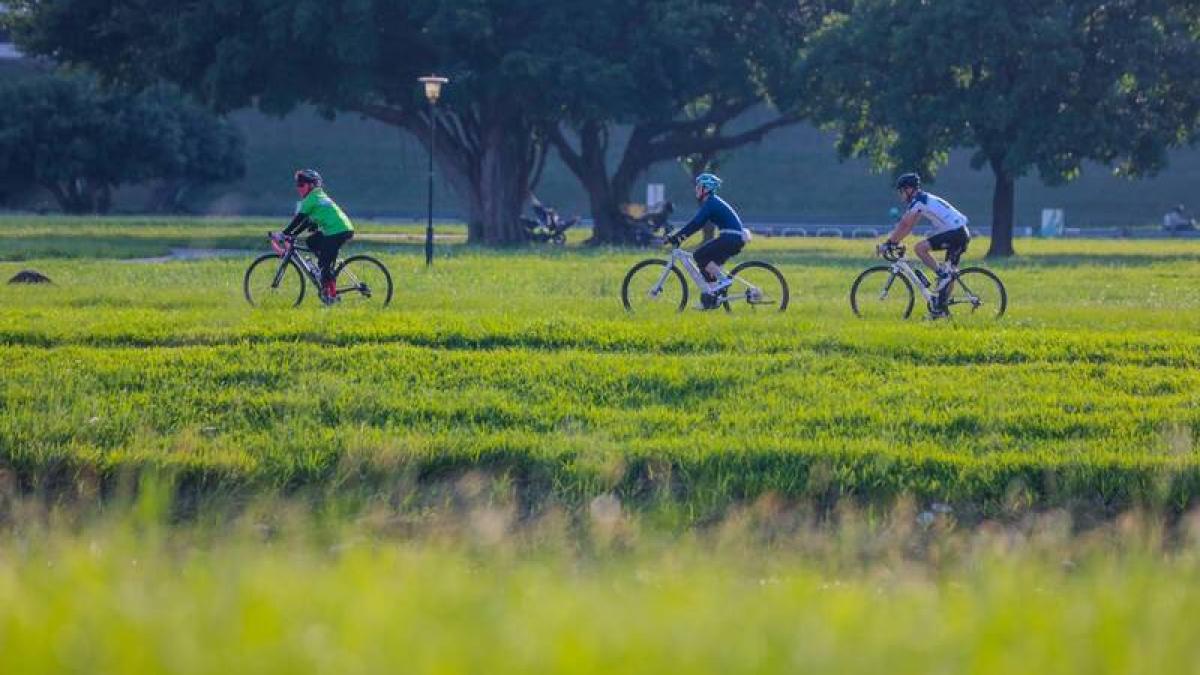
Every year, tens of thousands of Taiwanese ride bicycles around the island, treating it as a rite of passage. Today, more and more travelers are also cycling around Taiwan, experiencing a side of the island rarely seen by outsiders. Recently, Ethan, a cyclist living in Taipei, rode along a solitary coastal road hugging the cliffs of Taiwan’s remote east coast. After passing through a dense forest, he finally reached the top of the Coastal Mountain Range, where before him stretched a vast ocean, calm as glass, extending to the horizon. "Some say if you haven’t completed at least one full loop around the island in your lifetime, you’re not a true Taiwanese," the rider joked. "Huan Dao," literally meaning "to circle the island," is a beloved journey for many residents. Every year, tens of thousands set off from Taipei, cycling clockwise along a route of approximately 1,000 kilometers (621 miles). Along the way, they pass the dramatic rock formations and humble fishing villages of the North Coast, venture into the sparsely populated east coast, ride past the white sandy beaches at the southern tip of the island, and race toward the highly urbanized west coast. While the loop can also be completed by car or motorcycle, many Taiwanese choose to cycle the journey during their school years or before entering university, treating it as a "coming-of-age ritual." Ethan told reporters he has already completed four or five cycling loops around the island. "Each time I take a different route—big loops or small ones," he explained. "Taiwan is just too beautiful; there’s always new scenery to see." The Birth of a "National" Cycling Route Long-distance cycling has been popular in Taiwan for over 50 years, and the island is hailed as one of the world’s best cycling destinations. However, the concept of "cycling around Taiwan" truly entered the public imagination after the 2006 release of the film "Island Etude." The movie tells the story of a university student who spends seven days cycling around the island. In the film, the student visits historical sites related to Taiwan’s Japanese colonial past, listens to ancient indigenous folk songs, and meets strangers in rural areas who kindly offer him a place to sleep or a meal. Since then, real-life students have followed in his footsteps, hoping to discover another side of their island home. As more and more Taiwanese took up cycling around the island, the government officially named the circular route "Taiwan Cycle Route No. 1" in 2015, establishing a kind of "national" cycling and road network. Circling Taiwan on Two Wheels While most cyclists start and finish in Taipei, the beauty of cycling around Taiwan lies in the freedom to begin anywhere—or, like me, to ride only a portion of it. On my previous two visits to Taiwan, I mostly stayed in the densely populated north and west. This time, I decided to cycle 500 kilometers from Taipei to Taitung along the island’s remote east coast, to see another side of Taiwan that most travelers rarely experience. After leaving the capital, Taipei, I followed a dedicated bike path under an elevated highway to the port city of Keelung, stopping at the famous night market to eat soup dumplings and braised eel. But the real cycling joy began about 30 kilometers east in the seaside town of Fulong, where a historic 2.1-kilometer Old Caoling Tunnel has been converted into a bike path. I cycled through the stone passage under flickering lights and emerged at the northern tip of Taiwan’s east coast—feeling as if I had entered another world. While Taiwan’s north and west are dominated by modern, outward-expanding cities, the east is rooted in the island’s indigenous cultures. Because of the difficult-to-cross mountain ranges in central Taiwan and the scarcity of flat land in the east, most Han Chinese immigrants and settlers in the 20th century remained in the western plains, helping preserve indigenous cultures in the remote eastern regions. This cultural and geographical divide remains clearly visible today. Taiwan’s high-speed rail cannot cross the Central Mountain Range, so it only connects western cities. In the east, you feel open space. The mountains are more majestic, the palm trees taller. It faces the vast Pacific Ocean, not the narrow Taiwan Strait. The waters in the east are deeper, the color a richer blue. Carved wooden totem poles, geometric mosaic patterns, and indigenous culinary traditions are evidence that before the arrival of Han Chinese and Japanese, Taiwan was already home to indigenous groups like the Amis, Taroko, and Puyuma. The Warmth of Rural Life During this 11-day journey, I mostly stayed in family-run guesthouses: treehouses on mountaintops, cabins at the mouth of marble canyons, and guesthouses along empty coastlines. Siloko Akila, an Amis resident managing the "Wagalicong" (a Hokkien transliteration of "I’m telling you") guesthouse in Dulan, told me that while cycling around the island has become popular in recent years, few travelers truly take the time to deeply experience the indigenous cultures of the east. "We still need to attract more people," she added. But when I asked her what Dulan’s greatest appeal was, she said, "The people here are friendly, warm, and helpful. There’s real human warmth here." Inside the guesthouse, a documentary was playing behind the counter, showing the Amis people’s close relationship with nature. Over 95% of Taiwanese have Han Chinese ancestry, but more and more people are now interested in learning about the island’s indigenous peoples. A young Taiwanese guest told me he chose to study an indigenous language in high school. In the evening, Akila and her friends began playing guitar and singing moving Amis folk songs. This family-like hospitality extends across the island. For example, when I had a flat tire on the North Coast, a Taiwanese cyclist stopped to help me fix it. When I arrived at Ruisui Village in Hualien at dusk, the owner of a fully booked guesthouse called every other inn until he found me a place to stay. Upon arrival, the family insisted on treating me to fried noodles and pork soup. A "Coming-of-Age" Ritual Although I only cycled to Taitung, completing half the loop, many continue on the return journey to Taipei, first passing through Kenting—the island’s oldest national park. There, once-endangered wild sika deer roam freely in evergreen forests, and white sandy beaches surround the island’s only tropical national park. Yafan Chang, 30, completed her first loop in 2012 at age 16, as part of a school trip. Like many riders I met, she told me her favorite part of the route was a mountain road north of Kenting National Park. "There’s about a 12-kilometer uphill climb, and then you can coast all the way down," she recalled. "You’re on a grassland, yet you can see the sea sparkling at sunset." After 12 days of riding, with less than 100 kilometers to go, Chang encountered a typhoon on the outskirts of Taipei and couldn’t complete the full loop. A few years later, she set out again with her younger brother and uncle, because they felt they had to see the entire island. "It felt incredibly rewarding," she said. Moreover, whenever she felt tired, people across the island encouraged her to keep going. I experienced this feeling myself—passersby often leaned out of car windows to give a thumbs-up or shout "Jiayou!" ("Go! Go!"). Aside from not completing the full loop, my only regret was not scheduling more rest days to more deeply explore Taiwan’s lesser-known villages. One day, while cycling along the east coast, I met two friends from Taiwan, Doris Kwok and Jessie Chan. They told me they had actually completed the entire loop on foot. When I asked why they chose walking instead of cycling or driving, Doris said something that still resonates with me: "Taiwan is just too beautiful—you have to walk it slowly to truly appreciate it." Planning Your Trip The "Huan Dao" website offers practical advice for those planning to cycle or drive the route. The best seasons for cycling are March to April or October to November, avoiding extreme temperatures and summer monsoons. Giant, one of the world’s largest bicycle brands, is headquartered in Taiwan; travelers can rent bikes at Giant stores across the island and return them at other locations. 7-Eleven and FamilyMart convenience stores are everywhere, providing essential hydration, snacks, restrooms, and Wi-Fi. As you ride south, layers of history and identity gradually unfold. Today, most Taiwanese practice Buddhism, Taoism, or folk religions. However, Christianity, introduced by European missionaries in the 17th century and now followed by only about 5% of Taiwanese, still persists in these remote villages. About 100 kilometers south of the Old Caoling Tunnel, in Heping Village, I saw my first church. A white cross stood against towering mountains, serving mainly the local Taroko people. Nearby, I also saw crosses standing on traditional horseshoe-shaped Han Chinese tombstones.
FACT BOX
- Source: PR Times
- Category: News