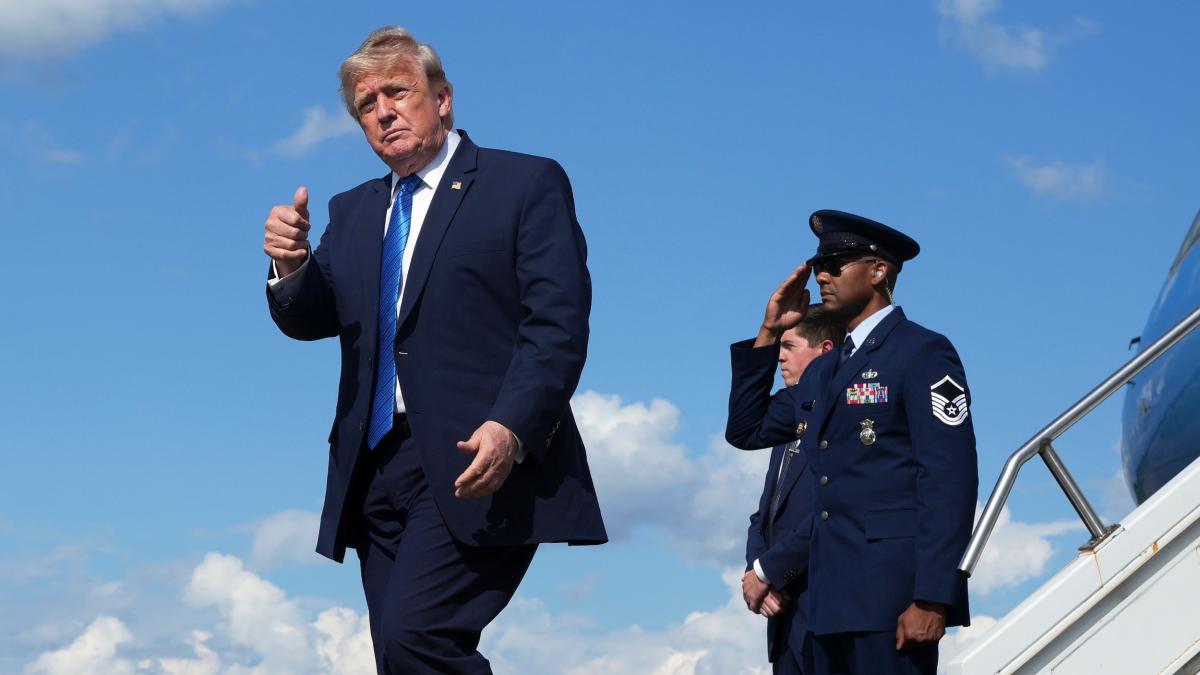
U.S. President Donald Trump announced late on the evening of the 1st via a social media post that a 'framework agreement' to end the war has been reached at the request of Iran and Middle Eastern allies. Trump stated that he has also agreed to order the U.S. military to pause new large-scale airstrikes on Iran, provided that both sides can quickly sign a final agreement. However, the Associated Press (AP) and Reuters noted that Tehran did not immediately respond after Trump's post, and the Israeli government has not issued any official statement.
Trump claimed the agreement would 'fully reopen the Strait of Hormuz.' In his post on Truth Social, Trump said the emerging agreement includes 'the immediate, complete, and total reopening of the Strait of Hormuz, and the end of Iran's nuclear threat.' Trump wrote: 'Based on this request, for the future well-being of the world, and for the survival of a successful and prosperous Iran, I have agreed to cancel the attack operations, provided we can quickly reach an agreement.' Trump also claimed that Israel has agreed to join the U.S. in working toward finalizing this ceasefire agreement.
Just the day before, Trump had told the media at the presidential retreat Camp David that he was preparing to deliver a 'heavy blow' to Iran. Within hours, his stance took a sharp U-turn. The U.S. and Israel launched a large-scale airstrike against Iran on February 28 this year, plunging the Middle East back into conflict. The Strait of Hormuz was subsequently blocked by Iran's Revolutionary Guard. Although a temporary ceasefire was reached in mid-June, disputes over navigation rights in the Strait led both sides back into missile exchanges.
Saudi Crown Prince Urgently Calls Trump Over Oil Field Concerns
Reuters noted that Trump's sudden policy shift highlights the high anxiety among Middle Eastern allies over escalating conflict. News site Axios first reported that Saudi Arabia's de facto leader, Crown Prince Mohammed bin Salman, urgently called Trump on the 1st to express serious concerns about the U.S. potentially significantly escalating military action against Iran.
Insiders revealed that Saudi Arabia fears that if the U.S. launches large-scale attacks on Iran's energy infrastructure, power plants, or bridges, Tehran will retaliate massively by targeting oil and energy facilities in Saudi Arabia and other Gulf states. During the call, Crown Prince Mohammed asked Trump to clarify what specific actions the U.S. is considering.
Reuters reported that Iran's state media outlet Nournews issued a warning on the 1st, emphasizing that if U.S. forces attack Iran's energy facilities, Iran will launch devastating strikes on oil fields in Saudi Arabia and the UAE, and natural gas fields in Qatar and Israel, 'turning everything to ashes.'
Saudi Arabia had previously cooperated with U.S. strikes on Iran-backed Iraqi militia bases but has since strongly urged the U.S. and Iran to return to negotiations. This week, the Crown Prince dispatched his brother, Saudi Defense Minister Prince Khalid bin Salman, to Washington to meet separately with Trump and Vice President JD Vance. While Middle Eastern nations hope to de-escalate, Israeli Prime Minister Benjamin Netanyahu has strongly urged Trump to continue applying military pressure on Iran.
U.S. Issues Security Alert to 10 Middle Eastern Countries
Reuters reported that Iran's Foreign Minister Abbas Araqchi held phone calls on the 1st with Pakistan's Army Chief of Staff Asim Munir, Turkey's Foreign Minister Hakan Fidan, and Saudi Foreign Minister Prince Faisal bin Farhan. Araqchi emphasized to Prince Faisal that Iran will deliver 'proportional retaliation' against any attacks from the U.S. or Israel, or against regional countries participating in such military actions.
White House spokesperson Karoline Leavitt expressed U.S. dissatisfaction, emphasizing that Tehran 'signed a ceasefire memorandum with the U.S. last month, but then quickly violated it by firing on commercial ships and killing American soldiers.' Meanwhile, Trump has dispatched a negotiation team consisting of his son-in-law Jared Kushner, envoy Steve Witkoff, and Secretary of State Marco Rubio to shuttle across the Middle East and swiftly finalize the agreement.
Given the heightened regional tensions, the U.S. State Department issued its highest-level security alert on the 1st to 10 Middle Eastern countries: Bahrain, Israel, Iraq, Jordan, Kuwait, Lebanon, Oman, Qatar, Saudi Arabia, and the UAE. The alert urges U.S. citizens to prepare for sudden disruptions such as flight cancellations and airspace closures. Trump also claimed in his post that U.S. forces are 'fully ready' to demonstrate 'military might not seen since World War II' at any moment.
Combat Continues: Kuwaiti Facilities Attacked, Tanker Hit in Strait of Hormuz
Despite ongoing diplomatic efforts, military clashes on the battlefield have not truly ceased. Kuwaiti Defense Ministry spokesperson Brigadier General Saud Abdulaziz Al-Otaibi confirmed that Kuwaiti forces were fully engaged on the 1st in responding to drone attacks from Iran. The military intercepted and shot down some drones, but falling debris and attacks damaged several key facilities in the north, including a government building, and private facilities on Bubiyan Island, causing property damage. Fortunately, there were no casualties.
Attacks continue in the Strait of Hormuz: The UK Maritime Trade Operations (UKMTO) reported that an oil tanker was struck in its engine room by an unknown projectile 11 nautical miles northeast of Lima, Oman, sustaining damage. Another oil tanker reported loud explosions 21 nautical miles northwest of Khasab. Satellite imagery also shows an oil leak from a sanctioned tanker that recently ran aground off the Omani coast.
In the Red Sea, Yemeni rebel group 'Houthis' military spokesperson Brigadier General Yahya Saree announced continued maritime blockade against Saudi vessels, forcing eight Saudi cargo ships to reroute around Africa's Cape of Good Hope. On Friday, July 31, the Israeli military destroyed tunnels beneath the 12th-century Beaufort Castle, drawing protests from Lebanese President Joseph Aoun, who criticized the move as sending a 'negative signal' ahead of peace talks.
AP and Reuters analyzed that this conflict is deeply unpopular within the U.S., and with the November midterm elections approaching, the White House faces immense political pressure. Since the war began in February, global energy supplies have been severely disrupted. Brent crude futures, the international oil benchmark, surged 24% in July alone. Although Trump argues that preventing Iran from acquiring nuclear weapons justifies short-term high oil prices, economic pain has already turned into strong political backlash.
FACT BOX
- Source: PR Times
- Category: News