Nearly four decades after shutting down all its nuclear reactors, Italy is facing the largest energy policy shift in the European Union. According to the Financial Times and the Associated Press, Prime Minister Giorgia Meloni’s right-wing government is embracing next-generation 'small modular reactors' (SMRs) and pushing legislation to restart nuclear power, driven by soaring electricity prices, energy security crises triggered by the Ukraine-Russia and Middle East conflicts, and public opposition to wind turbines and solar panels altering natural landscapes.
German renewable energy giant RWE is preparing to build seven 200-meter-tall wind turbines in Italy. Monica Tommasi, president of Friends of the Earth Italy, is actively opposing the project. Tommasi’s grandmother lives in Orvieto, a historic city in Umbria near the proposed wind farm site, and she, along with other residents, opposes the turbines. She firmly believes that the solution to Italy’s energy crisis lies in nuclear power.
Tommasi told the Financial Times that she once believed renewable energy could free Italy from its dependence on imported fossil fuels. However, she now realizes that renewable energy goals mean wind turbines and solar panels will blanket the countryside. 'This distorts our landscape and cultural identity,' she emphasized. 'If we need to decarbonize, we must use the best available technologies, and nuclear is one of them. This is no longer the 1970s or 1980s—nuclear technology has evolved.'
On June 18, 2026, at the Latina nuclear power plant, located about 60 kilometers south of Rome. This plant was one of Italy’s earliest commercial reactors, operating from 1963 until it was shut down in 1987 following a public referendum after the Chernobyl disaster. (AP)
The Financial Times notes that decades ago, Rome shut down all its reactors amid strong public opposition. But now, people like Tommasi who want to revive nuclear power are not few. Italy heavily relies on imported natural gas, resulting in electricity prices for businesses and households that are among the highest in Europe. Prime Minister Giorgia Meloni’s right-wing coalition government is now betting heavily on nuclear revival to fundamentally ease energy pressures.
Environmentalists Support Nuclear Power
Francesco Pratesi, president of the Tuscan chapter of the environmental group Italia Nostra, points out that nuclear power occupies minimal land while generating electricity equivalent to hundreds of acres of wind or solar farms, causing far less impact on agriculture and landscapes than renewables. His wife, Alessandra Fenizzi, once voted against nuclear power but now admits, 'We were wrong back then.'
James P. Graham, a British artist living locally, told the Financial Times that Italy’s long-standing practice of importing nuclear power from France while opposing it domestically is 'fundamentally hypocritical.' He believes nuclear power is indeed 'the only stable baseload energy source currently available.'
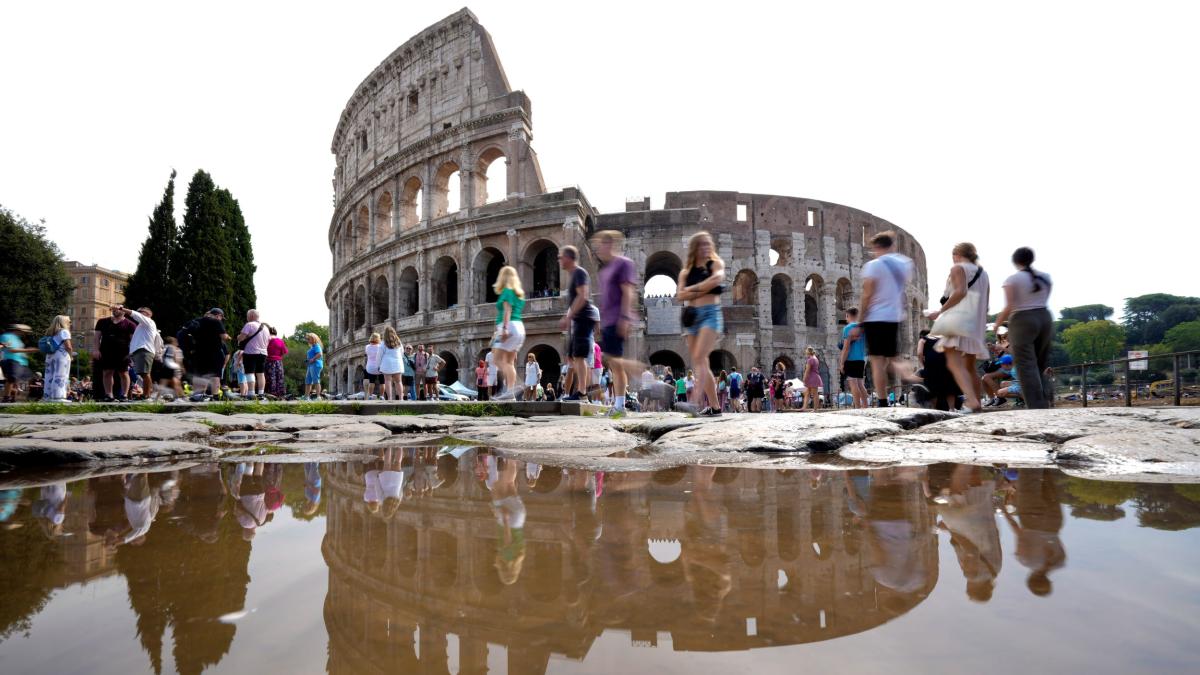
On August 1, 2026, tourists visit the ancient Roman Forum. (AP)
According to the Energy Institute, fossil fuels still account for nearly half of Italy’s total electricity generation, causing electricity bills for businesses and households to be about 30% higher than the European average. Inspired by former U.S. President Donald Trump, Prime Minister Meloni sees Italy’s adoption of SMRs as 'a great prospect, a great vision, and a great dream.'
The Associated Press reports that Italy’s parliament will vote next week on a government-led nuclear framework bill, which is expected to pass smoothly. Once enacted, the Roman authorities will have 12 months to draft subordinate regulations covering reactor licensing, safety standards, site selection, and nuclear waste management.
On July 22, 2026, Environment and Energy Minister Gilberto Pichetto Fratin was interviewed by the Associated Press in Rome. (AP)
Gilberto Pichetto Fratin, Italy’s Minister of Environment and Energy Security, told the Associated Press in an exclusive interview that Italy’s electricity demand is expected to grow by at least 30% within the next decade, a need that renewables alone cannot meet. 'The government’s current responsibility is to create the conditions so that those who decide to build in the future have a legal basis to do so,' he said. He estimates that the first new-generation reactors could begin operations between 2033 and 2035.
Stefano Buono, CEO and physicist at Franco-Italian nuclear startup Newcleo, revealed that many energy-intensive industries, including steel and cement, are already inquiring about power generation details and wish to supply their factories with SMR-generated electricity. Newcleo has raised $780 million (approximately NT$25 billion) and is dedicated to developing lead-cooled small reactors fueled by recycled nuclear waste. Buono stated, 'As soon as regulations are in place, we will immediately submit our nuclear plant application.'
Challenges on the Path to Nuclear Revival
However, the Associated Press also notes that Italy’s path to nuclear revival is not without obstacles. Michele Governatori, senior advisor at climate and energy think tank ECCO, warns that the construction cost of a single 300 MW SMR is estimated at €3–6 billion (approximately NT$100–200 billion), excluding grid and infrastructure costs, and that SMR technology has yet to be proven at commercial scale. 'Currently, nuclear plants under construction in Europe are extremely expensive, and private funding is withdrawing.'
Confindustria, Italy’s most influential business organization, also warns that industries, already burdened by high electricity prices, cannot afford to wait another ten years for nuclear revival and urges the government to immediately approve the expansion of renewables. Currently, 130 GW of solar and wind projects are stuck in the approval pipeline in Italy. Developer RWE, however, clarifies that their Orvieto wind project (42 MW capacity, powering 40,000 households) has achieved a balance between cultural heritage preservation and green energy, and the turbines are not visible from the historic city center.
Nevertheless, Energy Minister Fratin points out that as of early 2026, Italy’s installed solar and wind capacity is only about 60 GW, far behind Germany and Spain. 'Two-thirds of Italy’s land is hilly or mountainous, much of it agricultural and possessing world-class tourism value. We cannot cover the entire country with solar panels and wind turbines.'
Generational Divide After Forty Years
Italy developed civilian nuclear power in the 1960s–1970s but shut down all nuclear plants following a public referendum after the 1987 Chernobyl disaster. After the 2011 Fukushima disaster, former Prime Minister Silvio Berlusconi attempted to restart nuclear power, but 94% of voters rejected it in a referendum.
The Associated Press notes that Italy’s current energy debate reveals a significant generational divide. At the Latina nuclear plant south of Rome, workers still wear protective gear while dismantling the remains of the first-generation plant. Viviana Cruciani, head of state-owned decommissioning company Sogin, observes that those who lived through the Chernobyl era still view nuclear power as a disaster, while younger generations are enthusiastic about it as a tool for decarbonization and technological progress.
Cristian Giannetti, a 20-year-old tourist, told the Associated Press that modern technology and resources have greatly reduced the risk of nuclear accidents. Paola Giovannini Pasti, president of Confagricoltura Donna, the women’s division of Italy’s main agricultural association, also supports restarting nuclear power to resolve the energy crisis.
Although polls by Only Numbers and YouTrend show that about 55% to 57% of Italians support developing next-generation nuclear power, experts warn that support plummets when it comes to specific questions about where to build reactors or nuclear waste disposal sites. Polls show that as many as 60% of Italians oppose having a nuclear reactor in their home province. If left-wing parties and environmental groups launch a new referendum, Meloni’s nuclear revival vision will face a severe political test.
FACT BOX
- Source: PR Times
- Category: News
- Organizations: RWE / Newcleo / Sogin