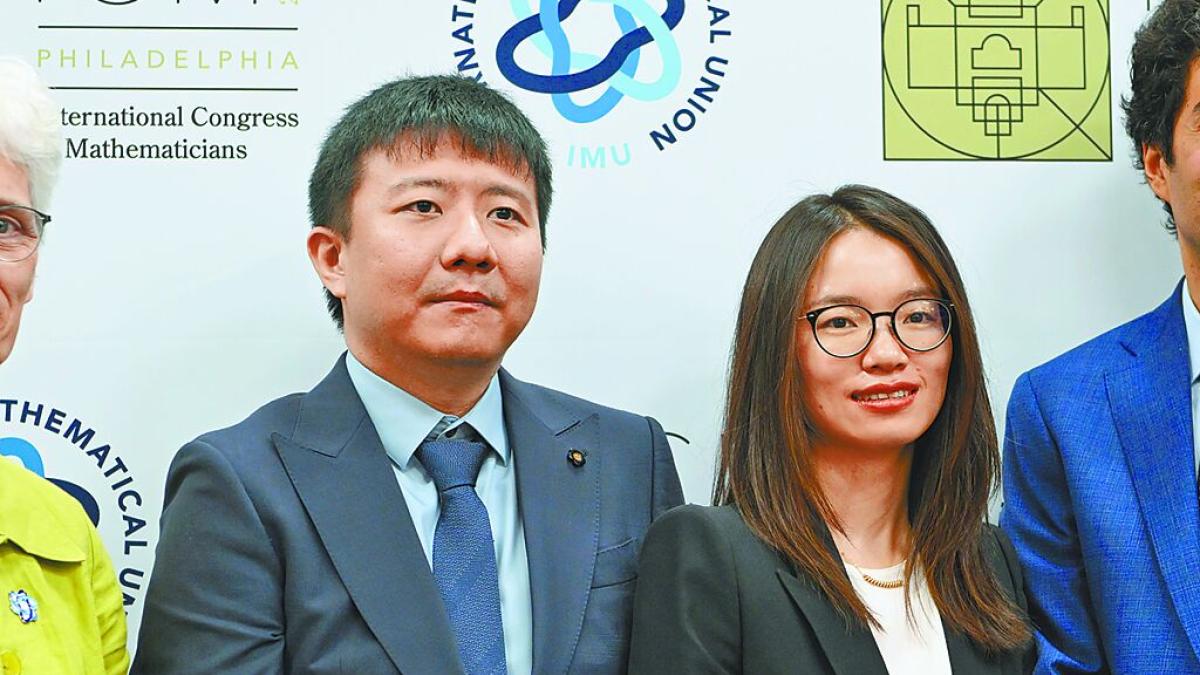
Global technology competition is rapidly entering a new strategic dimension. The focus of competition among nations has shifted beyond large language models, chip manufacturing, and computing power deployment, extending further into foundational science, research organization capabilities, and autonomous knowledge production systems. Recently, Chinese mathematicians Wang Hong and Deng Yu jointly received the Fields Medal, while Tsinghua University in Beijing has recruited Omar M. Yaghi, the anticipated 2025 Nobel Prize in Chemistry laureate, as a full-time professor, and continues to attract top international scientists to engage in interdisciplinary research. These developments profoundly reflect that global tech competition has entered a new phase centered on 'basic research and research organization.'
Tsinghua University's recruitment of Omar M. Yaghi carries significant strategic intent. Upon joining Tsinghua, he will deeply participate in building an AI-driven platform for chemistry and materials research, integrating AI, chemistry, materials science, and major scientific infrastructure into a unified system to construct a new knowledge production ecosystem. Additionally, in recent years, Tsinghua has continuously brought in world-leading scholars in fields such as lasers, ultrafast optics, and quantum technology. The core objective is to leverage world-class scholars to lead emerging disciplines, build major research platforms, and cultivate young talent, thereby forming a sustainable, self-updating research organizational capability.
Globally, the United States is also comprehensively advancing its strategic deployment of AI for Science (AI4S). Google's Isomorphic Labs has extended from AlphaFold to AI-driven drug design, establishing an end-to-end R&D system from protein structure analysis and small molecule design to candidate drug development. FutureHouse is dedicated to developing autonomous scientific agents that assist researchers in automating literature search, knowledge reasoning, hypothesis generation, experiment planning, and workflow integration, enabling AI to genuinely participate in knowledge creation. National laboratories, the Department of Energy (DOE), and the National Science Foundation (NSF) have also heavily invested in AI4S initiatives in recent years, deeply integrating AI into foundational fields such as materials, biomedicine, energy, climate, and high-energy physics, and establishing interdisciplinary platforms and shared infrastructure. AI4S has evolved from a corporate R&D tool into a key component of national research capacity.
Mainland China is equally aggressive in advancing AI4S. Beyond Tsinghua University’s talent strategy, it has been continuously integrating artificial intelligence, mathematics, materials science, quantum technology, and major research platforms, gradually developing an 'Autonomous Scientific Discovery System' (ASDS). From BeiDou satellite navigation and high-speed rail engineering to quantum communication and open-source models like Kimi K3 and intelligent research platforms, it is evident that China's technology policy has expanded from past large-scale engineering projects to systematic construction of knowledge production capabilities.
Although the U.S. and China adopt different institutional models, their technology strategies point in the same direction: deepening foundational science, building AI4S platforms, integrating interdisciplinary talent, enhancing research organizational capabilities, and treating 'autonomous knowledge production capacity' as the core of the next phase of national competitiveness. More importantly, the focus of global technology competition has shifted from mere 'R&D outcomes' to 'R&D capabilities and organizational mechanisms.' Research platforms, talent cultivation, data infrastructure, intelligent agents, and interdisciplinary collaboration are collectively defining a new form of knowledge production system.
This talent and scientific advantage is deeply reflected in the foundational education system. Key figures currently leading the AI revolution—Tang Jie, CEO of Zhipu; Yan Junjie, founder of MiniMax; Liang Wenfeng, founder of DeepSeek; and Yang Zhiyun, founder of Moonshot AI—all built their foundations in undergraduate education in mainland China. The award-winning mathematicians Wang Hong and Deng Yu also completed their undergraduate education on the mainland before shining on the international stage. From industry leaders to top mathematicians, mainland China has established a talent chain that seamlessly connects basic education, advanced research, national platforms, and industrial engineering.
In contrast, Taiwan's current technology policy remains heavily anchored in semiconductor manufacturing, AI application promotion, and industrial subsidies. It still lacks a national-level AI4S strategic framework and has not established interdisciplinary research platforms integrating mathematics, physics, chemistry, biology, materials, engineering, and medicine. Although Academia Sinica, universities, research institutions, and the industry possess excellent research capabilities individually, a comprehensive system for cross-ministerial, cross-institutional, and interdisciplinary research organization has yet to be formed—especially a long-term technology strategy centered on autonomous scientific discovery systems.
The breakthroughs in the Fields Medal, Tsinghua University’s talent hub strategy, and the explosive progress in U.S. AI4S collectively reveal the evolutionary trajectory of the next phase of technological civilization. The ultimate core of national competitiveness has never been about the export value of a single product or chip fabrication processes, but rather whether a nation possesses world-class talent, major scientific discoveries, and sustained knowledge production capacity. Foundational science determines technological depth, research organization determines innovation efficiency, and a complete national innovation system determines the height of technological civilization.
From the Fields Medal to the four leading AI startups, the main axis of global technology competition has shifted from engineering applications back to foundational science, from data-driven approaches to scientific theory and knowledge inference, and from isolated technological breakthroughs to interdisciplinary knowledge integration. In the era of large-scale AGI, competition is not just about model performance or chip capabilities, but a comprehensive contest of foundational mathematics, AI4S, autonomous research systems, and talent cultivation. The talent structure behind the Fields Medal and the four AI startup leaders reflects that foundational science has once again become the core of global technological competition.
Faced with the comprehensive strategies of the U.S. and China in foundational science and AI4S, Taiwan must break free from the limitations of contract manufacturing thinking and rebuild a long-term strategy that emphasizes foundational science and interdisciplinary research platforms to maintain autonomy in future global technology competition.
*The author is a retired professor of science and technology management, industry commentator, and columnist for TAIA.
FACT BOX
- Source: PR Times
- Category: News
- Organizations: Google / Isomorphic Labs / FutureHouse
- Products / services: Kimi K3