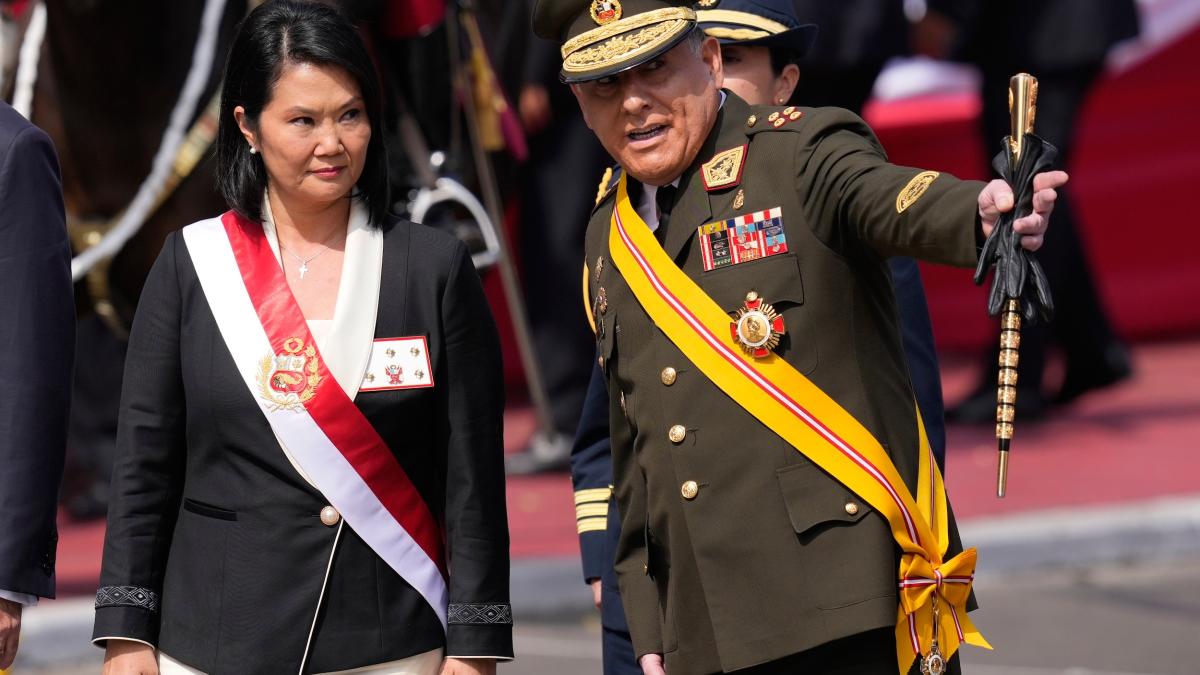
Peru's newly inaugurated President Keiko Fujimori has pledged to strengthen security and promote investment. At the same time, she must position the country within the geopolitical contest between the U.S. and China. Right-wing figure Keiko Fujimori assumed office as Peru's president on July 28, marking the return of 'Fujimorism'—a political movement combining neoliberalism, strong populism, and authoritarian state measures—to executive power after a 25-year gap. The daughter of the late dictator Alberto Fujimori (in office from 1990 to 2000), she takes office amid deep social divisions. Her policy agenda focuses on enhancing public security, promoting economic growth, and improving healthcare and education systems. However, beyond domestic priorities, Peru's strategic importance is increasingly evident as the new government takes power: the country has become a key battleground for influence between the U.S. and China in South America. Facing Major Domestic Challenges Fujimori has stated that domestic security will be her government's top priority. Her plans include expanding video surveillance, establishing a nationwide command and control center, strengthening police forces, and implementing tougher measures against crime and organized gangs. Additionally, four large prisons will be constructed. Eliana Carlin, a political scientist at the Pontifical Catholic University of Peru (PUCP), criticized these measures: 'I am concerned about the human rights implications of such policies. These measures are ideologically driven, aiming to justify placing police and armed forces under full military jurisdiction,' she said. In addition to tightening security policies, Fujimori has announced plans to advance infrastructure projects, attract private investment, build new schools and hospitals, and modernize the state through technology and artificial intelligence. However, the implementation of these measures depends on the new government's fiscal capacity. Peru still faces severe infrastructure and public service deficits, along with high crime rates and the potential return of the El Niño climate phenomenon. Chancay Port: More Than Just a Port Foreign policy is also emerging as a major challenge for the Fujimori administration. With the opening of the deep-water Chancay Port, Peru's strategic position in regional trade is rising, making it an even greater focal point for competition between Washington and Beijing. The infrastructure project has a total planned investment of $3.5 billion. Once fully operational, maritime transport time between Peru and China will be reduced from approximately 40 days to about 23 days. Chancay Port is becoming a new gateway from South America to Asia. China is now Peru's most important trading partner. Official data shows that bilateral trade exceeded $40 billion in 2024. The United States is Peru's second-largest trading partner, with bilateral trade nearing $25 billion. 'Peru may be the country most affected by the rivalry between the two powers in the region. Beijing has played a crucial role in Peru's economy for years, while the U.S. also seeks to expand its influence,' Michael Shifter, a Latin America expert at Georgetown University, told Deutsche Welle. 'Nowhere is the competition between Beijing and Washington more clearly visible.' Shifter believes the Chancay Port is significant not only for Peru: 'It's vital for several South American countries because it reduces transportation costs and boosts trade with Asia, especially China. This project holds enormous potential for the future of South America's economy.' The port is also part of the planned 'Transoceanic Corridor' between Brazil and Peru. This rail and road project aims to connect the Atlantic and Pacific Oceans, facilitating the export of goods from across South America to Asia. Caught Between Washington and Beijing Although Fujimori has announced plans to expand cooperation with the United States—particularly in security and combating organized crime—Shifter believes her greatest foreign policy challenge lies in balancing relations between Washington and Beijing. 'Fujimori wants to align with Washington and avoid tensions with the U.S. At the same time, China has been vital to Peru's economy for years, and the Chancay Port enjoys broad support in Peru. Balancing this relationship is no easy task,' he said. During her campaign and visit to the U.S., Fujimori expressed her intention to push for Peru's inclusion in the so-called 'Shield of the Americas,' an anti-organized crime alliance initiated by Donald Trump, comprising right-wing governments from Argentina, Chile, Ecuador, and El Salvador. Shifter believes Peru's potential future membership in the 'Shield of the Americas' is primarily a political signal to Washington. 'Joining the Shield also helps demonstrate close ties with the Trump administration,' he said. Peru's New Role in Latin America Fujimori's inauguration comes at a time when conservative forces are gaining influence in several Latin American countries. However, Shifter believes Peru's case is unique. 'It's easy to interpret her electoral victory as a further rightward shift in Latin America. But Peru's situation is more complex. Keiko Fujimori has influenced Peruvian politics for years, and the country has taken a more pragmatic path,' he said. Eliana Carlin, the political scientist from PUCP, believes Peru's foreign policy will take a new direction. 'Peru has clearly signaled its desire to align more closely with the U.S. and conservative governments. I believe we will see Peru adopt a tougher foreign policy stance. But I don't think Peru can afford to break with China. Severing ties with Beijing is unrealistic,' she said. DW Chinese has an Instagram! Follow dw.chinese for more in-depth图文 and video reports. © 2026 Deutsche Welle. All content is protected by copyright. Unauthorized use without special permission from DW will result in compensation claims and criminal prosecution.
FACT BOX
- Source: PR Times
- Category: News