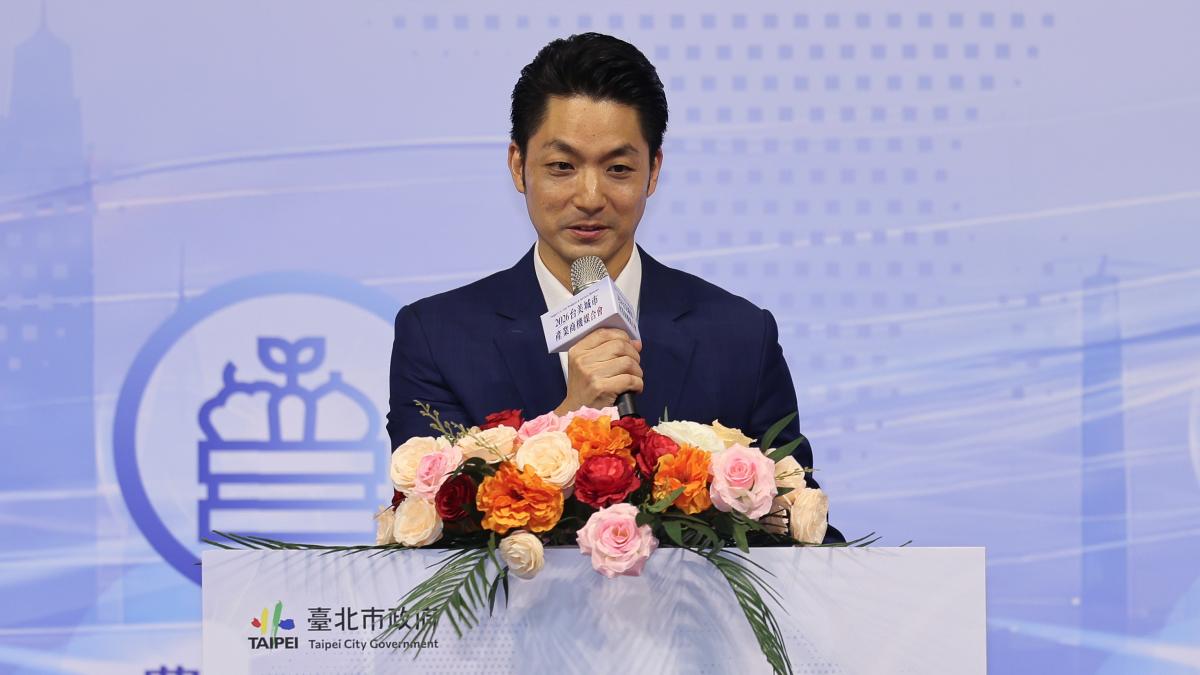
According to election and referendum databases, Chiang Wan-an received 42.29% of the vote in the 2022 Taipei mayoral election. In comparison, Chen Shui-bian received 43.67% in the 1994 Taipei mayoral race. Chiang faced vote-splitting from the Taiwan People's Party, just as KMT candidate Huang Ta-chou once competed against New Party's Jaw Shaw-kong. However, comparing Chen and Chiang's vote shares fails to highlight Chiang's superior political strength. It's a case of 'fifty paces laughing at one hundred'—with political ambition too overt.
Over the past two years, political storms have repeatedly invoked the 'Wan-an Exercise.' During Taipei's large-scale recall campaign, Mayor Chiang conducted the 'Wan-an Exercise,' turning the failed recall into a political halo. This allowed him to expand his network among legislative members and establish an alliance platform between central and local governments. Recently, amid oil quality issues, Chiang spearheaded a protest march on Ketagalan Boulevard, once again taking center stage. He proactively contacted the party chair, legislative caucus, mayors of special municipalities, and county and city leaders—an array of political moves unmatched by previous Taipei mayors.
Politicians rise through fortune and public sentiment; political operatives climb through calculation and ambition. The massive recall effort failed, and in hindsight, there are objective justifications: hatred spilled over, and indiscriminate recalls meant even those deserving removal were spared, escaping the crisis. With a minority ruling party and a dominant opposition ('small government, large opposition'), the ruling party needs greater political tolerance. Without room for negotiation or strategic planning, political order becomes chaotic. Middle-ground voters and the general public would rather monitor stock prices than engage with political turmoil.
Under partisan hostility, irrational legislators gain more visibility and voice. Party headquarters tacitly approve such behavior for political confrontation, allowing situations to escalate unchecked. If society attempts evaluation, accusations that the ruling party disrespects opposition oversight—deliberately confusing the constitutional principle that the Executive Yuan is accountable to the Legislative Yuan—exaggerate conflict and neglect the balance of the five branches. The public lacks time to study the differences between constitutional amendments and the original constitution; how can objective evaluation emerge?
Returning to constitutional provisions, the president's authority must be respected. Examining Article 3 of the Additional Articles of the Constitution, Paragraph 2, Clause 2 stipulates a reconsideration process. If, after reconsideration, the original resolution is maintained, the Premier must accept it. The original Constitution set the reconsideration threshold at two-thirds of legislators, while the Additional Articles lowered it to one-half of all legislators. If the original Constitution's standard were applied, no current reconsideration case could sustain its original resolution. Comparing the Additional Articles with the original Constitution, the former emphasizes legislative majority protection, while the latter safeguards executive authority through an absolute majority. When the ruling party lacks a legislative majority, the executive should yield under the Additional Articles to remain constitutional. In other words, irrational confrontation during a 'small government, large opposition' scenario, exercising reconsideration rights, amounts to self-humiliation.
Alternatively, if the Premier refuses to countersign, one must compare the special exceptions in the Constitution and Additional Articles regarding countersignature. The president's orders to appoint or remove the Premier, appoint personnel confirmed by the Legislative Yuan, or dissolve the Legislative Yuan do not require the Premier's countersignature. However, the Premier must countersign the president's promulgation of laws and issuance of orders. If the Premier refuses countersignature to oppose the legislature instead of using reconsideration, the president cannot promulgate laws or issue orders. Even if a bill passes the legislature in three readings, without the Premier's countersignature, the legislative process cannot be constitutionally completed.
Considering the 'small government, large opposition' reality, thick political barriers, and communication deadlock, inter-branch conflicts between the Executive and Legislative Yuan can, per Article 44 of the Constitution, be resolved by the president convening relevant branch heads for consultation—except where the Constitution specifies otherwise (e.g., reconsideration, no-confidence motions under amended articles). The opposition mocks President Lai's 40.05% vote share as the lowest since direct presidential elections, a disrespectful and unconstitutional act. Chiang Wan-an's 42.29% is not the lowest, but compared to Ko Wen-je's re-election vote of 41.06%, the difference is negligible. It's fifty paces laughing at one hundred—both with low vote shares—why make things difficult for each other? The Constitution, its Additional Articles, and the Presidential and Vice-Presidential Election and Recall Act never require a president to win over 50%; a relative majority suffices for legal election. President Lai is not a lame duck. As head of state and international representative, attacking him as such equates to calling Taiwan a lame-duck nation. The president is not accountable to the Legislative Yuan; policy success or failure lies with the Executive Yuan. Clarifying constitutional roles of the president, Premier, and legislators should end unnecessary political struggles.
The mayor's miscalculation, the premier's setback. A vote of no confidence is a politically miscalculated scheme. Simply put, the Taiwan People's Party struggles to maintain its eight at-large legislative seats. If a no-confidence vote passes, the TPP, to preserve influence, must field district candidates against KMT and DPP nominees. Given the political spectrum and the ongoing 'Lai Gei Qing-de effect,' how could Chiang naively believe that dissolving the legislature would benefit the KMT? Only the president can accept a premier's resignation. While Article 57 of the Constitution states the Premier must resign or accept defeat after failed reconsideration, Article 3, Paragraph 2 of the Additional Articles suspends this clause. Thus, failed reconsideration does not constitutionally obligate the Premier to resign. Furthermore, Article 3, Paragraph 3 of the Additional Articles sets the no-confidence threshold at one-half of all legislators. If the KMT and TPP support it, the Premier must resign within 10 days and may request the president to dissolve the Legislative Yuan. After consulting the Legislative Speaker, the president may dissolve the legislature.
As a legal professional, Mayor Chiang should know a no-confidence vote is the legislature's ultimate weapon against the executive—potentially a self-destructive, mutually damaging act. Under the 'Lai Gei Qing-de effect,' KMT and TPP voter overlap is high. Practical legislative operations show clear KMT-TPP cooperation. Ko Wen-je asks if 'Lai can be toppled,' but electorally, it should be precisely framed as 'blue-white分流' (blue-white分流). 'Toppling white' may be more effective than 'toppling Lai.' But this hinges on the president dissolving the legislature; otherwise, all political calculations are moot. To stabilize political order and focus on year-end local elections, President Lai has neither the political leisure nor emotional incentive to fall for such schemes.
If politics devolves into vicious partisan conflict and the legislature passes a no-confidence motion, current constitutional amendments require the premier to resign. Yet, the majority will expressed in such a motion is hollowed out by political infighting, failing to reflect constitutional spirit or democratic principles. Given the constitutional separation between the Legislative and Executive Yuan, judicial review or constitutional reform is needed to avoid majority tyranny and break political cycles. Constitutional reform directly reflects majority will and resolves inter-branch disputes. Using a no-confidence motion to force Premier Cho's replacement is excessively aggressive and politically unnecessary. In response to shifting voter sentiment, President Lai will naturally assess the situation.
Passing a no-confidence motion is easy for a combined KMT-TPP majority. For Premier Cho, this poses clear political disadvantages. Whether resignation is accepted depends on President Lai's assessment of inter-branch conflict resolution and its impact on year-end elections. The current dilemma lies in President Han's limited effectiveness in coordinating opposition caucuses, due to their high autonomy. Committee bill discussions, for convenience, abuse majority rule by discarding rational debate, turning majority decisions into majority bullying. If the opposition continues mocking President Lai as a 'minority president,' the constitutional stature of the presidency is undermined, making inter-branch consultation impossible. For instance, if President Han chairs a caucus meeting but legislators persistently oppose his authority, how can the Legislative Speaker exercise power smoothly? With mutual distrust between ruling and opposition parties, President Lai's hope to personally manage inter-branch conflicts via 'Gei Qing-de' seems futile.
The annual budget affects new funding across sectors—some for infrastructure, others for vulnerable groups. Continued delay and inaction in review are the responsibility of both ruling and opposition parties. Taiwan faces external threats from China and internal political chaos. Legislators from the KMT, TPP, and DPP should exercise restraint.
*Author is a freelance writer.
FACT BOX
- Source: PR Times
- Category: News