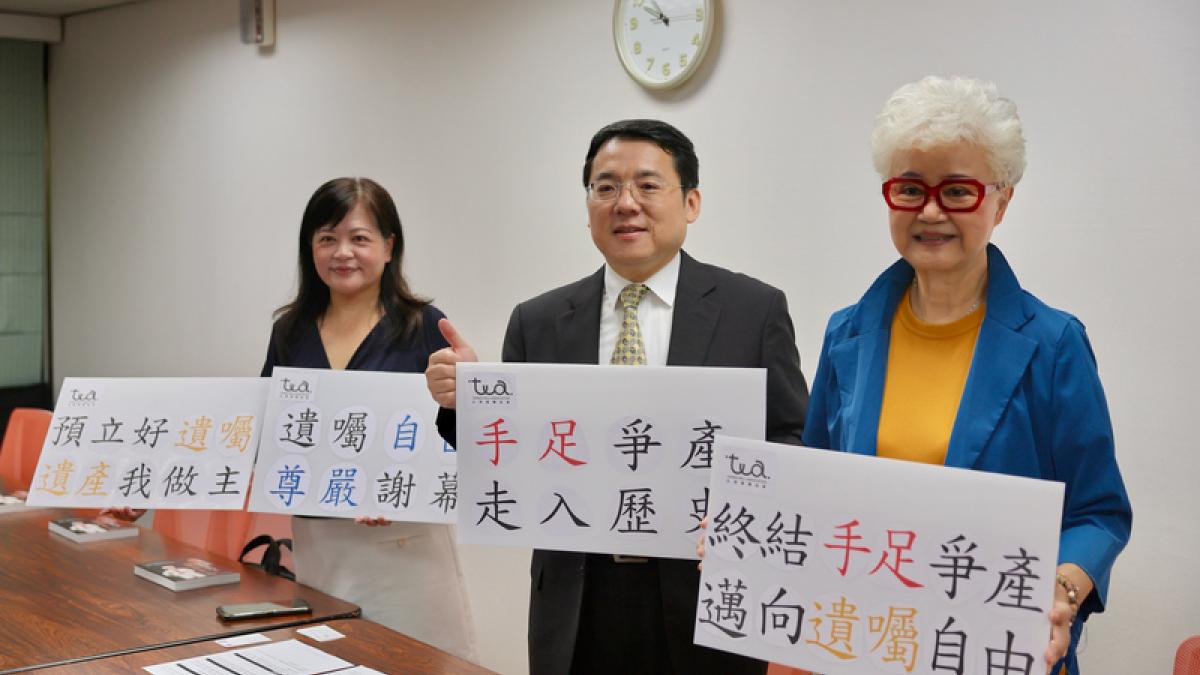
Taiwan's Legislative Yuan passed a bill last Wednesday to remove the provision on 'forced heirship share for siblings' in the Civil Code. This reform is correct in direction, commendable, and has far-reaching implications. However, it is regrettable that the move is somewhat 'incomplete.' The Civil Code's 'Inheritance Chapter' can be considered the 'constitution' governing inheritance and property distribution for families and individuals. Yet this legal framework was established in 1930 during the 'tutelage period' of the Nationalist government. After more than 90 years, with profound changes in societal structure, family dynamics, and interpersonal relationships, the social foundation upon which these laws were built has become unrecognizable. The removal of Article 1223 of the Civil Code, which previously granted siblings a forced heirship share, eliminates what was essentially an 'ancient relic' from nearly a century ago—a rule that had long been entirely outdated. Inheritance law revolves around two key concepts: 'statutory share' (yingjisfen), which defines who is eligible to inherit, their order of priority, and their respective distribution ratios; and 'forced heirship share' (teliusfen), which refers to the portion of inheritance that cannot be deprived by will. For example, the forced heirship share for children is set at half of their statutory share. This means that no matter how biased a parent may be toward one child, or how ungrateful another may be, the parent cannot completely disinherit the 'unfilial child' or leave all assets to the favored child. This legally protected minimum share is the forced heirship. A notable example occurred ten years ago when Evergreen Group founder Chang Yung-fa passed away, leaving his vast fortune and the CEO position to his fourth son, Chang Kuo-wei, triggering a power and inheritance battle between the first and second families—partly because the will violated the legal forced heirship requirements. The now-repealed rule on siblings' forced heirship likely seemed baffling to many modern individuals. Under this rule, when a person died leaving a spouse but no children or living parents, the spouse would inherit only half of the estate, with the other half divided equally among siblings. Moreover, even if a will was made stating that the entire estate should go to the spouse, the law would still invalidate that provision. According to Article 1223 of the Civil Code, 'the forced heirship share of siblings shall be one-third of their statutory share,' meaning that at least one-sixth of the estate was legally guaranteed to siblings. It is easy for modern individuals to recognize how outdated, even absurd, this rule had become. In earlier times, this provision made sense given close-knit extended families and strong sibling bonds, where siblings were expected to support each other long-term. However, it also carried an implicit 'discrimination'—treating the spouse (especially the wife, as most property was registered under the husband's name) as an 'outsider,' thus ensuring that half the estate 'returned' to the family. Today, nuclear families dominate, and the traditional extended family structure has largely disappeared. In such families, the closest bonds are between spouses, parents, and children. While siblings may remain friendly, their relationships are no longer as close—often limited to occasional family gatherings. Ask most childless individuals, and they would overwhelmingly prefer to leave all their assets to their spouse rather than have siblings inherit a portion after their death. Therefore, the amendment proposed by the Ministry of Justice and passed by the Legislative Yuan better aligns with contemporary societal needs and personal interests, and deserves recognition. The real question is why such reform took so long. As for the criticism that the legislature failed to simultaneously pass配套 measures like the 'special contribution system' and 'discretionary estate allocation' originally proposed by the Ministry of Justice—labeled as 'incomplete virtue'—the reality may not be so clear-cut. While these measures sound ideal and compassionate—aimed at protecting siblings who provided special care or are economically vulnerable—they are highly subjective in practice and could open new avenues for inheritance disputes. However, the reform does indeed carry an air of 'incomplete virtue,' but not for the reasons cited above. The real issue lies elsewhere. For instance, while both the executive and legislative branches acknowledged that sibling relationships today differ significantly from the past and thus removed the forced heirship provision for siblings, they retained Article 1144, which stipulates that when there are no children, the spouse inherits half and the other half goes to siblings. Removing the forced heirship allows the deceased to use a will to exclude siblings from inheritance. However, officials and legal experts are well aware—and have warned—that most people overlook the importance of making a will. It would have been better to retain siblings' inheritance priority under Article 1138 (to ensure there are heirs when no higher-priority relatives exist—spouse, children, parents), but directly remove siblings from co-distribution under Article 1144, so that the spouse automatically inherits everything without requiring a will. Indeed, many forced heirship provisions could be re-examined. Fundamentally, allowing the deceased to distribute their estate according to their wishes is more reasonable and respectful of property rights. Forced heirship, along with proposals like the 'special contribution system' and 'discretionary estate allocation,' implicitly attempts to use inheritance law to enforce various 'social moral' goals—an effort that is not only unnecessary but also breeds confusion and fails to achieve its aims. A comprehensive review is long overdue.
FACT BOX
- Source: PR Times
- Category: News